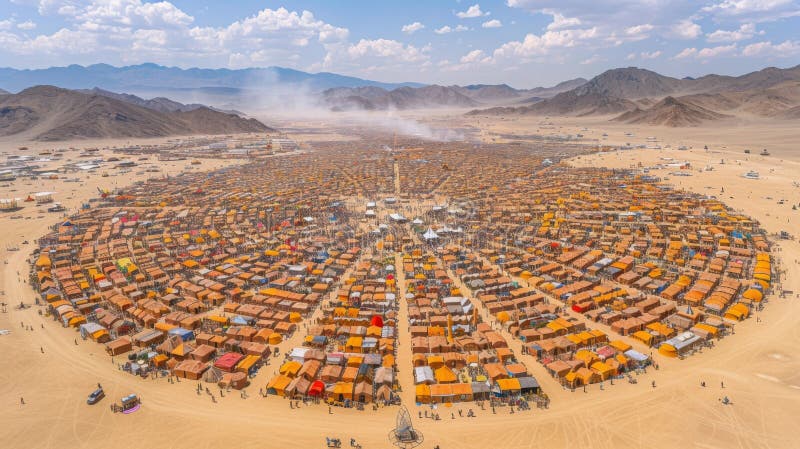
Black Rock Desert, September 3, 2023 — cybernewschronicle.com — The Black Rock Desert does not forgive. That lesson has returned with force at this year’s Burning Man, where a single severe storm has flipped a week-long celebration into a crisis. One person is dead.
Tens of thousands are stranded. The festival is closed to vehicles.
What was supposed to be a peak year for the event — one of the largest and most successful yet, according to organizers — has become a test of the very principles the gathering was built on. Radical self-reliance is the fourth of Burning Man’s ten guiding principles. It means attendees are expected to bring everything they need: food, water, shelter, medical supplies.
No commerce. No handouts.
In a normal year, that ethos works because the desert is dry, the weather predictable, and the biggest risk is dust. But a storm that drops heavy rain on a dry lakebed turns the ground into a substance that swallows cars and trucks whole. Vehicles cannot move.
Emergency access becomes a nightmare. The remote and inhospitable nature of the Black Rock Desert — a selling point for the festival’s isolation — becomes a trap. This is not the first time weather has disrupted the event.
Dust storms are routine. Heat waves are expected.
But flooding on this scale, with a confirmed fatality, is different. It cracks the assumption that preparation alone is enough. The organizers have a reputation for being well-prepared and self-sufficient.
They were caught off guard. That matters.
It suggests that even the most disciplined planning cannot always outrun nature in a place where nature has the final say. What happens next is uncertain. The priority is safety and evacuation for those who need to leave.
But moving tens of thousands of people out of a flooded desert is not a simple operation. Roads that were dirt are now mud. Vehicles that could drive yesterday are stuck today.
The festival has been held annually since 1990. It has grown from a small gathering on a San Francisco beach to a global event that draws people from every continent.
That growth has brought infrastructure, paid staff, and a certain institutional weight. But it has also brought scale. A flood that might have inconvenienced a few hundred people in 1995 now strands tens of thousands.
The ceremonial burning of the Man, the centerpiece of Saturday evening before Labor Day, is now in doubt. The festival had been expected to be one of the largest and most successful yet.
That expectation is gone. Instead, the story is about survival, about what happens when a community built on radical self-reliance faces a problem it cannot solve by itself. The desert is inhospitable.
Emergency services are struggling to access the area. The true extent of the damage and disruption is still becoming clear. This event will force a reckoning.
Not just for Burning Man, but for any large gathering in remote environments. The principles of inclusion and gifting and decommodification do not stop a flood.
They do not get a truck through mud. The festival has always sold itself as a temporary city built by its citizens. But cities have emergency plans, evacuation routes, and heavy equipment.
This temporary city has a single road in and out, and that road is now impassable. The gap between the ideal and the reality has never been wider.
The question now is whether the community can close it before the storm does more damage.