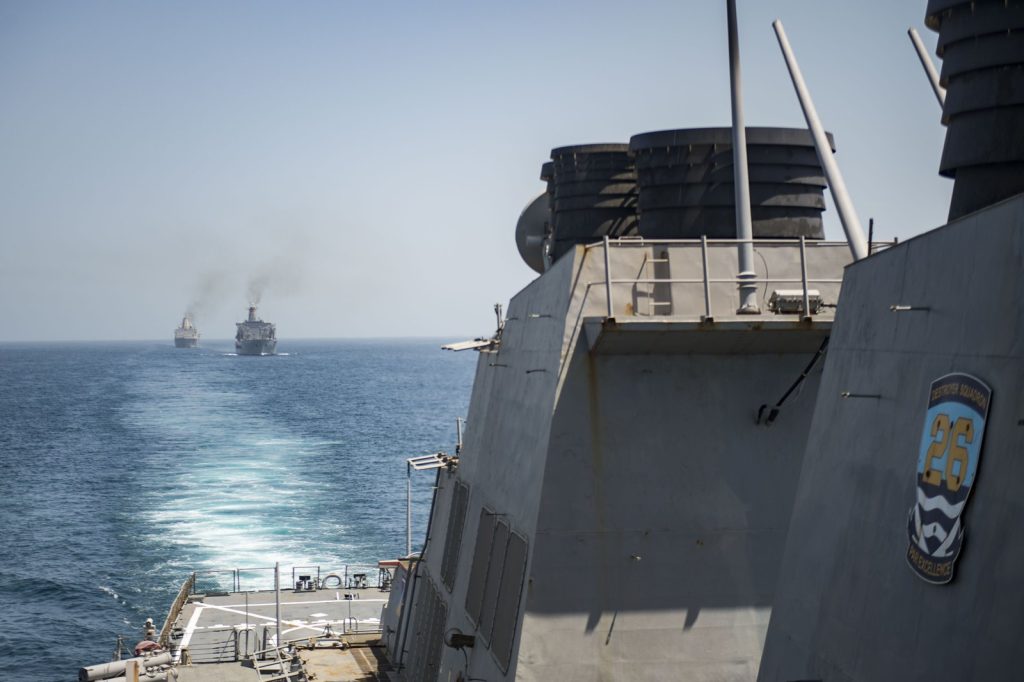
Oil tankers that once slipped through the Strait of Hormuz in darkness, transponders dark, now had an escort. President Donald Trump said he ordered the U.S. military to run a secret operation moving those vessels — commercial ships and oil tankers alike — through the strategic waterway during the 2026 crisis with Iran. The disclosure landed in Washington on June 10.
The numbers Trump cited are big: more than 200 commercial vessels and over 100 million barrels of oil. CNBC and ABC News reported his announcement.
Neither could independently verify those figures. What happens next is the open question. The Strait of Hormuz is a narrow chokepoint.
Roughly 20 percent of global petroleum supplies used to pass through it every day. That was before U.S. and Israeli strikes on Iran earlier this year.
After those strikes, traffic plunged. Iran retaliated. It attacked ships.
It mined the sea lane. Many vessels responded by switching off their transponders — a desperate move to hide from whoever might be watching. Trump framed the secret operation as proof of American control.
“The United States, not Iran, controls the Strait of Hormuz,” he said. That claim carries weight only as long as the escorts keep running.
The military commitment is real. Keeping 200-plus vessels moving through mined waters, under threat of attack, requires constant naval presence. It requires intelligence, surveillance, and a willingness to shoot back.
That is not a one-time surge. It is a sustained deployment.
The consequences ripple outward. Global energy markets watched the Hormuz crisis all year. Insurance rates for tankers transiting the strait spiked after Iran began its attacks.
Some shipping lines simply stopped sending vessels through. The secret escort operation changes the calculus for those companies — if the U.S. military guarantees safe passage, the risk drops. But only if the guarantee holds.
One mine missed, one missile fired, one tanker hit, and the calculus flips again. Iran is watching too.
The Strait of Hormuz is Tehran’s pressure point. For decades, Iranian leaders have threatened to close it, to block oil exports from Saudi Arabia, Iraq, the UAE, Kuwait. The U.S. strikes and the subsequent retaliation already proved Iran can disrupt the waterway.
Mining it, attacking ships — that is not a hypothetical. That happened.
Trump’s announcement tells Iran the U.S. will not let the disruption stand. That is a direct challenge. Tehran will have to decide whether to escalate further or accept the U.S. military’s control of the strait.
The broader confrontation between Washington and Tehran now has a new front line. It is not just about nuclear programs or proxy militias. It is about who physically controls the passage of oil tankers through a 21-mile-wide stretch of water.
The secret escort operation is the U.S. answer. The question is how long it can last.
Military escorts are expensive. They tie up naval assets that might be needed elsewhere. They create a target-rich environment for any Iranian commander looking for a trophy.
Trump’s disclosure itself carries consequences. Secret operations lose their secrecy the moment a president announces them.
Iran now knows exactly what the U.S. military is doing in the strait. It can plan around it. It can test it.
It can probe for weaknesses. The element of surprise is gone. What remains is the brute fact of American naval power, committed to keeping oil flowing through a narrow, dangerous channel.
For now, that is enough. For how long, nobody can say.