Sub-Neptunes are the most common type of planet in the galaxy, yet they have no counterpart in our own Solar System. Their very existence challenges standard formation models because their atmospheres are obscured by high metallicity and clouds, leaving astronomers uncertain whether they are gas dwarfs or water worlds.
The Missing Planet Class
A sub-Neptune is an exoplanet smaller in radius than Neptune but larger than the small planet radius gap, a boundary that separates them from rocky super-Earths. Based on their low bulk densities, these planets likely possess a low-density envelope surrounding a rocky core. Data from the Kepler space telescope showed that planets between two and four Earth radii orbiting within 245 days can be found around 31 percent of Sun-like stars, making them far more numerous than giant planets in the inner planetary system. Intriguingly, no sub-Neptune is known to exist in the Solar System.
The Radius Valley
The “radius valley” — also called the radius gap — is a scarcity of planets between roughly 1.5 and two Earth radii. It splits the small planet population into two distinct groups: super-Earths below the gap, which lack a significant envelope, and sub-Neptunes above it, which retain one. Many research papers use the terms “sub-Neptune” and “mini-Neptune” interchangeably to refer to this population above the gap. The debate over their exact nature centres on whether they are “gas dwarfs” with hydrogen-helium envelopes, “water worlds” rich in volatiles, or smaller versions of ice giants containing both.
High Metallicity and the Cloud Problem
Identifying which model is correct has proven difficult. Among the current population of exoplanets, very few sub-Neptunes have had their atmospheric composition identified. This is primarily due to sub-Neptunes having high metallicity, clouds, and hazes that obscure absorption features. These obscuring features often produce a spectrum that presents itself as featureless, especially in the near-infrared. The science behind this is straightforward: the heavy elements and condensed particles block the light passing through the atmosphere, hiding the chemical fingerprints researchers need to distinguish between a gas dwarf and a water world.
Breakthroughs from the Cold
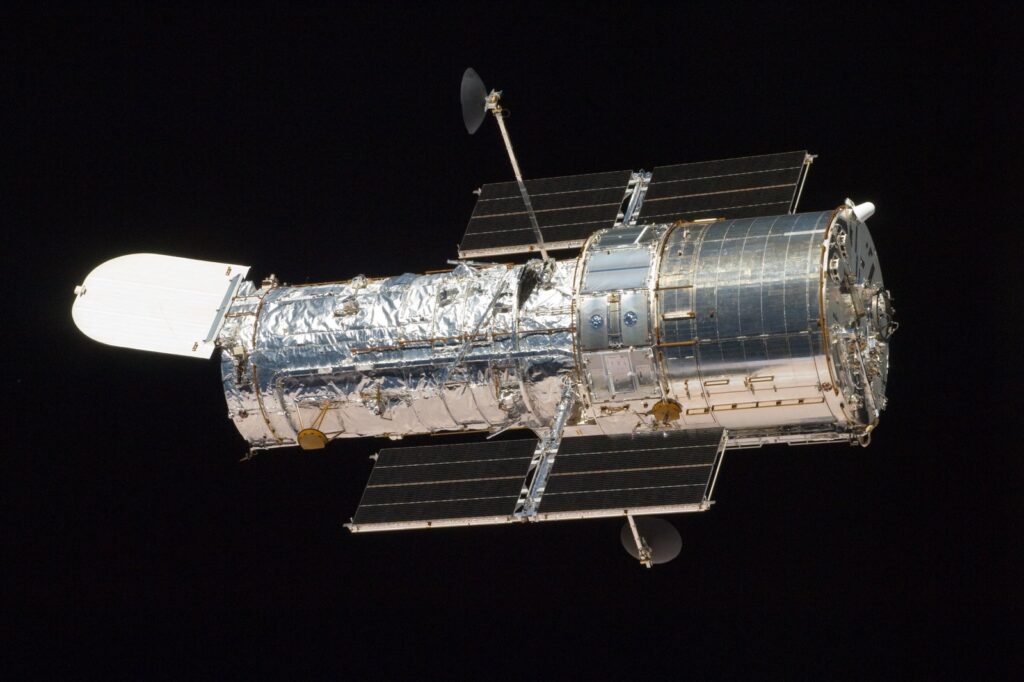
Recent research suggests a way through the haze. Tentative trends indicate that sub-Neptunes with the lowest equilibrium temperatures — below 400 Kelvin — have detectable features, perhaps due to inefficient haze production or cloud sedimentation. TOI-6478 b is a low-density sub-Neptune with an equilibrium temperature of 220 Kelvin assuming zero albedo. In a study submitted to the Astronomical Journal, researchers presented the highest signal-to-noise spectral feature of any sub-Neptune detected using the Hubble Space Telescope’s Wide Field Camera 3, reaching a significance of roughly six sigma. The feature sits at 1.4 microns, but the narrow bandpass of Hubble could not distinguish whether it comes from water or methane absorption. Self-consistent atmospheric models provide physical motivation for methane to be the dominant absorber, given that water should condense or cold-trap at higher pressures.
JWST and the Path Forward
The Hubble data alone cannot distinguish between major absorbers. However, a broader wavelength coverage by the James Webb Space Telescope will be able to measure the atmospheric composition in detail, due to the high signal-to-noise features for this target. Several sub-Neptunes, such as GJ 1214 b and K2-18 b, have already been observed by both Hubble and JWST in order to infer their compositions and formation histories. What researchers found with TOI-6478 b suggests that the coldest sub-Neptunes may finally offer a clear window into how these mysterious planets form.
Sources
- Sub-Neptune
- The SPACE Program IV: Atmospheric Features on the Cold Transiting Sub-Neptune TOI-6478 b
- HD 3167's Planets May Not Be Particularly Perpendicular – AAS Nova
- Winners announced for 13th annual Taste of Wrightsville Beach – WWAYTV3
- Astronomer Patryk Sofia Lykawka says a hidden Planet X2 with 1.5 to 2 times Earth's mass could be circling the Sun at least 200 times farther out than Earth, in a model that ran 4.5 billion years of Solar System history
- Christian Neptune Injury: Looks probable for Iron Bowl
Photo: NASA (Public domain)