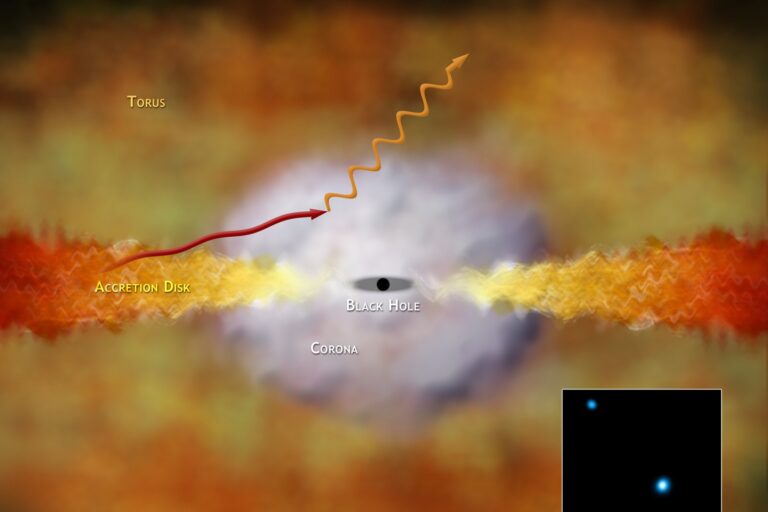
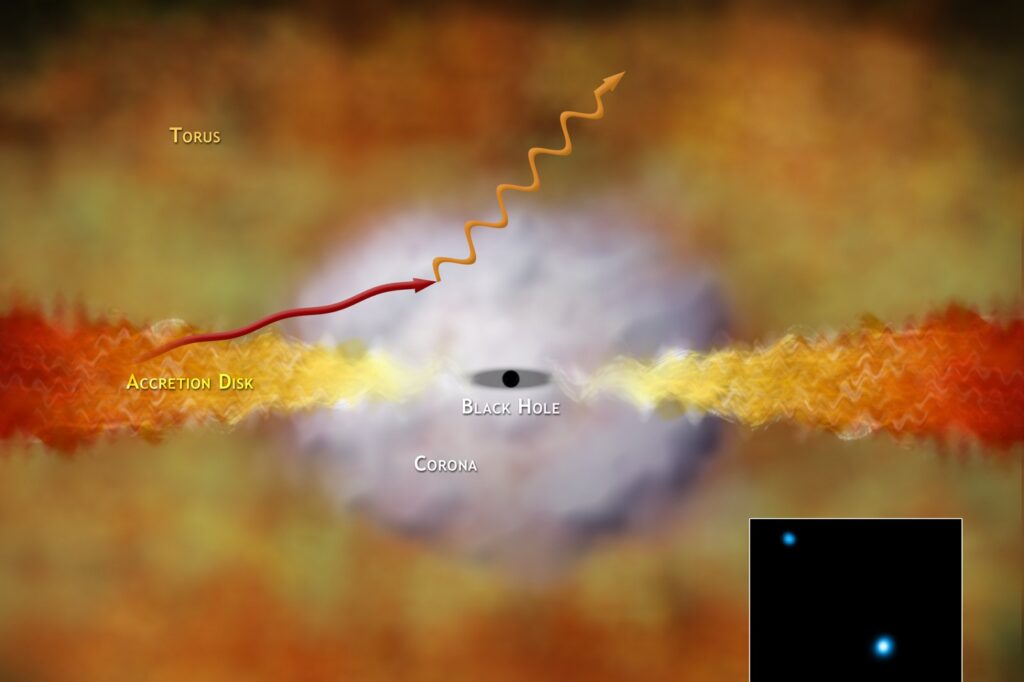
The Euclid space telescope has spotted the most distant quasar ever seen, a brilliant core powered by a black hole 360 million times the mass of the sun just 630 million years after the Big Bang. The find, confirmed by the James Webb Space Telescope, pushes the record back by 40 million years and forces a rethink of how such massive objects form so fast.
How the Discovery Was Made
Researchers led by Julien Wolf at the Max Planck Institute for Astronomy identified the object, designated J1504+6252 and nicknamed Dún Aonghasa, in 18 months of data from the Euclid Wide Survey. Euclid, launched in 2023 to map dark matter and dark energy, uses sensitive infrared imaging and wide sky coverage to pick out extremely rare, distant sources among millions of objects. Follow-up observations by the W.M. Keck Observatory, the Hubble Space Telescope, the Large Binocular Telescope, and finally the James Webb Space Telescope confirmed the redshift of z=8.13 and the black hole mass.
Why the Mass and Age Contradict Standard Models
Standard theory held that supermassive black holes require roughly one billion years of feeding and merging to reach hundreds of millions of solar masses. Dún Aonghasa appears when the universe was only 5% of its current age, 40 million years earlier than the previous record holder. “The closer to the Big Bang we find them, the faster their black holes must have grown or the more massive they must have been at birth — or both,” Wolf said. The discovery tightens the constraints on both light-seed models, which start from stellar remnants, and heavy-seed models, which begin with the direct collapse of massive gas clouds.
The Science Behind the ‘Slow Eater’ Puzzle
Intriguingly, Webb revealed that Dún Aonghasa is accreting material at a sub-Eddington rate, meaning it is a relatively slow eater despite its enormous mass. Quasars are brief phases where accretion disks outshine entire galaxies by factors of hundreds or thousands, but this one suggests its period of rapid gorging has either ended or paused. What researchers found implies the black hole must have undergone extremely rapid growth episodes very early on, a scenario that current formation models struggle to reproduce.
Implications for Early Cosmic History
Seeing a quasar this early also illuminates the epoch of reionization, when the first stars and galaxies cleared the cosmic fog and allowed light to travel freely. Quasars are the most luminous persistent sources in the universe, making them vital probes of this period. Euclid has already found 12 new quasars beyond redshift 7, more than doubling the known population at that distance, and 31 ancient quasars in total in just 1.5 years of operation.
Next Steps: Hunting for More High-Redshift Quasars
The study, published in Astronomy & Astrophysics, marks a serendipitous science result for a mission designed for dark universe cosmology. Wolf noted the record could fall again in a few months or stand for years. “Their prowling of the cosmic dawn continues.”
Sources
- Astronomers discover the most distant and ancient supermassive black hole-powered quasar in the universe
- Quasar
- Euclid breaks own quasar record by 40 million years
- New quasar record tightens constraints on black hole formation scenarios
- Scientists discover quasar formed 630 million years after the Big Bang
- Scientists discover quasar formed within a mere 630 million years of the Big Bang, setting a record
Photo: X-ray: NASA/CXC/D.Schwartz & S.Virani; Illustration: CXC/M.Weiss (Public domain)