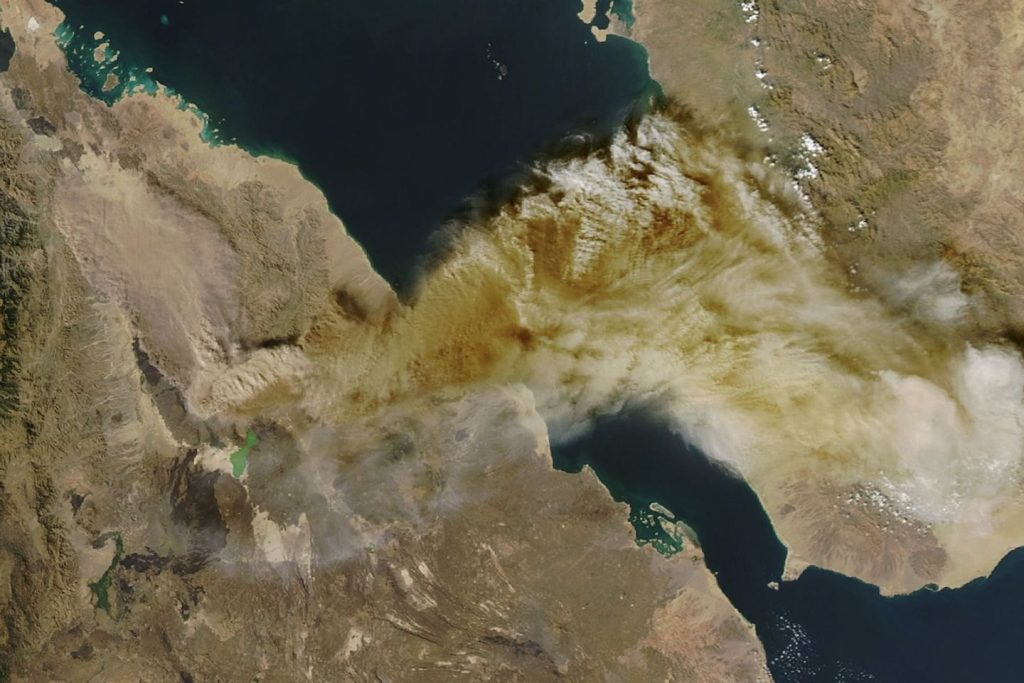
For roughly 12,000 years, Hayli Gubbi gave scientists little reason to pay attention. On Sunday, November 23, 2025, it fixed that. A powerful explosion shot ash about 14 kilometers into the atmosphere, and the eruption kept going for several hours.
The volcano sits in Ethiopia’s remote Afar region, close to the Eritrean border, in the East African Rift Valley. The clouds drifted over Yemen, Oman, India and northern Pakistan, and raised concern about flights and air quality along the way.
What the record shows
The Smithsonian Institution’s Global Volcanism Program has Hayli Gubbi quiet throughout the Holocene. Until this eruption there was no direct record of it erupting at all, though the remoteness of the region means records there are thin. Studies in 1969 and 1970 found lava flows on the southern flank that spilled over rock formed around 8,200 years before the present. That puts the last eruption somewhere later than 8,250 years ago, and little else.
Hayli Gubbi is a shield volcano, the southernmost of the Erta Ale Range. It lies where the African and Arabian plates move apart by about 0.4 to 0.6 inches every year.
Sleeping is not the same as dead
A dormant volcano has not erupted for a very long time but could again, unlike an extinct one. Magma may still sit far below the surface, and shifting plates or building pressure can bring it up. Arianna Soldati, a volcanologist at North Carolina State University, put it to Scientific American this way: “So long as there are still the conditions for magma to form, a volcano can still have an eruption even if it hasn’t had one in 1,000 years or 10,000 years.”
Others doubt the 12,000-year figure itself. Juliet Biggs, an earth scientist at the University of Bristol, said: “I would be really surprised if [more than 12,000 years ago] really is the last eruption date.” No confirmed eruption has been recorded in that time, she explained, but satellite images hint that the volcano may have released lava more recently.
The scale surprised her as well. “To see a big eruption column, like a big umbrella cloud, is really rare in this area,” Biggs said.
Experts have called the event highly unusual and say volcanic activity in the Afar area has been studied too little. Local authorities reported no casualties so far, though specialists warn that ash and debris could badly disrupt life for the region’s pastoral communities.
Sources
- Hayli Gubbi volcano erupts in Ethiopia after 12000 years: How does a dormant volcano become active suddenly | – The Times of India
- Hayli Gubbi