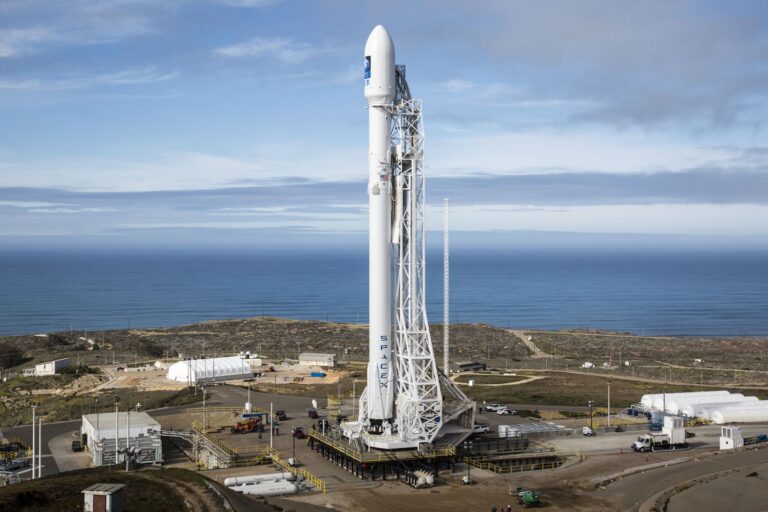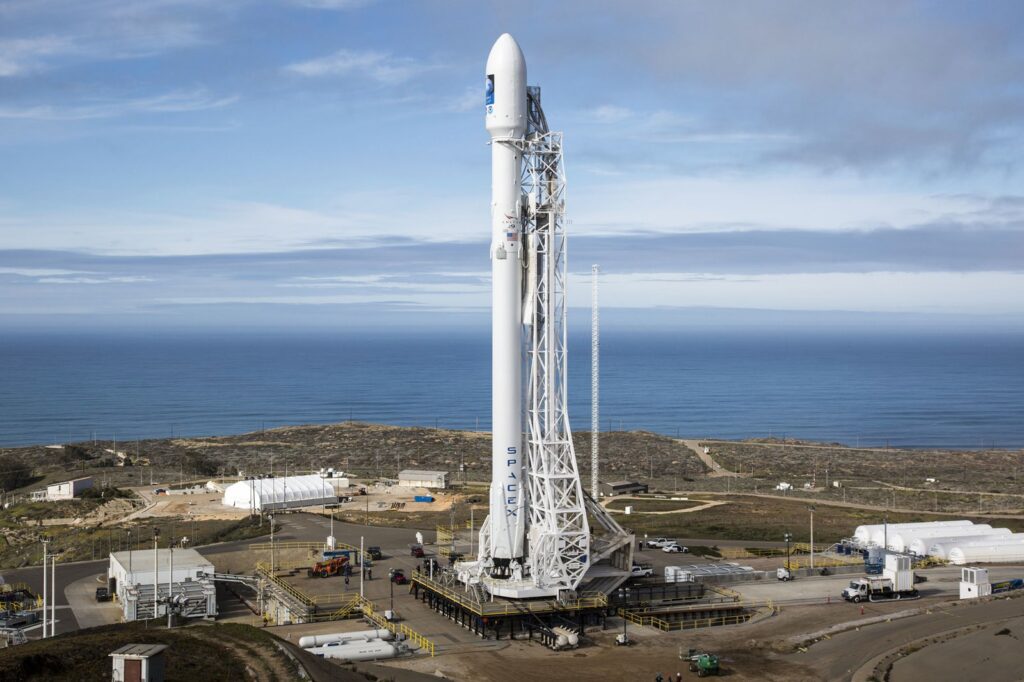
VANDENBERG SPACE FORCE BASE, November 21, 2026 — A SpaceX Falcon 9 rocket lifted off from Space Launch Complex 4E early Saturday, carrying the NROL-136 mission for the National Reconnaissance Office. The flight adds an undisclosed number of satellites to the NRO’s proliferated architecture constellation, marking the fourth such launch this year and the 15th to date.
The Architecture Shift
The NRO, which designs and operates U.S. intelligence satellites, announced in 2023 that it plans within a decade to quadruple the number of satellites it operates and increase the signals and images it delivers by a factor of ten. The agency provides signals intelligence to the National Security Agency, imagery intelligence to the National Geospatial-Intelligence Agency, and measurement and signature intelligence to the Defense Intelligence Agency.
Intriguingly, the proliferated architecture moves away from a small number of large, exquisite satellites toward massed constellations of smaller spacecraft in low-Earth orbit. The science behind the shift is straightforward: distributed systems offer shorter revisit times, persistent global coverage, faster data processing, and reduced vulnerability to adversary threats. What researchers found is that a mesh of many satellites makes the overall capability harder to degrade than a handful of high-value assets.
Sustained Cadence
Saturday’s launch continues a high-tempo deployment rhythm. The NROL-105 mission in January marked the first national security launch of 2026 and the 12th proliferated architecture mission overall. The agency plans approximately a dozen launches this year, with continued expansion through 2029. Principal Deputy Director William Adkins, appointed January 12, 2026, oversees the day-to-day operations of this scaling effort, including classified programs and commercial partnerships. Adkins previously spent ten years on the House Appropriations defense subcommittee and 13 years as a project manager for the CIA and NRO.
How It Works: The Launch Vehicle
The Falcon 9 first stage booster, tail number B1097, flew its 14th mission on Saturday. Its flight history includes previous NRO missions, a Space Force launch, a Transporter rideshare, a commercial satellite, a NASA ocean-monitoring satellite, and eight Starlink batches. Roughly 7.5 minutes after liftoff, the booster returned to Landing Zone 4 at Vandenberg, the 38th landing at that site and the 680th Falcon booster recovery overall. Reuse at this cadence is how the NRO maintains launch tempo without waiting for new hardware production.
Industrial Base Strain
The rapid expansion carries a $33 billion price tag over five years, according to a Government Accountability Office report published November 17. The GAO warns that the Pentagon’s shift to massed low-Earth orbit constellations is stressing a specialized industrial base already consumed by competing markets. The report cites a study finding that 94 percent of U.S. satellites on orbit are privately owned, meaning military and intelligence programs compete with commercial megaconstellations for the same semiconductors, electronics, raw materials, and manufacturing capacity.
A follow-up GAO assessment on November 20 found the Department of Defense lacks a coordinated approach for identifying industrial-base risks across its military space portfolio. When multiple satellite programs draw from the same limited tier of sub-tier vendors — electronics, optics, propulsion — delays at a single supplier can ripple across separate acquisition offices without senior leadership holding an integrated view. The GAO recommended that Secretary of the Air Force Troy Meink and NRO Director Roger Mason establish a formal joint framework to manage these shared supply chain risks. The Pentagon agreed.
National Security Doubleheader
The NROL-136 mission closed a national security doubleheader at Vandenberg. On Wednesday, a Falcon 9 launched the classified USSF-317 mission for the U.S. Space Force from the same pad, with its booster landing on the droneship Of Course I Still Love You in the Pacific. Saturday’s booster flew back to land at Landing Zone 4, demonstrating the operational flexibility that supports the sustained launch cadence the proliferated architecture demands.
Sources
- Live coverage: SpaceX to launch intelligence-gathering satellites for the National Reconnaissance Office
- National Reconnaissance Office
- NRO's William Adkins Wins 2026 Wash100 Award | Wash100
- Space industrial base stretched thin amid low-orbit satellite constellation shift, GAO says
- Falcon 9 flies national security doubleheader
- GAO Finds Pentagon Lacks Coordinated View of Military Space Supply Chain Risks
Photo: SpaceX (CC0)