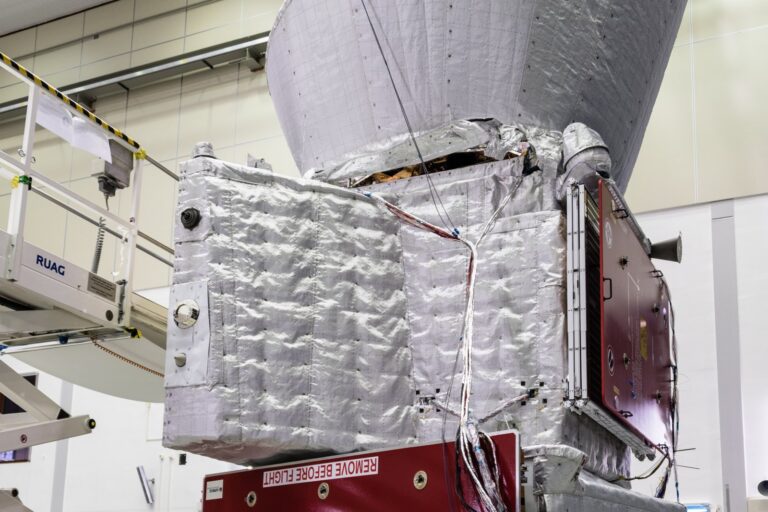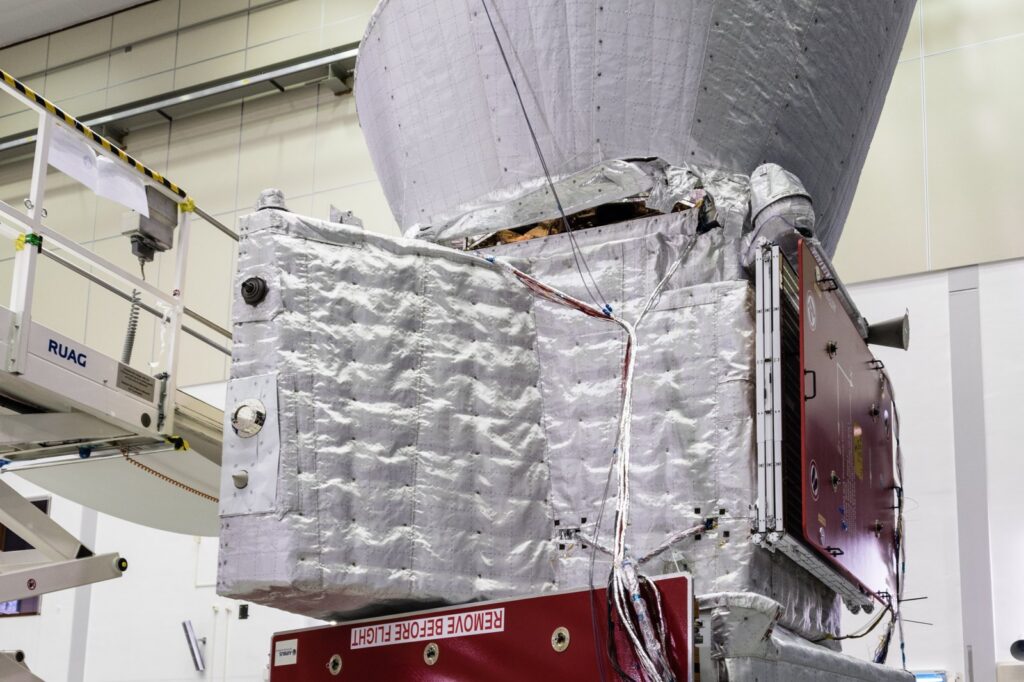
After an eight-year, six-billion-mile journey, a joint European-Japanese spacecraft is set to swing into orbit around Mercury on Saturday. The BepiColombo mission will become only the second in history to circle the planet and the first to deploy two orbiters simultaneously.
Orbit Insertion and Spacecraft Separation Timeline
Flight controllers plan to fire the spacecraft’s thrusters on November 21, 2026, to capture the joined pair into a polar orbit around Mercury. The Mercury Transfer Module (MTM), which provided ion propulsion for the cruise, was jettisoned on September 3, 2026, after its final electric-propulsion thrust arc ended on June 15. What remains is the European Mercury Planetary Orbiter (MPO) carrying the Japanese Mio orbiter on top.
If capture succeeds, Mio will be deployed on December 9-10, followed by the detachment of its protective sunshield (MOSIF) on December 16. The MPO will then manoeuvre to its own lower science orbit. Science operations for both orbiters are expected to begin in April 2027.
The Core Paradox: A Magnetic Field on a Tiny World
Mercury has intrigued scientists since NASA’s Mariner 10 discovered a global magnetic field there in the 1970s. The planet is only about 50% larger than Earth’s Moon but has four times the Moon’s mass, making it exceptionally dense. A planet this small should have cooled and solidified long ago, shutting down the dynamo that generates a magnetic field. Yet the field persists.
Prof Emma Bunce of the University of Leicester, who has worked on the project for 20 years and serves as principal investigator for the MIXS instrument, said the mission is the best hope yet of understanding how Mercury formed so close to the Sun and why it retains a magnetic field. The MPO will study the planet’s interior to shed light on its unusually large core, while Mio will measure the magnetic field and the sodium exosphere — the extremely thin layer of gas and atoms surrounding the planet.
Water Ice in Scorching Heat
Equally puzzling is the presence of water ice in permanently shadowed polar craters. Surface temperatures can reach 430°C (about 800°F) during the day, yet inside these craters temperatures plunge to -180°C. The ice survives because the planet’s axial tilt is nearly zero, leaving crater floors in permanent darkness. BepiColombo’s instruments will analyse the composition of these deposits, which may hold clues to the delivery of water in the inner solar system.
Dual-Orbiter Design: MPO for Surface, Mio for Magnetosphere
The mission comprises two distinct orbiters. ESA’s MPO will map the surface and composition at high resolution and probe the interior structure. JAXA’s Mio will focus on the magnetosphere and the space environment. This simultaneous two-point measurement is a first for Mercury and will allow researchers to disentangle temporal changes from spatial variations in the magnetic field and particle environment.
Prof Geraint Jones, ESA’s lead project scientist, said the team expects to learn a huge amount by bringing more powerful instruments on two spacecraft to study all aspects of the planet — its interior, surface, and the space around it.
Journey Challenges: Solar Gravity Braking and Ion Propulsion
Reaching Mercury is harder than reaching Pluto. The spacecraft falls toward the Sun, gaining enormous speed, and must bleed off enough orbital energy to avoid overshooting the planet. BepiColombo launched on October 20, 2018, on an Ariane 5 rocket from Kourou, French Guiana. During its cruise it performed one Earth flyby, two Venus flybys, and six Mercury flybys to slow down.
The MTM’s ion thrusters provided a force roughly equivalent to the weight of two sheets of paper resting on a hand, but they ran for two years to carry the spacecraft about six billion miles (10 billion km). A power anomaly in the solar arrays, reported in 2024, reduced thrust and delayed arrival from December 2025 to November 2026. Engineers recovered about 90% of the earlier thrust by May 2026.
Science Operations Begin April 2027
Only two previous spacecraft have visited Mercury: NASA’s Mariner 10 in the 1970s and Messenger, which orbited from 2011 to 2015. BepiColombo’s €1.65 billion (US$1.86 billion) mission aims to fill the gaps left by those flights. The next milestone is the orbit insertion burn on Saturday, November 21, 2026.
Sources
- BepiColombo
- BepiColombo spacecraft arriving at Mercury after eight years
- Spacecraft reaches Mercury on second-ever mission to enter its orbit
- 10 winners welcome BepiColombo to Mercury
- The long-awaited BepiColombo mission enters Mercury orbit this Saturday
- How BepiColombo Will Enter Mercury Orbit
Photo: ESA–C. Carreau (CC BY-SA 3.0 igo)