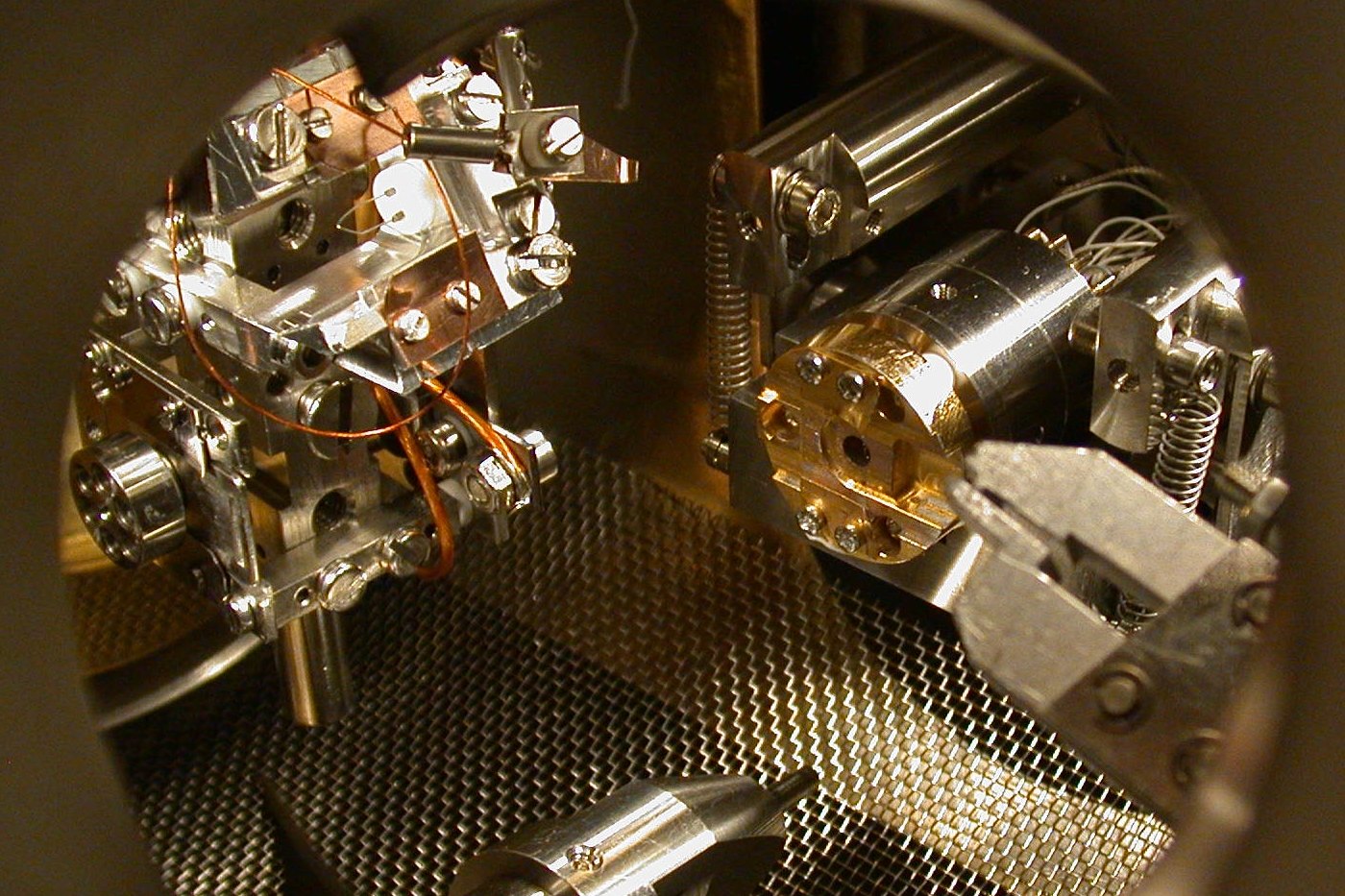
Researchers have shrunk the ancient Archimedes screw to a single molecule, creating a tiny motor that conducts electricity up to 100 times better when it spins. The international team built the device from a helicene molecule — a ribbon of fused rings that coils into two full turns — and ran the experiments at 4.2 kelvin inside a vacuum chamber.
From Water Screw to Nano Motor
The Archimedes screw has lifted water for over 2,000 years. Turn a giant spiral inside a cylinder, and water travels uphill. The new device inverts that logic: instead of the screw pushing a flow, the flow of electrons pushes the screw into rotation. Chemists led by Michael Pittelkow at the University of Copenhagen synthesized the helicene, adding sulfur atoms at each end to anchor it to gold. Oren Tal and Anil Kumar Singh at the Weizmann Institute of Science in Israel then stretched single molecules between two atomically sharp gold tips and ran a current through them.
How It Works: Electrons Hand the Molecule a Twist
The mechanism surprised the researchers. As electrons scatter off the coiled molecule, they transfer a small angular momentum — a tiny twist. Those twists add up. Below a threshold voltage, the molecule hops between three preferred resting angles. Above that threshold, the hops become continuous, directed rotation. A straight molecule of similar length, tested the same way, showed no such switching, confirming the helical shape is essential. Theorists at the University of Augsburg, the Niels Bohr Institute, and Huazhong University of Science and Technology ran quantum simulations that tied the current surge directly to the rotation.
The Numbers: 420 Millivolts and a Hundredfold Jump
At 420 millivolts, the current jumped between three discrete values in a fixed cyclic order, each matching a resting angle of the molecule between the tips. Raise the voltage and the jumps sped up; reverse the voltage and the order reversed. The team recorded this cyclic switching in 122 junctions, with every jump following the same direction around the cycle. Once rotating, the molecule carried up to 100 times the current it did at rest, operating successfully up to about 52 microamperes before the gold tips fused and expelled the molecule. Stretching or squeezing the junction by less than the width of an atom moved the threshold voltage, with the lowest threshold occurring where calculations show electrons deliver the most twist per turn.
Why Rotation Opens the Best Conducting Paths
Intriguingly, the positions the molecule avoids at rest — where it is squeezed hardest against the gold tips — are the ones where its electron-carrying orbitals connect best to the metal and align energetically with incoming electrons. “The surprising thing is that it is precisely the positions that the molecule avoids when at rest that conduct electricity best,” said Léon Martin, a doctoral student at Augsburg who ran the simulations. “It is only the rotation that makes these positions accessible.” The team’s calculations ruled out the obvious guess that the spinning screw pumps electrons like its ancient namesake pumps water; such pumping would move orders of magnitude too little current to explain the measurements.
A New Operating Principle for Molecular Electronics
“We have shown that an electric current can be used to generate a directed rotation and that this rotation, in turn, controls the current,” said Fabian Pauly at the University of Augsburg. “This is a new operating principle for machines at the very limits of miniaturization.” The machine has run only in a cryogenic vacuum, one molecule at a time. The team expects other helicenes with the same structure and anchoring groups to behave similarly and plans next to drive the rotor with circularly polarized light or spin-polarized currents. The full study was published in Nature.
Sources
Photo: DrHughManning (CC BY-SA 4.0)