Astronomers have detected a completely invisible object in the J0008+0128 star system by watching its gravity tug on a nearby red giant star. The unseen body weighs up to 2.8 times the mass of the Sun, a measurement that drops it squarely into a puzzling “mass gap” between the heaviest known neutron stars and the lightest black holes.
How It Was Found
Researchers spotted the object not by its light — it emits none — but by its gravitational pull on a companion red giant. The pair orbit each other once every 1,218 days, an unusually wide circuit that has complicated efforts to slot the discovery into standard stellar evolution models. Song Wang, an associate researcher at the National Astronomical Observatories of the Chinese Academy of Sciences and a co-author of the study published in Science Advances, told 404 Media that the survey has found more than 10 neutron stars, but J0008+0128 is the most massive among them.
Why the Mass Gap Matters
Stellar remnants usually sort themselves by weight. Stars more than 25 times the mass of the Sun are expected to collapse into black holes; those between roughly 10 and 25 solar masses become neutron stars; smaller stars like the Sun end up as white dwarfs. Neutron stars are extraordinarily dense, packing more than a solar mass into a sphere only a few miles across. Yet astronomers have long noticed a scarcity of objects between about 2.5 and five solar masses. The new object, at up to 2.8 solar masses, sits at the lower edge of that desert. One hypothesis is that it is an extremely rare, super‑massive neutron star — a collapsed core that somehow avoided becoming a black hole.
Connection to Dark Matter and Gravitational Lensing
The discovery arrives as a separate line of inquiry is mapping the universe’s invisible scaffolding. Dark matter is an invisible form of matter inferred from gravitational effects that cannot be explained by visible matter alone; it makes up about 85 % of the universe’s total mass, providing the gravitational scaffolding for galaxies and clusters. The Euclid space telescope released its first major data set on 12 Nov 2026, mapping billions of objects and revealing over 15,000 strong gravitational lenses that trace dark‑matter concentrations. Strong lensing allows scientists to “weigh” galaxies and map invisible mass, a technique that could help determine whether the J0008+0128 object is ordinary matter or an exotic dark‑matter clump. Researchers at the University of Portsmouth’s Institute of Cosmology and Gravitation led the Euclid lens search, emphasizing the role of gravitational lensing in uncovering hidden mass.
Implications for Cosmology and Future Observations
If the invisible object is not a known compact star, it could represent a new class of dark‑matter‑dominated bodies, forcing revisions to current cosmological models. ESA’s Director of Science Carole Mundell called the Euclid data release a “scientific milestone” for studying the dark universe. The upcoming Extremely Large Telescope (ELT), with first light scheduled for March 2029, will use instruments like NEXUS@SHARP to probe ultra‑diffuse galaxies and test Lambda‑CDM predictions, potentially shedding light on objects like the newly found mass‑gap anomaly. Current estimates place the total dark‑matter mass out to Neptune’s orbit at roughly 10¹⁷ kg, comparable to a large asteroid, highlighting how even modest amounts can have measurable gravitational effects.
Sources
- Scientists find mysterious invisible object in deep space
- Dark matter
- Dark matter breakthrough coming? Euclid space telescope unveils its 1st look into the dark universe (video)
- The ELT Can Probe Ultra-Diffuse Galaxies and Their Dark Matter Mysteries
- Unlocking the enigma of dark matter: Gazing beyond the lens into the universe
- Twisted starlight sheds new light on dark matter
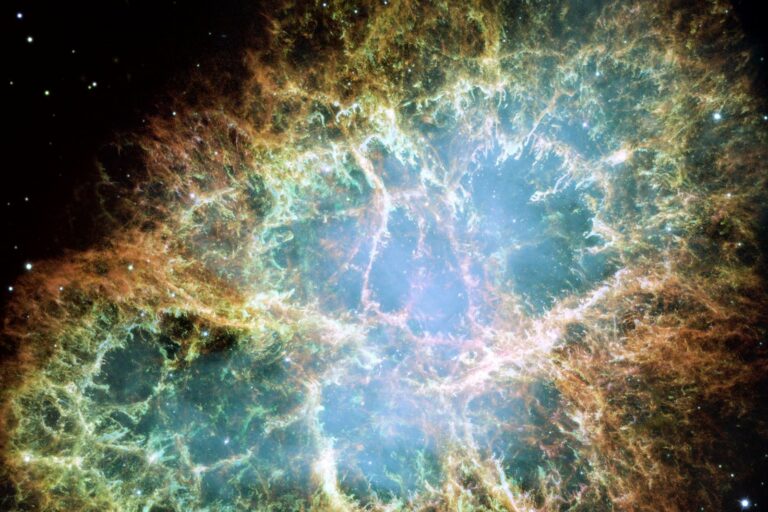
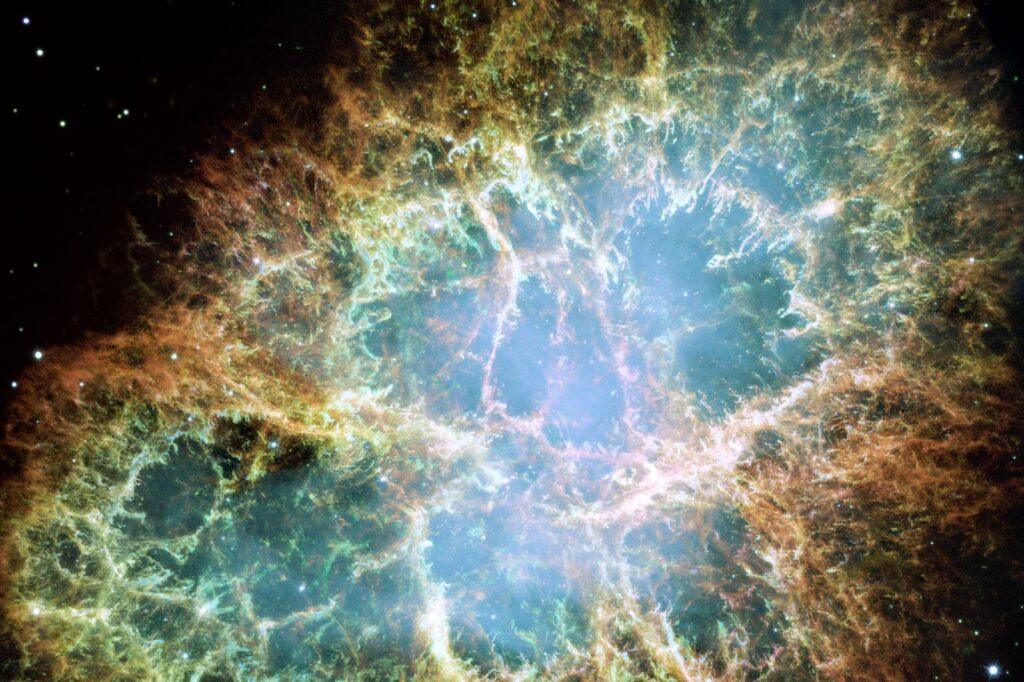
Photo: NASA, ESA, J. Hester and A. Loll (Arizona State University) (Public domain)