
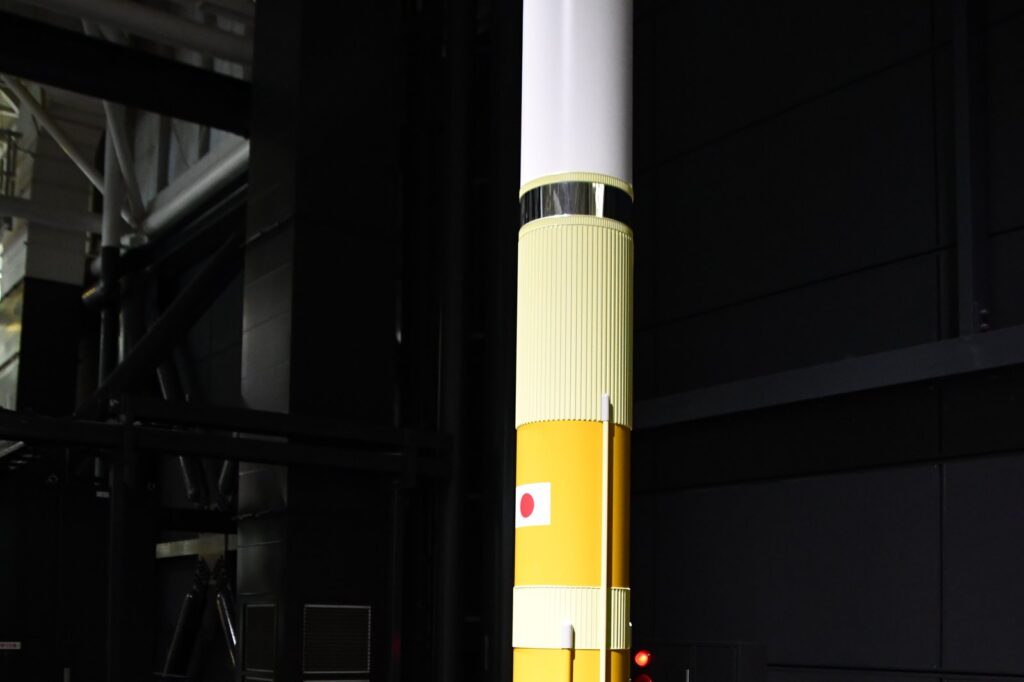
How do you send a 4.48-ton probe to a moon of Mars and bring a piece of it home? Japan’s answer starts on October 20 at 4:41:03 a.m., when JAXA plans to launch Flight 15 of its H3 rocket from the Tanegashima Space Center, carrying the Martian Moons eXploration (MMX) mission. The probe is meant to collect samples from Phobos and return them to Earth. If it succeeds, it will be the first Martian moon sample return.
A rocket with a long fairing
Flight 15 uses the H3-24L configuration: two LE-9 engines burning liquid hydrogen and liquid oxygen, four SRB-3 solid boosters, and a long payload fairing. It is the first operational use of a long fairing on the H3. The name is a code. The first digit is the number of core-stage engines, the second is the number of boosters, and the letter gives the fairing, short, long or wide. Five configurations were on offer as of 2026: H3-30S, H3-22S, H3-22L, H3-24L and H3-24W.
That flexibility is the point of the design. The first stage can have two or three LE-9 engines and zero, two or four boosters, the same SRB-3 units used on the Epsilon S small-lift rocket. The second stage runs on an upgraded LE-5B-3 engine from a family in use since the H-I rocket. Mitsubishi Heavy Industries (MHI) and JAXA developed the H3 as the successor to the H-IIA and H-IIB, for both government and commercial customers.
The engine that took the time
Here is how it works, and why it was hard. The LE-9 uses an expander bleed cycle, which had flown before on the upper-stage LE-5A but never on a first stage. Such cycles usually cannot produce much thrust, yet the LE-9 was designed to reach 1,471 kN. Simpler, cheaper engines were the route to lower manufacturing time, technical risk and cost.
Ground tests began in April 2017. In May 2020 qualification tests, engineers found an opening in the combustion chamber wall and a fatigue fracture in the liquid-hydrogen fuel turbopump turbine. Fixing those problems pushed the first launch from 2021 to 2023.
Setbacks along the way
The H3 was approved by the government on May 17, 2013, with detailed development starting in 2014. The first launch attempt, on February 17, 2023, was aborted just before the boosters were due to ignite. On March 7, 2023 the second-stage engine failed to light, and JAXA destroyed the rocket and its ALOS-3 satellite. The first fully successful flight followed on February 17, 2024.
The H3-24 flew for the first time on October 26, 2025, carrying the HTV-X cargo spacecraft to the International Space Station. Then an H3-22S failed on December 22, 2025. JAXA suspected the payload support structure failed shortly after fairing separation and damaged the second-stage hydrogen tank. The rocket returned to flight on June 12, 2026 with the first H3-30, which placed a test payload and several rideshare payloads into orbit.
Who builds what
MHI handles overall development, final assembly and the liquid-fuel engines. IHI Corporation makes the engine turbopumps and the solid boosters. Kawasaki Heavy Industries builds the S- and L-type fairings, and Toray Industries supplies the carbon fiber and resin for the booster motor cases and fairings. Beyond Gravity, based in Switzerland, makes the W-type fairing, a 5.4-meter-wide design also flown on Ariane 6 and Vulcan Centaur.
Beyond MMX, the H3 is also planned to launch the Lunar Polar Exploration Mission probe. JAXA says the Phobos samples should help explain the origin of the Martian moons and the formation and evolution of the Martian sphere.
Sources
- [Note Exclusive] H3 Rocket Flight 15 to Launch the Day After Tomorrow at Dawn; MMX to Unravel the Origin of Martian Moons, Aiming for Phobos Sample Return by 2030|相模経済新聞
- H3 (rocket)
- JAXA’s Martian Moons eXploration (MMX) Mission Set to Launch Next Tuesday on H3 Rocket – SpaceWatch.GLOBAL
Photo: Hunini (CC BY-SA 4.0)




