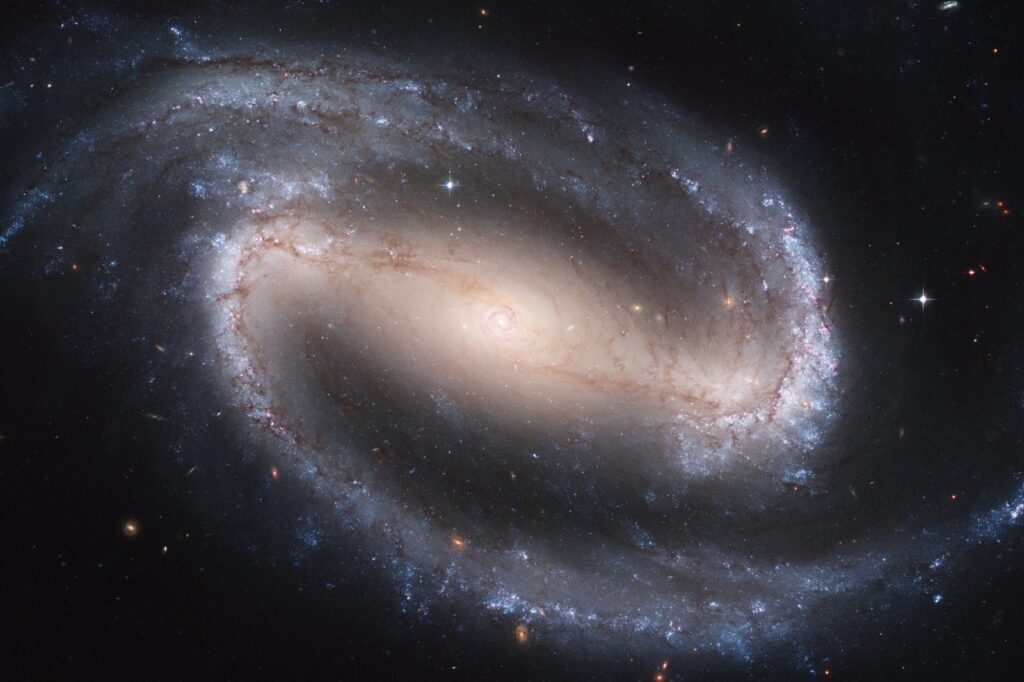
A stretch of the Milky Way long mapped as the Norma spiral arm may actually be a shock front where gas piles up along the galaxy’s central bar. The finding, published in Nature Astronomy, comes from a team led by Hillary Davis, who recently completed her doctorate at the University of Sydney.
Why Mapping the Milky Way Is So Hard
We sit inside the galaxy’s disk, looking out through thick clouds of dust. Structures at different distances overlap along the same line of sight. That makes it exceptionally difficult to decide which visible features belong together and which are separate. For decades, astronomers have pieced together a map of spiral arms using whatever tracers they can see through the dust.
The Role of the Galactic Bar
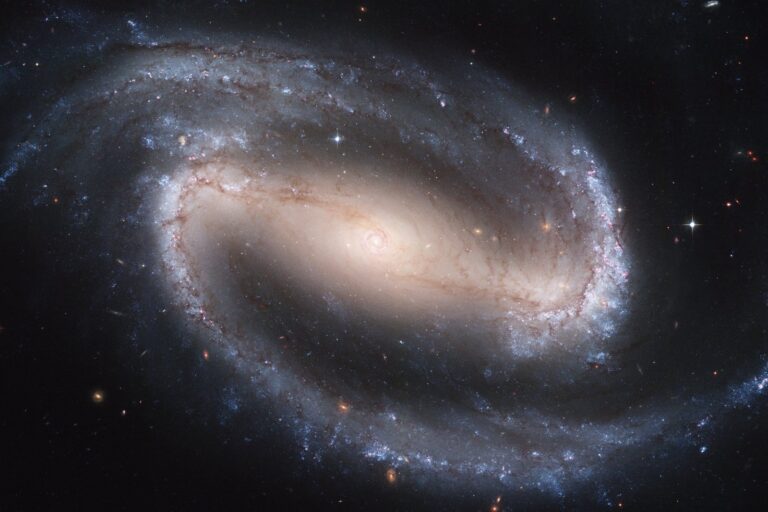
The Milky Way is a barred spiral galaxy. Its central bar is an elongated concentration of stars stretching roughly 14,000 light-years from the centre along its major axis. It rotates relatively slowly. As it turns, its gravity redirects surrounding gas. Those flows can slam into abrupt changes — shock fronts — that compress material into dense lanes along the bar’s leading edges.
How the Science Works: Masers as Signposts
To track where massive young stars are forming, the team used masers. A maser works on the same principle as a laser but at microwave wavelengths. They occur naturally in dense, star-forming regions. Surveys including the BeSSeL Survey and Japan’s VERA project had previously measured the positions and velocities of these masers. Those measurements helped assign the regions to the Norma arm.
What Researchers Found
Davis and her colleagues compared detailed galaxy simulations with the observed maser locations and gas-velocity patterns. The simulations matched. Intriguingly, the masers previously associated with the Norma arm align closely with the shock front predicted along the bar’s leading edge. This suggests that at least part of what we called the Norma arm may not be a separate spiral arm at all, but a star-forming region within the bar structure itself.
Why This Is Unusual
In many barred galaxies, the shock fronts along the central bar actually suppress star formation, even when plenty of gas is present. Strong shocks and turbulence can disrupt collapse rather than encourage it. Nearby barred galaxies commonly show weak star formation along these dust lanes. The Milky Way appears to be an exception — star formation continues actively along the bar’s shock front.
What It Means for the Map
The interpretation does not settle the fate of the entire Norma spiral arm. It only reassigns the segment near the galactic centre. But because the simulations successfully reproduce the observed pattern, they also provide new constraints on the bar’s size, angle and rotation speed — a topic debated for decades. More observations are needed to determine how much of the Norma arm follows the proposed shock front.
Sources
- New discovery raises questions about the existence of the Milky Way’s Norma arm
- New discovery raises questions about the existence of the Milky Way’s Norma arm
- Graphic showing overlap of ‘Norma arm’ and the bar shock front in the Milky Way where stars are forming.
- Our Milky Way is an oddball: Nearby galaxies form new stars differently
- New discovery could reshape the map of the Milky Way
Photo: NASA, ESA, and The Hubble Heritage Team (STScI/AURA); Acknowledgment: P. Knezek (Public domain)