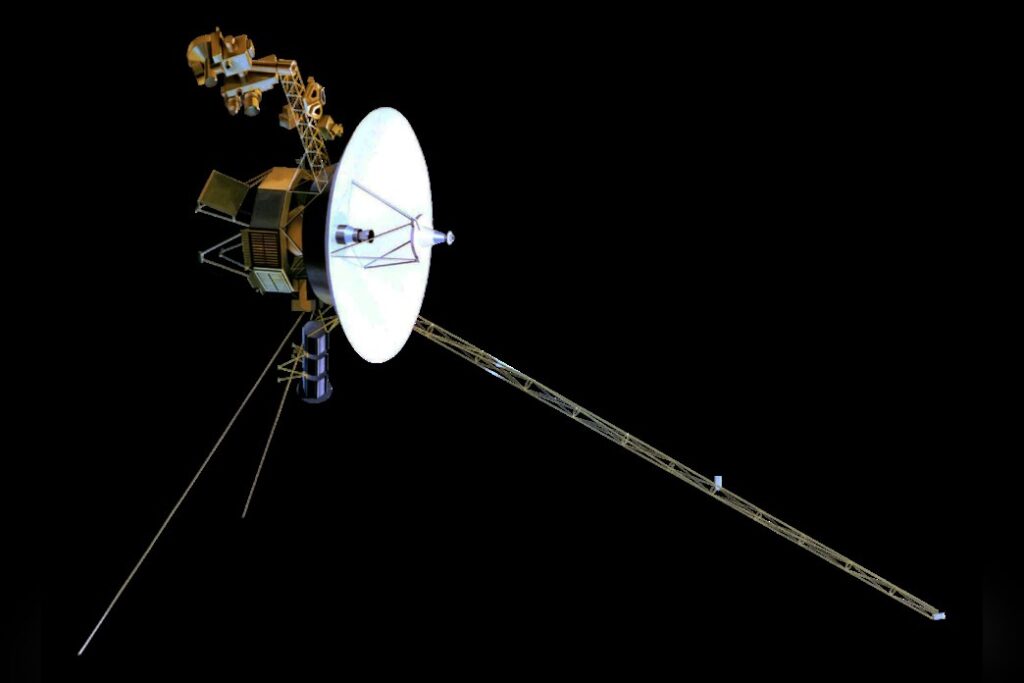
On the map of the solar system, the oldest borders are not between planets but between plasmas, and humanity’s first crossing of one is now old enough to have a sequel. Voyager 1 slipped over the heliopause in August 2012, “at about 121 times the Earth-Sun distance” and Voyager 2 followed in 2018. An explainer published in early October on a heliophysics site defines the line precisely: the heliopause is “the boundary separating the Sun’s outward plasma environment from the surrounding interstellar plasma” The framing in a second, longer read from August is sharper: “The Sun does not simply light the solar system; it inflates it.” A wind of charged particles streaming out at hundreds of kilometers per second carves a vast bubble in the thin gas between the stars, and “everything we call home lives inside it” When Voyager 1 crossed the outer edge it became “the first human object in interstellar space” the first scout past the border of the Sun’s own regime.
Strategically, the territory matters more than the line. The heliopause is “not a wall you could touch” but “a transition, marked by changes in the kinds of particles present and the density of the surrounding plasma” Inside, the medium belongs to the Sun’s wind; outside, to the colder, denser gas of the galaxy. The approach has order to it: the solar wind runs supersonic until the termination shock slows it to subsonic speeds, then a disturbed band called the heliosheath runs out to the heliopause itself. Nor is the frontier fixed. The boundary answers to pressure and motion, shifting as the solar wind shifts, which is why the October explainer treats it as “a responsive region” rather than “a permanent sphere with one exact radius” NASA’s IBEX observations, the same page notes, show changes that begin near the Sun producing a delayed response at the far edge.
The verification story is an intelligence story. Voyager 1 reached the frontier with no working instrument to measure the solar wind directly, so the crossing had to be deduced. Density supplied the decisive clue: a burst of solar activity “rang the surrounding plasma like a bell” and the pitch of that ringing, picked up by the probe’s antennas, showed that the gas around the spacecraft had jumped to interstellar levels. Particles from the Sun fell away sharply while cosmic rays from the galaxy rose, and the case was closed. Voyager 2’s crossing in 2018 was cleaner: its plasma instrument still worked, so it measured the boundary directly and confirmed the picture. The broader stakes are cartographic. Two probes on different headings, at different speeds, crossed the same border six years apart, and the October explainer is explicit that the dates “should therefore not be interpreted as a contradiction” because the boundary itself varies with direction and time. Two local crossings “give valuable samples along two paths” and the wider map now comes from combining them with models and with IMAP, a mission that reads the boundary remotely, from a detector near Earth.
What the crossing does not mean is as important as what it does. The heliopause is a plasma border; the Sun’s gravity reaches vastly beyond it, and the probes remain gravitationally bound, with the distant Oort Cloud still ahead and tens of thousands of years needed to pass beyond it. That is why reports of Voyager “leaving the solar system” keep colliding: one writer is using the heliosphere as the boundary, another the far larger gravitational system, and the honest piece states its definition. The same caution, the October page argues, applies to loose phrases like “edge of space” since “There is no universal edge that answers every scientific question” Meanwhile the envoys keep signaling. Their transmissions take hours to reach Earth and arrive barely detectable, pulled in by giant dishes straining for a whisper of power, and each carries the Golden Record, “greetings in dozens of languages” music, and “the sound of a heartbeat and of waves on a shore” Their aging power sources will fade within a few more years, after which they go on “coasting on in the dark” as “the first envoys of Earth in interstellar space”
What this signals, ultimately, is ownership of the map. Before the Voyagers the heliopause was theory; the probes turned it “from a line in a diagram into a place with measured properties” and found it more complex and turbulent than anyone expected, opening fresh questions about the bubble’s shape and its dealings with the galaxy. New missions are in design to pursue the boundary up close, though the October page adds a discipline for readers: distances keep moving, so “A number in an old article belongs to its date” and a Sun-referenced distance and an Earth-referenced one differ as the planet goes around its star. The calculus of the whole affair remains improbable: “two 1970s spacecraft” that “outlived every expectation” got there “by accident of longevity” and, in crossing, took the species, for the first time, beyond its own star’s plasma domain. The firmest close is the one the August read supplies: “Launched before we knew exactly where the edge was, they found it the only way possible: by crossing it, and calling back to tell us.”