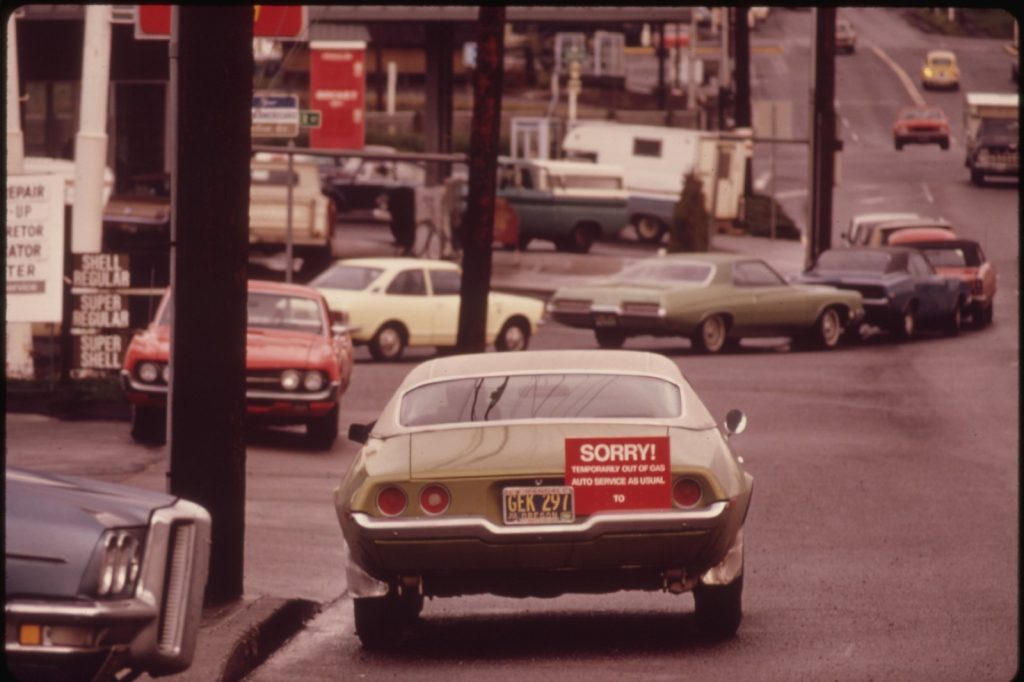
In October 1973, the Organization of Arab Petroleum Exporting Countries announced a total oil embargo. The targets were countries that had backed Israel at any point in the Yom Kippur War, which began when Egypt and Syria launched a surprise attack to win back land lost in 1967.
Faisal of Saudi Arabia led the effort. The first countries named were Canada, Japan, the Netherlands, the United Kingdom and the United States. Portugal, Rhodesia and South Africa were added later.
OAPEC lifted the embargo in March 1974. By then crude had climbed nearly 300 percent, from $3 a barrel to almost $12 worldwide, and American prices ran well above the global average. The episode became known as the first oil shock. A second followed in 1979, after the Iranian Revolution.
An economy open to a cutoff
American output peaked in 1970, and the country began importing more. Oil imports rose 52 percent between 1969 and 1972, and by 1972 about 83 percent of them came from the Middle East. Between 1970 and 1973 crude imports nearly doubled, reaching 6.2 million barrels a day. Nixon had capped oil prices in August 1971, which kept consumption high while production fell.
OAPEC countries cut production and stopped exports to the United States after Nixon asked for $2.2 billion to support Israel’s war effort.
A warning in the Washington Post
The threat was not a secret. In April 1973, Saudi Oil Minister Ahmed Zaki Yamani went to Washington and told Henry Kissinger that King Faisal was growing more unhappy with the United States. Yamani later said Kissinger did not take the warning seriously and only asked him to stop talking about it. On April 19, 1973, Yamani told the Washington Post that Faisal was weighing an embargo. The prevailing view in Washington was that the Saudis were bluffing.
Stagflation
The word came from Iain Macleod, a British Conservative politician, who used it in a 1965 speech to Parliament. “We now have the worst of both worlds,” he told the House. “Not just inflation on the one side or stagnation on the other, but both of them together.” Stagflation means high inflation, stalled growth and elevated unemployment all at once, a mix that cuts against the Phillips Curve idea that inflation and unemployment move in opposite directions.
Economists have found it in seven major market economies from 1973 to 1982. They offer two main explanations: a supply shock such as a jump in oil prices, or government policy that hurts industry while the money supply grows too fast. Both were argued over for the 1970s.
The data do not make the embargo the whole story. Between 1968 and 1970, unemployment in the United States rose from 3.6 to 4.9 percent while consumer price inflation went from 4.7 to 5.6 percent. Nixon’s price controls and wage freeze, imposed from August 1971, held the problem down. When the controls came off in mid-1973, consumer prices surged to 8.5 percent, months before the embargo began.