
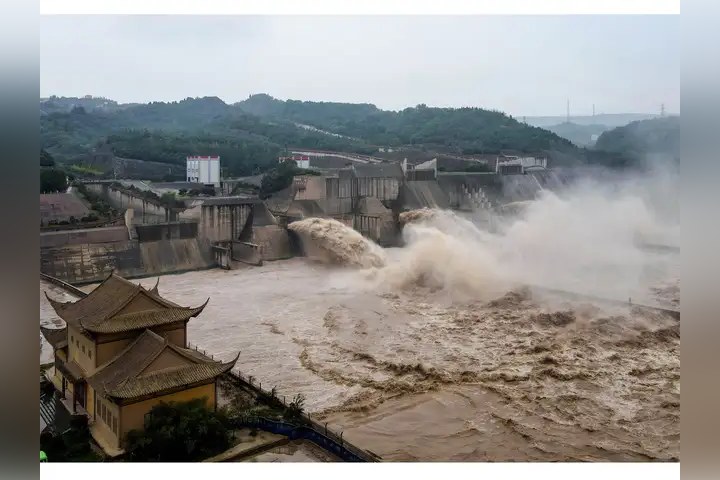
Beijing, August 28 — A devastating dam disaster in China’s Henan province, which occurred on August 8, 1975, has resurfaced as a topic of discussion due to its striking similarities with recent floods in the region. The Banqiao Dam, considered a showpiece of the Communist Party’s campaign to tame China’s mighty rivers, failed after Typhoon Nina dumped more than a year’s worth of rain over parts of Henan in just three days.
The disaster was triggered by the typhoon, which formed over the Philippine Sea at the end of July 1975 and intensified rapidly before making landfall in China’s Fujian province. The storm’s remnants became trapped over central China, resulting in extreme rain, with maximum one-day rainfall exceeding 1,000 mm near the storm’s centre. Data shows that the Banqiao Dam received 1,422 mm of rainfall over three days, including 784 mm on August 7, causing water to pour into the reservoir at an estimated peak rate of 13,000 cubic metres per second.
The dam’s failure, along with that of the Shimantan Dam and dozens of smaller dams, unleashed China’s deadliest dam disaster, which is ranked as the world’s third-deadliest flood in recorded history. The scale of the tragedy was enormous, with a wall of water up to 10 kilometres wide racing across the valleys and plains of Henan province, catching downstream villages in their sleep.
The flood directly killed around 26,000 people, according to a 2017 study by researchers from Princeton and Tsinghua universities, while famine and disease subsequently caused approximately one lakh additional deaths. A much higher estimate of about 2.3 lakh deaths was produced by eight senior Chinese experts, cited by Human Rights Watch in 1995. Officials noted that the disaster was exacerbated by poor dam design, official inaction, and failed warnings, with China’s state-controlled media barely reporting the dam collapse.
The exact toll remains contested, but around 10 million people were affected or left without adequate shelter, while entire villages and towns, roads, railway lines, and vast stretches of farmland disappeared underwater. The 1975 disaster has acquired fresh relevance after the latest flash flood along Nepal’s Bhote Koshi-Trishuli river system, close to the Tibet border, with several Nepali journalists and experts alleging that China’s little-known infrastructure construction along the border might have contributed to the disaster.
As the region continues to experience extreme weather events, it is essential to monitor the situation closely and ensure that timely information about landslides, natural river blockages, glacial lakes, rainfall, and reservoirs is available to countries and communities downstream of the Himalayas.




