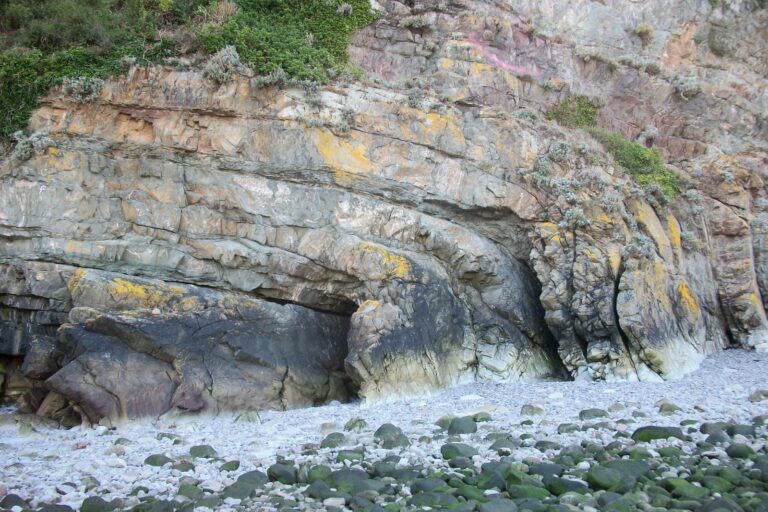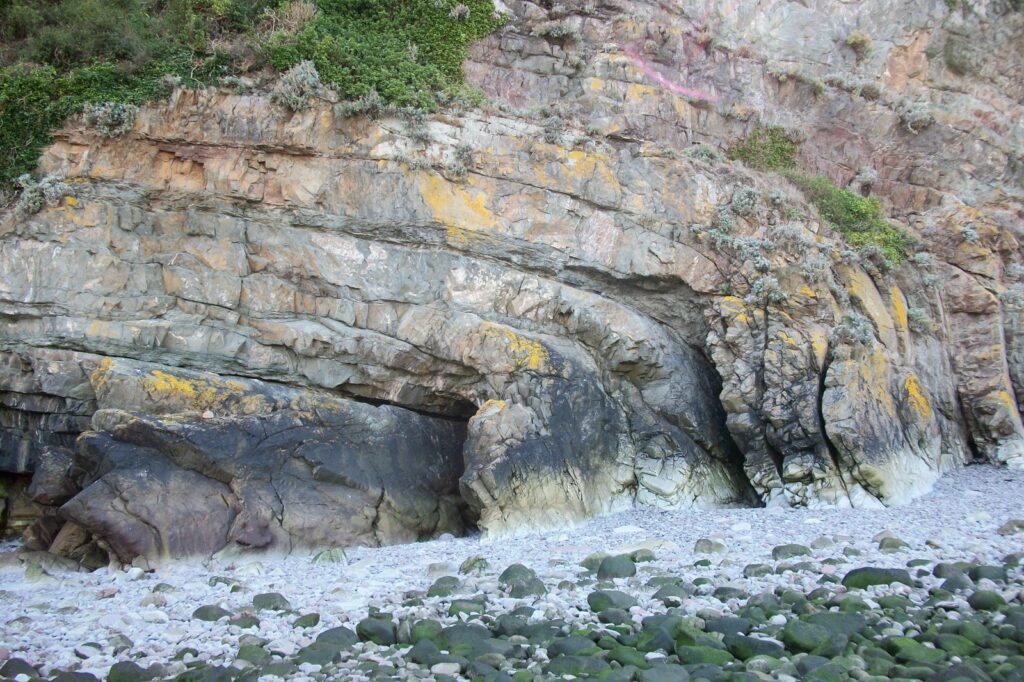
Scientists have uncovered the world’s oldest known fossil forest in the sea cliffs of southwest England, a 390-million-year-old woodland that predates the rings of Saturn. The discovery in the Hangman Sandstone Formation reveals how Earth’s earliest trees began reshaping the planet’s atmosphere and climate.
A Weird Woodland Preserved in Stone
Researchers examining the Devon and Somerset coast stumbled upon an entire fossilized forest floor preserved in sandstone. Upright trunks stand where they originally grew, alongside flattened logs, root traces, and ancient ripple marks left by water. “This was a pretty weird forest – not like any forest you would see today,” said Neil Davies, a sedimentary geologist at the University of Cambridge who led the research.
The trees belong to an extinct group called Calamophyton, distant relatives of modern ferns and horsetails. They stood only two to four meters tall with skinny, hollow trunks supported by woody strands rather than solid wood. Instead of leaves, their crowns carried hundreds of tiny twig-like structures that served as photosynthetic organs. As the trees grew, they constantly shed their lower branches, carpeting the ground in debris.
Christopher Berry, a paleobotanist at Cardiff University and co-author of the study, recognized the trees immediately from photographs after three decades studying similar plants worldwide. “It was amazing to see them so near to home. But the most revealing insight comes from seeing, for the first time, these trees in the positions where they grew,” Berry said. This in-situ preservation offers the first clear view of how these early forests functioned as ecological systems.
How the First Forests Began Changing the Planet
Plants had colonized land tens of millions of years earlier, but this forest represents a crucial transition. The Calamophyton stands grew together in dense groups, creating an environment fundamentally different from the low-growing vegetation that preceded them. Their shed twigs accumulated on the forest floor in quantities the planet had not seen before.
This debris accumulation mattered because it began locking away carbon on a new scale. Early forests like this played a crucial role in drawing down atmospheric carbon dioxide and cooling the planet. The strange trees helped change Earth’s atmosphere and climate through their growth and the sheer volume of organic matter they deposited.
The landscape they inhabited had no leaves, no birds, no grass, and no shade. Yet these modest, twig-crowned trees standing just a few meters high initiated processes that would eventually transform barren continents into the complex terrestrial ecosystems we know today. Their fossilized remains in Devon cliffs now show exactly where that transformation began.
Sources
- The World's Oldest Known Forest Was Found in England, and Its Strange Trees Helped Change the Planet
- List of oldest trees
- The race to save California’s forests – American Forests
- In 1964, a graduate student got permission to cut down a bristlecone pine on a Nevada mountain. He counted 4,862 rings, making it the oldest tree known at the time – Futura-Sciences
- THIS WEEK IN WV HISTORY: Nov. 22–28 – The Real WV
- Trump, UFC chief Dana White to honor Marine Band with donations
Photo: michael (CC BY-SA 2.0)