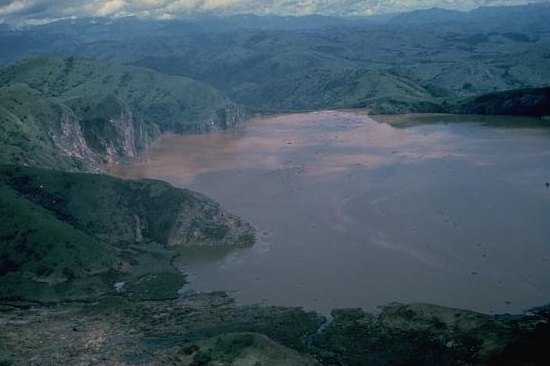
The company that installed the degassing system says Lake Nyos is now safe for residents to return, a stark contrast to the night of August 21 1986 when a sudden release of carbon dioxide killed about 1,700 people and 3,500 livestock.
Limnic Eruption Explained
Scientists identified the 1986 disaster as a limnic eruption, a rare event where deep, carbon‑rich waters rise and release dissolved gases. The lake sits in an ancient volcanic crater in the Oku field, about 315 km northwest of Yaoundé, and had accumulated CO₂ from the mantle beneath more than 200 m of water. When a landslide likely disturbed the stratified layers, the gas escaped in a rapid chain reaction, displacing oxygen and suffocating villages downhill.
Degassing Pipes in Action
Engineers responded by installing vertical degassing pipes that tap the lake’s deepest layers. The pipes allow CO₂‑laden water to rise through a vent, where the gas expands, escapes to the atmosphere, and the water returns to the lake surface. By continuously venting the gas, the system prevents dangerous pressure buildup.
Monitoring the Gas Balance
Continuous monitoring stations now measure dissolved CO₂ concentrations at multiple depths. Data shows the lake no longer contains enough dissolved carbon dioxide to trigger a disaster, according to geologist Isaac Konfor Njilah, head of a laboratory at the University of Yaoundé.
Remaining Challenges
Survivors still fear the lake, and reconstruction has been hampered by the Anglophone crisis that erupted in 2016. Njilah notes that insecurity makes scientific work and community rehabilitation difficult, with access to the area “dangerous” for outsiders.
“The lake is very safe for the population to return,” Njilah told DW, confirming that the degassing system and monitoring network have effectively mitigated the risk of another limnic eruption.
Sources
Photo: Jack Lockwood, USGS (Public domain)