
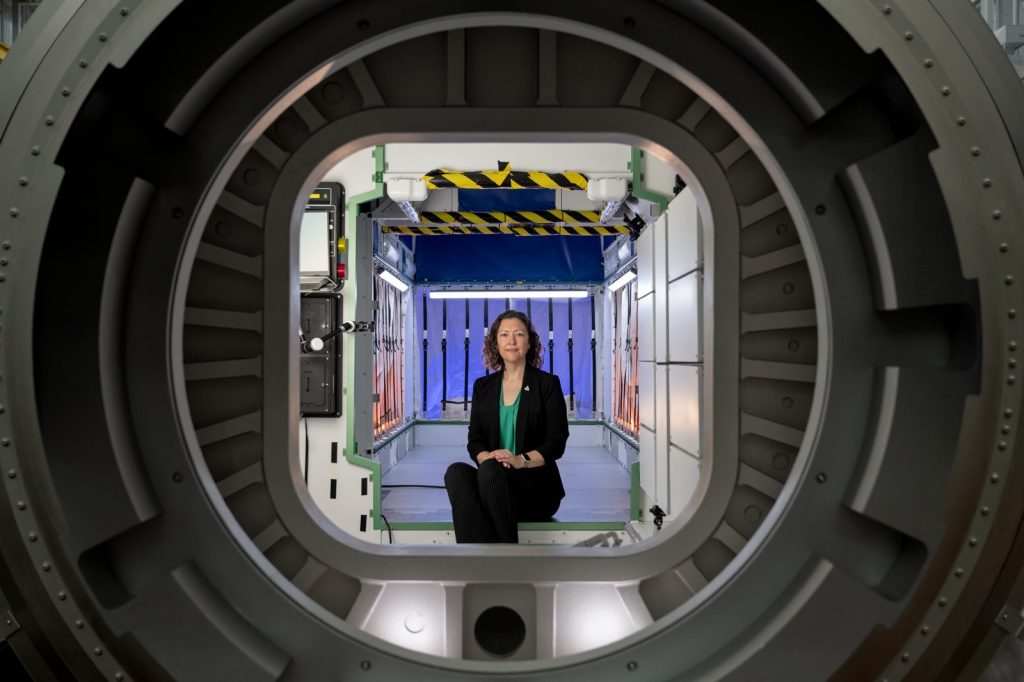
Gateway is meant to be the first space station anywhere beyond low-Earth orbit, and it is designed to run on its own. NASA says it can operate uncrewed, by remote control, for up to three years, and that it will have a minimum 15-year lifespan with the potential for extension well beyond that.
It is also small. Once fully assembled, NASA says, the outpost will measure roughly a fifth of the International Space Station and tip the scales at 63 metric tons, offering about 125 cubic meters of living space. As ever with lunar hardware, the detail that matters is not size but where it sits.
An orbit chosen with care
Gateway is to fly a near-rectilinear halo orbit, or NRHO, a polar path around the Moon that NASA says takes 6.5 days to complete, roughly a week. The station passes as close as about 1,500 kilometers to the Moon and swings out as far as about 70,000 kilometers.
NASA’s own explanation, published in 2022, sets the choice against two alternatives. A low lunar orbit makes trips to the surface simple but demands more propellant to hold, which suits a stay of at least 15 years poorly. A distant retrograde orbit is stable and frugal with fuel, but it makes the surface harder to reach. NRHO, in the agency’s words, marries the upsides of both. It hangs “almost like a necklace from the Moon,” balanced between Earth’s and the Moon’s gravity, and it gives the station a continuous line of sight to Earth, which means uninterrupted communication.
Syfy Wire, describing the same orbit, put the closest pass at 1,000 miles above the surface and the farthest at as much as 43,500 miles, with a swing in about once a week.
The first two modules
Construction begins with two pieces launched together on a SpaceX Falcon Heavy ahead of the Artemis IV mission. The Power and Propulsion Element, built by Lanteris Space Systems, is a 60-kilowatt solar-electric spacecraft. It supplies power and fast communications, steers the station and handles the transfer to lunar orbit. NASA says nothing with solar electric propulsion has flown with more power.
The Habitation and Logistics Outpost, known as HALO, is the first crew module. Syfy Wire reported that Thales Alenia Space built it in Turin, Italy, and that it reached Northrop Grumman’s facility in Gilbert, Arizona, on April 1, 2025. There it is due to get propellant and electrical lines, thermal radiators and equipment racks. Syfy Wire put the launch of the joined pair no earlier than September 2028. It said the integrated spacecraft will take about a year to settle into its lunar orbit.
Three research payloads fly with the first elements: the European Radiation Sensors Array, the Heliophysics Environmental and Radiation Measurement Experiment Suite and the Internal Dosimeter Array. All three study solar radiation in deep space.
Who is in the partnership
Five space agencies are contributing to the assembly: NASA, the European Space Agency, the Japan Aerospace Exploration Agency, the Canadian Space Agency and the Mohammed Bin Rashid Space Centre. NASA says it has contracts with about 100 American companies, drawn from 14 states. Canada supplies Canadarm3, a robotic arm approximately 8.5 meters long for maintenance, inspection and capturing visiting vehicles.
Crews will not live aboard for long. With an Orion capsule docked, early configurations can host as many as four astronauts for 30 to 90 days, NASA says, and between visits the station sits empty while research continues. Astronauts are due to enter Gateway for the first time on Artemis IV.
Sources
- Meet HALO, the First Module of NASA's Gateway Lunar Space Station
- Gateway Capabilities – NASA
- A Lunar Orbit That's Just Right for the International Gateway – NASA




