
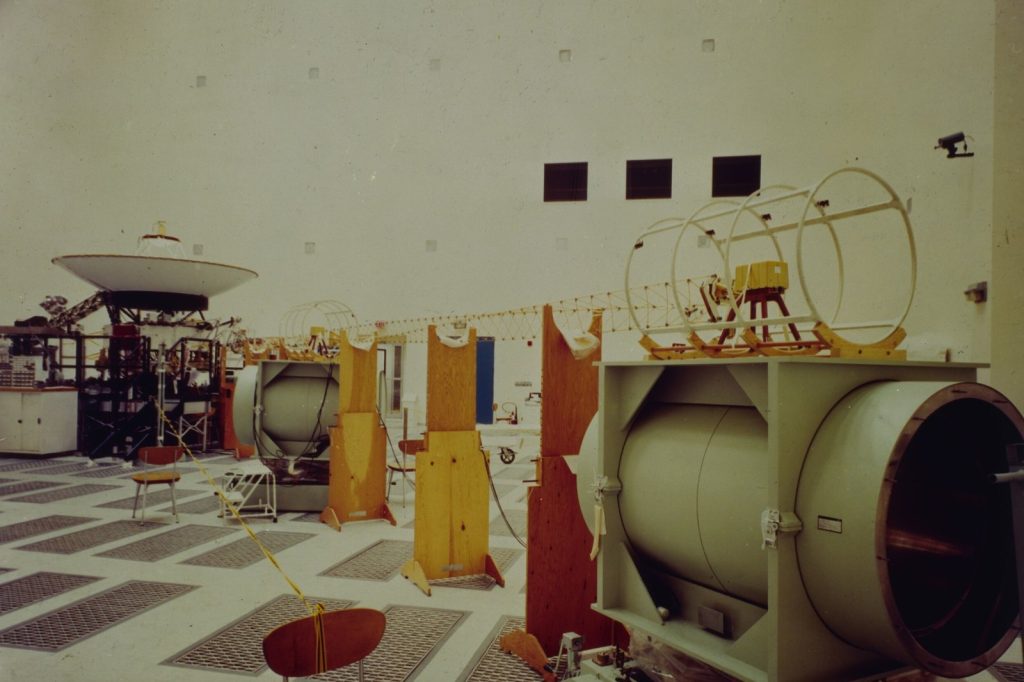
Voyager 1 launched on Sept. 5, 1977, and it still talks to Earth. Its three onboard computers share 68 kilobytes of memory. Commands crawl out to it at 16 bits per second. Rediff described the probe as a spacecraft planned for five years of work that has now run for nearly fifty.
Jupiter and Saturn
Voyager 1 left after its twin, Voyager 2, yet took a faster route and overtook it on Dec. 15, 1977. NASA records its closest pass of Jupiter at 12:05 UT on March 5, 1979, about 174,000 miles (280,000 km) from the planet. The flyby turned up a faint ring and two new moons, Thebe and Metis. Close-ups of Io showed volcanoes erupting. Europa, Rediff noted, turned out to hide an ocean under cracked ice.
Saturn came on Nov. 12, 1980, at a range of about 78,000 miles (126,000 km). There the probe found five new moons and a ring now called the G-ring, along with “shepherd moons” that keep some rings sharply defined. Images of Titan showed a thick atmosphere hiding the surface entirely, 90% nitrogen with methane and heavier hydrocarbons mixed in. NASA says that chemistry hinted prebiotic reactions might be possible there.
Voyager 1 did not go on to Uranus and Neptune. The Titan flyby required a path that sent it north out of the ecliptic plane. That job fell to Voyager 2, which completed the full planetary tour and gave humanity its only close-up views of those two worlds.
A picture of home
In 1990 the cameras took a last set: 64 images from 40 Astronomical Units (AU) out, a portrait of six planets. Earth appears in it as a speck, the view that inspired the “Pale Blue Dot” Carl Sagan made famous. Those frames were the final entries in a total of 67,000 pictures the two Voyagers took.
Crossing the boundary
The Voyager Interstellar Mission began on Jan. 1, 1990. On Feb. 17, 1998, at 69.4 AU from the Sun, Voyager 1 passed Pioneer 10 to become the most distant human-made object. It reached the termination shock on Dec. 16, 2004, and entered the heliosheath. Then came Aug. 25, 2012, when it became the first spacecraft to exit the heliosphere, the bubble of particles and magnetic fields the Sun blows around itself. Voyager 2 reached the same boundary six years later, Rediff reported.
The message aboard
Each probe carries a 30-centimeter gold-plated copper disc meant for any finder. NASA lists greetings in 55 languages, 35 sounds from life on Earth such as whale songs and laughter, 90 minutes of music from Mozart and Bach to Chuck Berry and Blind Willie Johnson, 115 images, and recorded greetings from then President Jimmy Carter and UN Secretary-General Kurt Waldheim. Sagan’s team curated the record.
Running out of power
The probes draw on decaying plutonium-238 and lose about four watts a year. Engineers have switched off instruments one by one to stretch what remains. On April 17, JPL engineers shut down another instrument on Voyager 1, leaving two science instruments running. In late 2023 the probe began sending gibberish, and NASA engineers spent five months tracing it to a failed memory chip and repairing it remotely from 25 billion kilometres away. Between November 13 and 18 this year, Rediff reported, Voyager 1 will sit one light-day from Earth, 25.9 billion kilometres out.
Sources
- Voyager 1: The Farthest Spacecraft – NASA Science
- One Light-Day Away: Voyager's Epic Voyage – Rediff.com




