
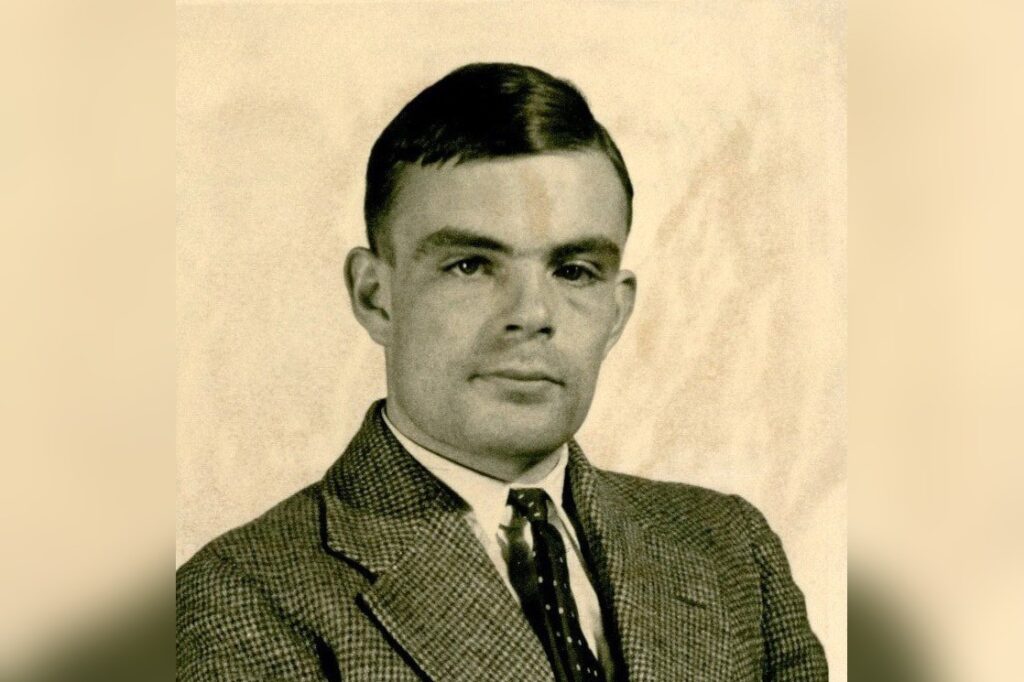
Inside Bletchley Park, Britain’s codebreaking centre, Alan Turing for a time ran Hut 8, the section that took on German naval ciphers. The Government Code and Cypher School had hired a mathematician. What it got reshaped two fields.
Alan Mathison Turing, OBE, FRS, lived from 1912 to 1954. He worked as a mathematician, logician, cryptanalyst and computer scientist, and many people call him the father of computer science and of artificial intelligence.
The machine on paper
His best-known idea is the Turing machine, a conceptual device. It formalised what “algorithm” and “computation” mean, and it can be read as a model of a general-purpose computer. The modern theory of computation grew from it.
Breaking the Nazi ciphers
During World War II he devised several techniques for breaking German ciphers. One was the bombe, an electromechanical machine that could find the settings of an Enigma machine. His work on the Enigma code used by the Nazis is what he is most remembered for.
When the war ended he moved to the National Physical Laboratory, where he designed the ACE, one of the first designs for a stored-program computer. In 1948 he joined Max Newman’s Computing Laboratory at Manchester University. There he helped develop the Manchester computers and turned to mathematical biology. He wrote a paper on the chemical basis of morphogenesis and predicted oscillating chemical reactions such as the Belousov-Zhabotinsky reaction, which scientists first observed in the 1960s.
Can machines think?
He also proposed the Turing Test, a way to judge whether a machine can show intelligent behavior equivalent to, or indistinguishable from, that of a human.
Not everyone found the question useful. Speaking at a regional conference in Austin, Texas, in November 1984, Professor Edsger Dijkstra said Turing “thought about criteria to settle the question of whether machines can think,” a question he called about as relevant as “whether submarines can swim.”
Prosecution
Turing was also criminally prosecuted in 1952 for homosexuality, which was illegal in the United Kingdom at the time. The case has made him a notable figure in the LGBTQ+ community.




