
The goal was set in 1961, by a president, with a deadline: land Americans on the Moon and bring them home safely before the decade ended. On the morning of 16 July 1969, Apollo 11 left Kennedy Space Center aboard a Saturn V; three days later the crew reached lunar orbit, and at 20:17:39 UTC on 20 July the lunar module Eagle stood on the Sea of Tranquility. The margin for error in that eight-day mission was thin, and the record of it, unusually for so famous an event, is precise.
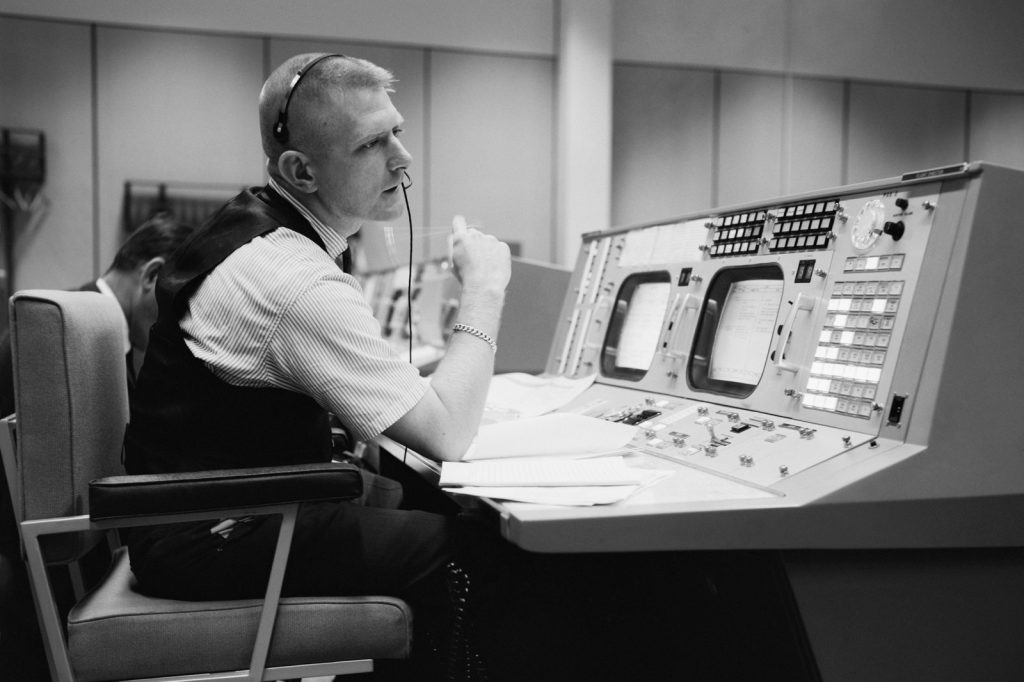
The final descent is where the care shows. Unfamiliar computer alarms, never seen in simulations, forced a call to Houston; flight controllers judged them safe to ignore. Then Armstrong saw the computer aiming for a boulder field, later identified as ejecta from West Crater, took semi-manual control, steered past a second crater and set Eagle down with seconds of fuel remaining. “Houston, Tranquility Base here. The Eagle has landed” was the report; Flight Director Gene Kranz’s answer was “We copy you down, Eagle.”
What followed, for two and a half hours outside the hatch, remains the best-documented walk in history. Some 530 million people watched Armstrong step down at 02:56 UTC on 21 July and say, “That’s one small step for [a] man, one giant leap for mankind.” He and Buzz Aldrin read a plaque, planted a flag, took a call from President Nixon, shot roughly 125 frames on a Hasselblad, and left working instruments behind: a seismometer that returned 21 days of data before failing, a solar-wind foil, a dust detector, and a laser retroreflector that laboratories still target today to track the Moon drifting away at 3.8 centimetres a year. They gathered 21.5 kilograms of rock and soil on a single excursion.
The encouraging part, for anyone weighing what public engineering can do, is the arithmetic underneath. A rocket 111 metres tall, 2.8 million kilograms fuelled, 34.5 million newtons of thrust; 13 crewed Saturn V launches, not one lost. NASA’s direct bill for Apollo 11 came to $355 million, about $3 billion in today’s money, spread across a workforce of roughly 400,000. Collins orbited alone, 30 times, waiting.
The mission’s afterlife was quiet and careful: three weeks in quarantine, released on 10 August; five more landings through Apollo 17 in 1972; 33 astronauts flown across 11 missions, 12 of them moonwalkers. The samples are still being analysed, and they helped confirm the giant-impact account of the Moon’s origin. NASA’s Artemis program now cites Apollo as its inheritance. The encouraging part is that the evidence is still answering: point a laser at Tranquility Base, and the reflector replies.




