
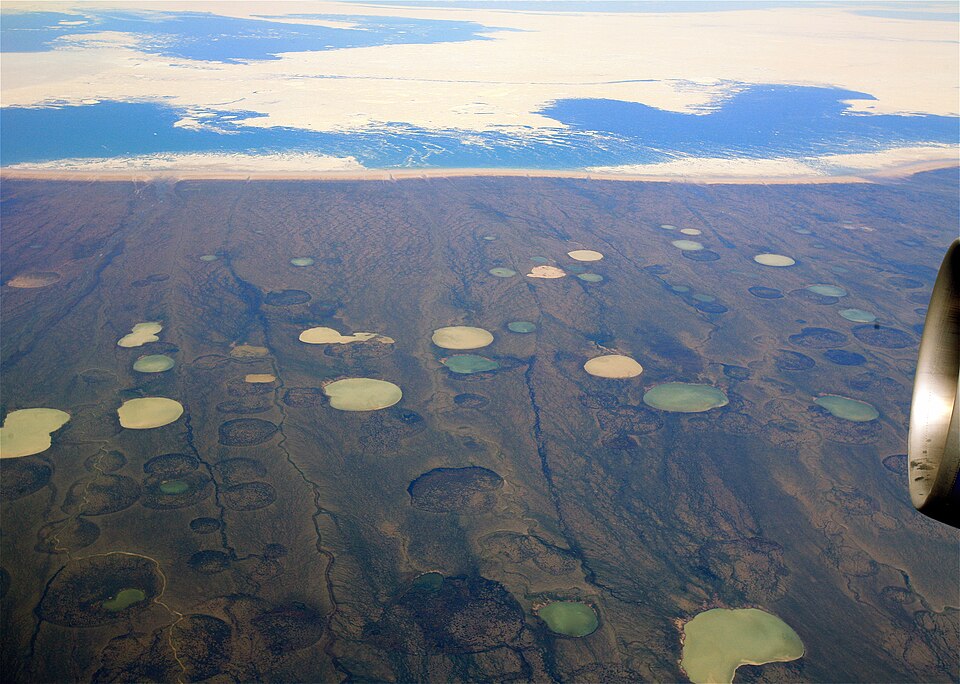
About 1,300 gigatonnes of organic carbon sit in Arctic permafrost on land, and another 400 gigatonnes in ocean sediments and river deltas. That is the stock researchers at the Alfred Wegener Institute (AWI) put on the table in August 2026, and it explains why every new measurement of thaw moves climate forecasts.
A very large stockpile
A review in Nature Reviews Earth & Environment, published in January 2022, set the total higher: nearly 1,700 billion metric tons of frozen and thawing carbon. The authors were blunt about the gap in knowledge. Warming threatens to release an unknown quantity of it, through what scientists call the permafrost carbon feedback.
The review pointed to two fast routes. Abrupt thaw and thermokarst, the collapse of ground as ice within it melts, could send a large amount of carbon into the air within days to years, including deep carbon locked in Yedoma soils. Wildfires are the second route. They are growing more frequent in the Arctic, and the authors called the resulting carbon flux notable but unpredictable.
Carbon dioxide still makes up the bigger share of Arctic emissions. The review noted, though, that thawed ground and soils turning oxygen-poor could raise the methane share in future.
What happens when carbon reaches the sea
Thaw and eroding coastlines also wash carbon into the Arctic Ocean. Manuel Ruben, lead author of the AWI study, said up to 0.02 gigatonnes now enter the sea each year, and forecasts suggest that flow could rise by 70 to 150 percent by 2100. What nobody knew was how much returns to the atmosphere as gas.
His team, working with MARUM at the University of Bremen, took sediment cores off Qikiqtaruk (Herschel Island) in Canada. The cores hold roughly 50 years of deposits. Pore water in them carried chemical fingerprints: carbon isotopes that show whether the microbes fed on land carbon or fresh marine carbon, and whether the old permafrost material was on the menu at all.
The answer, published in Nature Geoscience, was reassuring. Microorganisms convert around ten percent of the organic carbon in the sediments into gases. Most of the rest stays buried in the seabed. Geochemist Gesine Mollenhauer described “gourmet” bacteria that prefer fresh algal carbon to the old carbon from permafrost deposits, so older material may add less to atmospheric greenhouse gases than scientists once feared.
The team added a caution. Some permafrost carbon may already have broken down before it reaches the seabed, so the picture is incomplete and, in their words, further research is needed.
Darker, cloudier water
Carbon is not the only consequence. Eroded sediment clouds coastal water, and dissolved organic carbon darkens it. Less sunlight reaches the algae that feed a food web of fish, crustaceans and seals. The researchers plan to follow this up in the international “Arctic Pulse” campaign scheduled for 2027, using the Polarstern icebreaker, AWI research aircraft and sites on land.
Ruben said the work shows “more precisely than ever before” how much carbon is safely stored in the seabed, a foundation for climate models of thaw. The 2022 review made a related point: Earth system models must include permafrost dynamics, and satellite systems due online by 2025 should give the frequent data that monitoring of its emissions needs.
Sources
- Permafrost carbon emissions in a changing Arctic | Nature Reviews Earth & Environment
- Ancient Arctic carbon is pouring into the sea, but the seabed captures most of it | ScienceDaily




