
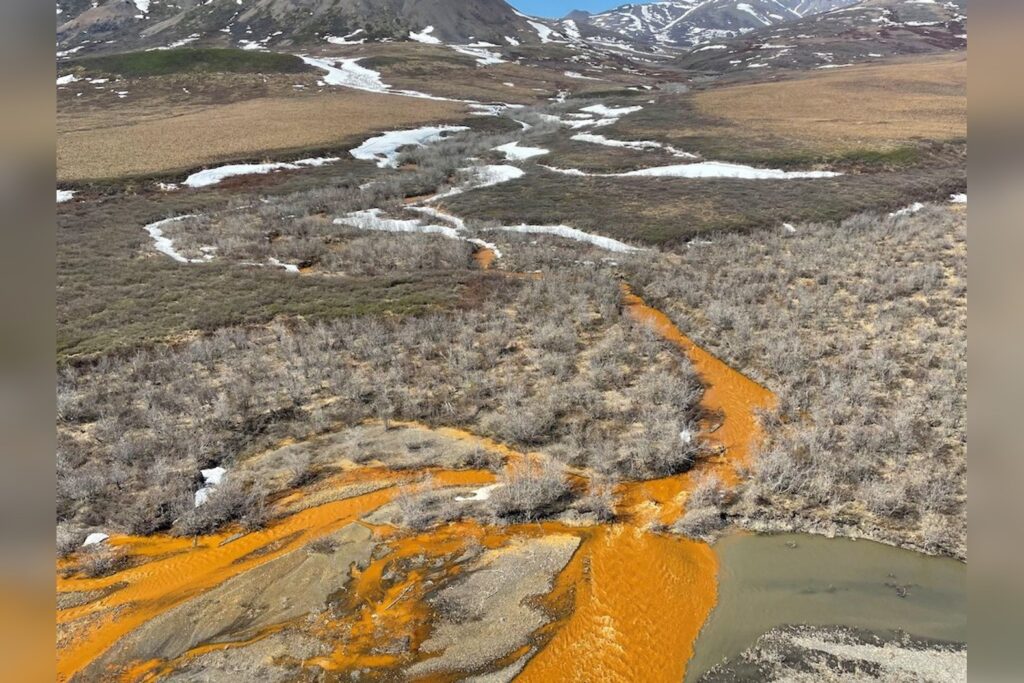
“There are certain sites that look almost like a milky orange juice,” says Jon O’Donnell, an ecologist with the National Park Service who has sampled the affected waters in northern Alaska. “The more we flew around, we started noticing more and more orange rivers and streams.”
The colour is rust. Scientists first widely noted it in 2018, though satellite imagery shows some Alaskan waterways changing from clear to rusted as far back as 2008. A new paper in the journal Communications: Earth & Environment, with O’Donnell among the authors, now points to the cause, and it is climate change.
Under the hood
As the Arctic warms, permafrost thaws. Acid and metals, among them zinc, nickel, copper, cadmium, iron and aluminum, are freed from the loosening soil and exposed to water and oxygen through weathering. The iron, especially, essentially rusts, staining the water a muddy orange-brown.
Across about 600 miles of waterways in the Brooks Range, the team identified 75 rivers and streams that have turned orange. Several are stained deeply enough to show up in images taken from space. Water samples registered a pH of 2.6, far more acidic than the typical river range of 6.5 to 8.
The detail that matters is where it happens. Brett Poulin, the study’s lead author and an organic geochemist at the University of California, Davis, used to teach in Colorado’s Rocky Mountains, where acid mine drainage discoloured waterways near abandoned mines. “We’re seeing the same sequences of changes in water chemistry in these rivers, but far from mine sources,” he says. No mine is involved. The thaw does the work.
What it does to the river
The damage reaches the base of the food chain. “When the river turned orange, we saw a significant decrease in macroinvertebrates and biofilm on the bottom of the stream, which is essentially the base of the food web,” Poulin told the Guardian. “It could be changing where fish are going to be able to live.”
That matters in a state where many rivers have already seen salmon runs decline from warming water, hitting Alaska Native communities and subsistence users. With more metals in the water, scientists also worry about rural drinking water, which at the least could taste different, CBS News reported.
Scott Zolkos, an Arctic scientist at the Woodwell Climate Research Center who was not part of the study, says the region is warming at least two to three times faster than the rest of the planet, “so, we can expect these types of effects to continue.” The researchers say more work is needed to understand how thaw affects water quality and how to prevent further damage.




