
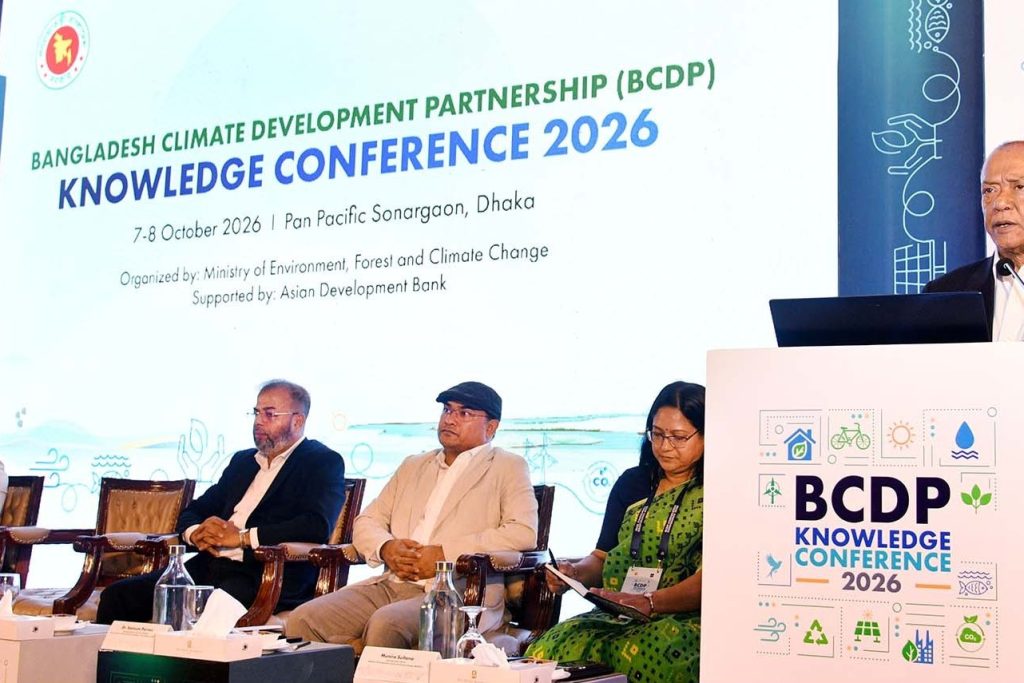
DHAKA, October 9 — Bangladesh is pitching a clearer pipeline of bankable climate projects to unlock larger flows of international finance, with the government telling development partners that project preparation, not just policy, is now the binding constraint. Environment, Forest and Climate Change Minister Abdul Awal Mintoo laid out the economic logic at the opening of the Bangladesh Climate Development Partnership Knowledge Conference 2026, arguing that current investment decisions will shape the country’s climate risk profile for decades and that major capital must price in those risks from day one.
The minister stressed that national frameworks — the National Adaptation Plan 2023–2050, the Bangladesh Delta Plan, and NDC 3.0 — need to be translated into implementable programmes with defined problems, identified beneficiaries, and rigorous climate risk assessments. Feasibility studies, technical option analysis, economic benefit calculations, and environmental and social impact reviews must precede financing requests.
Mintoo noted that a large part of adaptation spending yields no direct commercial return but delivers essential social and public benefits, so financing structures must reflect Bangladesh’s fiscal capacity and development priorities. Officials highlighted the private sector as a necessary counterpart. The ministry is encouraging private capital into clean energy, resource efficiency, climate-resilient infrastructure, and sustainable agriculture — areas where energy security and cost competitiveness align with resilience goals.
The two-day conference, organized by the Ministry of Environment, Forest and Climate Change with Asian Development Bank support, drew more than 500 climate experts, policymakers, development partners, private-sector representatives, researchers, and civil society members from Bangladesh and abroad.
Portal launch sharpens coordination
The BCDP web portal went live at the conference, designed to manage the climate project pipeline, enable real-time monitoring, integrate data, and coordinate across government ministries. Established in 2024, the BCDP platform is being strengthened to support climate finance mobilisation, resource allocation, policymaking, and implementation coordination. Satya Srinivas Lola, ADB executive director for Bangladesh, Bhutan, India, Lao PDR, Tajikistan, and Turkmenistan, said the conference’s success will hinge on follow-up actions and effective investment, underscoring that large-scale capital from both public and private sources is required.
First-day agenda signals priorities
Day one sessions focused on pathways to resilience and low-carbon growth, implementation of the National Adaptation Plan 2023–2050, and financing opportunities for NDC 3.0 through multilateral development banks and public-private structures. Attendees included State Minister Sheikh Faridul Islam, Prime Minister’s Special Assistant Dr Md Saimum Parvez, Principal Secretary ABM Abdus Sattar, acting Secretary Dr Fahmida Khanam, and Additional Secretary Mohammad Navid Shafiullah. Watch for whether the project pipeline the portal tracks can move from concept to financial close at a pace that matches the investment appetite development partners have signalled.




