
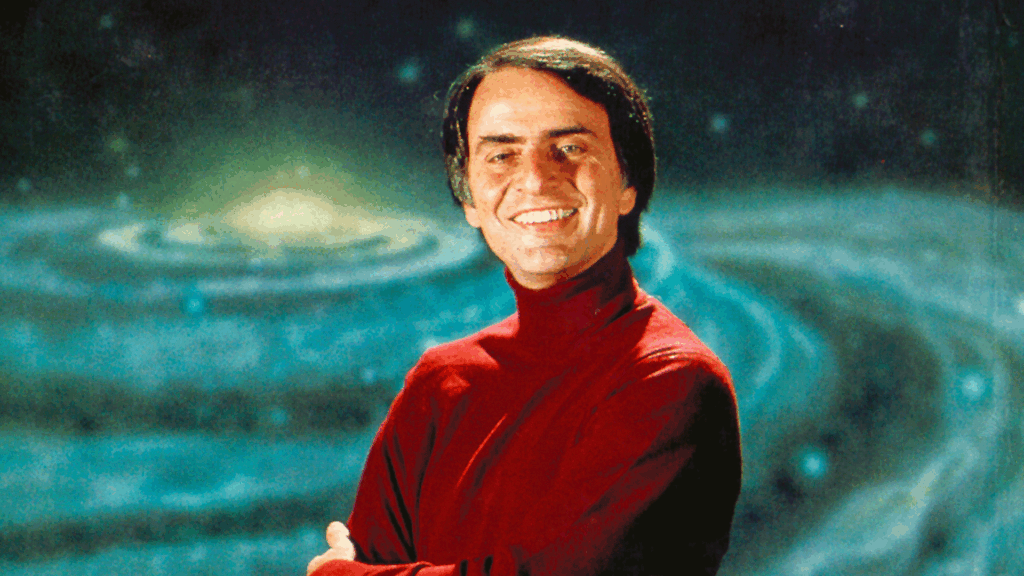
On December 20, 1996, Carl Sagan died at a cancer center in Seattle. Sagan was 62. Pneumonia killed him in the end, a complication of myelodysplasia, a bone marrow disease he had been fighting for two years; a marrow transplant in April 1995 had bought time but not a cure.
The Cornell astronomer was, by wide agreement, the most effective popularizer of science his century produced. Cosmos, the 1980 public television series he hosted, won an Emmy and a Peabody and drew an audience Cornell counted at more than 500 million viewers in 60 countries; the New York Times, in its obituary, put the figure at 400 million. The book version of the series spent 70 weeks on the Times bestseller list and, Cornell reported, sold better than any science book before it in English.
The science underneath the fame
The fame rested on real work. While still in his twenties he deduced that strange radio emissions from Venus came from a surface heated toward 900 degrees Fahrenheit beneath a crushing atmosphere; Soviet spacecraft observations later largely confirmed the deduction. With the physicist James Pollack he proposed that windblown Martian dust, not seasonal plants, explained the color shifts observers tracked on the red planet, and a Mariner spacecraft confirmed the case. He chose landing zones for the first successful Mars landers, the two Vikings, worked on the early Pioneer Jupiter flights, and sat on the team that sent the Voyagers through the outer solar system.
His Voyager legacy is the record. Sagan conceived the idea of fixing a message to the spacecraft in case something retrieves it centuries from now: a 12-inch copper phonograph disk, jacketed in aluminum, carrying greetings in many tongues, 90 minutes of music, and sounds encoded into pictures. He called it a “bottle cast into the cosmic ocean,” and the phrase has done duty as his epitaph ever since. He also lent his name and his math to the nuclear winter warning, the finding that smoke and dust thrown up by a nuclear war could chill the whole atmosphere.
A candle in the dark
Cornell, which had been Sagan’s academic home from 1968, mourned in two registers. “A gifted scholar and researcher, Carl Sagan inspired thousands of students here in Ithaca and across the world to open their minds to the wonders of science and the universe.” Rawlings, the university president, added that the legacy would last for generations. Yervant Terzian, who chaired the astronomy department, was blunter: “Carl was a candle in the dark. He was, quite simply, the best science educator in the world this century.” Bruce Alberts, then head of the National Academy of Sciences, offered the outside view: Sagan, he said, “more than any contemporary scientist I can think of, knew what it takes to stir passion within the
public when it comes to the wonder and importance of science.”
Brooklyn beginnings
Carl Edward Sagan was born November 9, 1934, in Brooklyn, the son of a garment factory cutter, and the vocation came early. “I didn’t make a decision to pursue astronomy,” he once recalled. “Rather, it just grabbed me, and I had no thought of escaping.” He read science fiction as a boy, decided by age 8 that other stars must host life, and finished his astronomy doctorate at Chicago in 1960. Harvard hired him young; Cornell kept him from 1968 onward and made him a full professor in 1971.
The output never stopped: more than 600 papers, more than 20 books, the Pulitzer Prize in 1978 for The Dragons of Eden, and in his final years the film adaptation of his novel Contact, co-produced with his wife and collaborator, Ann Druyan. He logged 26 appearances on Johnny Carson’s Tonight Show and defended the time as strategy: “The show has an audience of 10 million people,” he said, and those viewers “aren’t people who subscribe to Scientific American.”
He was buried after a graveside service in Ithaca on December 23, 1996, with a public memorial set for the following February. He was survived by Druyan, five children and a grandchild. What he left behind was less a list of findings than a posture: the universe as something a citizen could grasp, if someone would explain it well. Sagan spent a career being that someone, and the calculus never changed. The broader stakes, as he kept arguing, were that science answers to the public that funds it.
Sources
- Carl Sagan, Cornell astronomer, dies today (Dec. 20) in Seattle | Cornell Chronicle
- Carl Sagan, an Astronomer Who Excelled at Popularizing Science, Is Dead at 62




