GENEVA, November 4, 2026 — Physicists at CERN have found the first evidence of an ultra-rare particle decay that they have been hunting for more than four decades. The process, known as Bd to mu mu, sees a beauty quark decay into a pair of muons and is predicted to happen only once in every 10 billion beauty particles.
The Decay and the Hunt
The LHCb collaboration announced the result this week. Their analysis focuses on the neutral B⁰ meson, a particle that contains a beauty quark. Beauty quarks are heavy, unstable relatives of the up and down quarks that make up ordinary matter. They are produced in huge numbers in the Large Hadron Collider but survive for only about one and a half trillionths of a second before decaying.
In the vast majority of cases, a beauty quark decays into a spray of other particles. The specific decay into two muons — heavier cousins of the electron — is extraordinarily rare. The Standard Model of particle physics predicts a frequency of roughly one in 10 billion. Spotting it requires not just a colossal number of collisions but a detector capable of picking out the clean signature of two muons emerging from a single point amidst the debris.
The Upgraded LHCb and the Vertex Locator
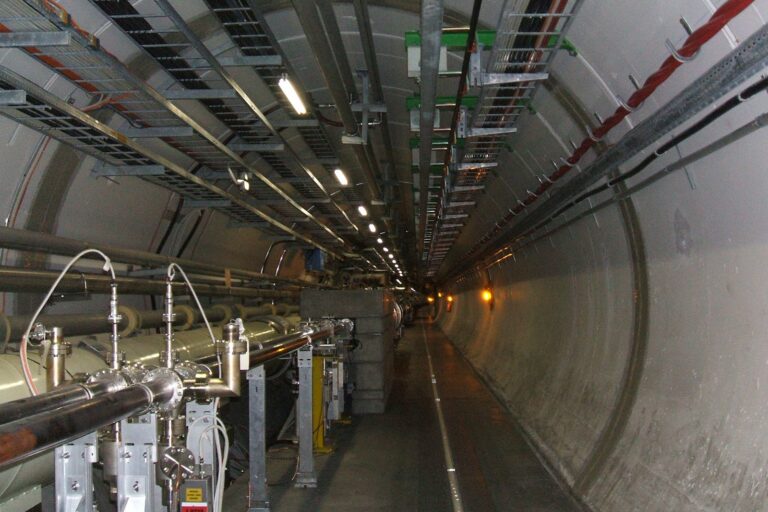
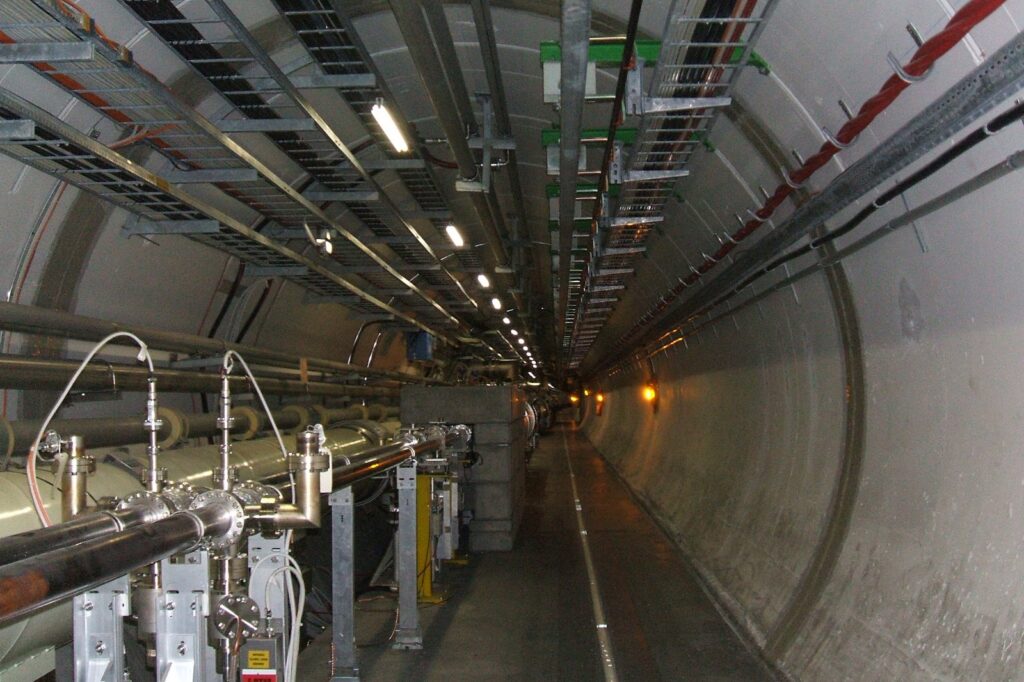
The evidence comes from the upgraded LHCb experiment, one of four major detectors at the LHC. A 15-year design and construction effort involving a 1,900-member international collaboration, the upgrade allows the experiment to collect data at up to five times its previous rate. The enhanced detector began taking data in 2024.
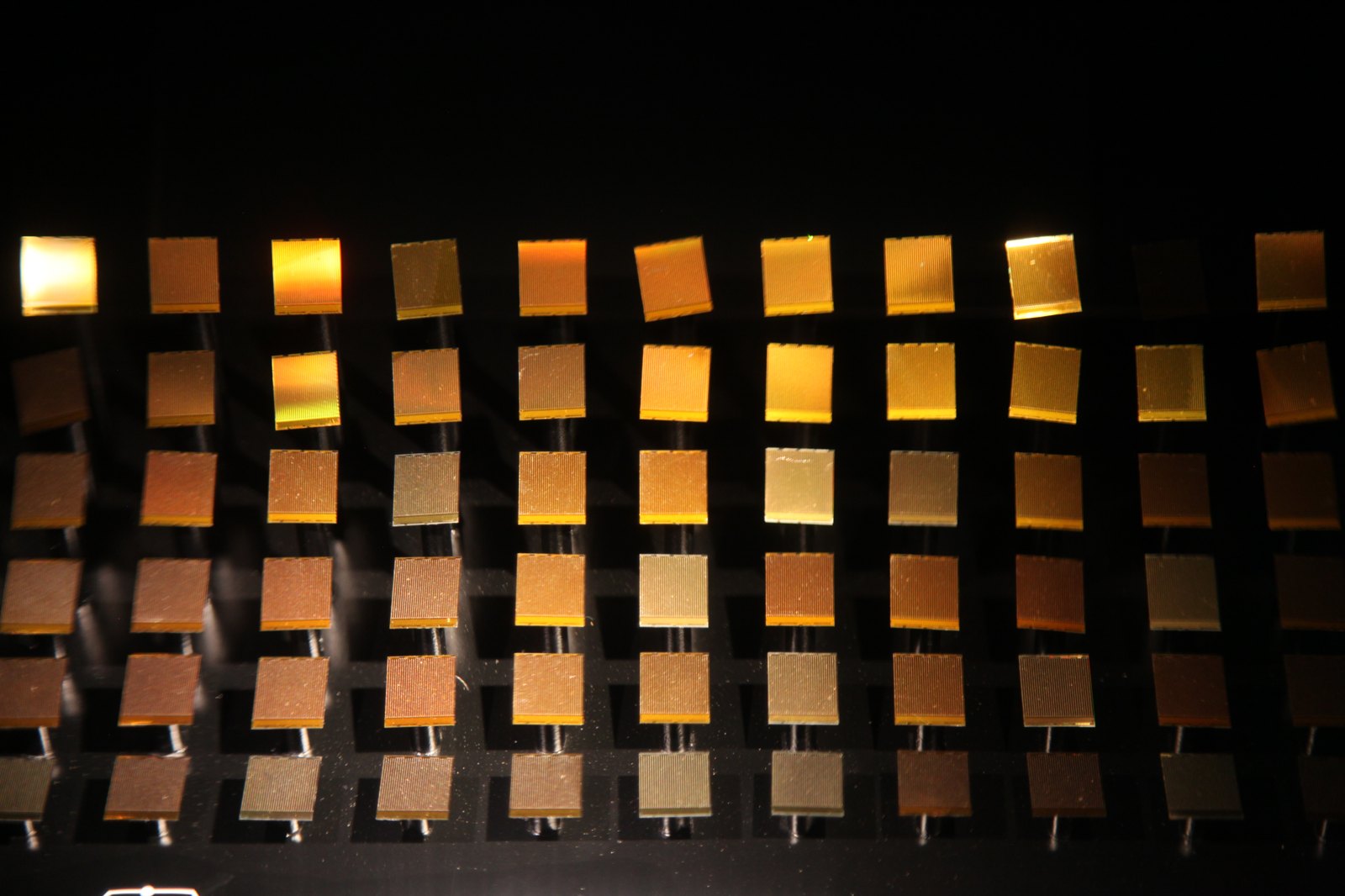
At the heart of the upgrade sits the Vertex Locator, or VELO. This silicon pixel detector was assembled by researchers at the University of Liverpool. It sits just five millimetres from the LHC beams, forming the first layer of the tracking system. Its job is to reconstruct the paths of particles emerging from collisions with extreme precision, pinpointing exactly where short-lived particles like the B⁰ meson decay. UK teams, funded by the Science and Technology Facilities Council, provided the largest contribution to the upgraded detector.
Researchers at the University of Manchester also developed advanced detector technology, including precision silicon detectors, to handle the high collision rates. Professor Chris Parkes of the University of Manchester leads the international LHCb collaboration.
What the Data Shows
The analysis combined the new 2024 and 2025 data with earlier runs from 2011 to 2018. Using improved particle identification and machine-learning techniques, the team isolated candidate Bd to mu mu events from the overwhelming background of other collisions.
The result carries a statistical significance of 3.2 sigma. In particle physics, that counts as the first evidence of a process but falls short of the five-sigma gold standard required to claim a formal discovery. The measurement agrees with Standard Model predictions.
As a by-product, the same analysis delivered the most precise measurements yet of a related rare decay, Bs to mu mu, which LHCb first observed in 2015. Together, the two measurements allow physicists to test the Standard Model with greater precision than before.
Probing the Zeptoverse
The result pushes experimental reach into what physicists call the Zeptoverse — distance scales around one zeptometre, or a billionth of a trillionth of a metre. That is roughly 100 billion times smaller than an atom. At these scales, the LHC does not take pictures. Instead, physicists use the measured rates of rare decays to infer the influence of particles or forces too heavy or too feeble to be produced directly.
If future, more precise measurements show the Bd to mu mu rate deviating from the Standard Model prediction, it would signal new physics — perhaps unknown particles or forces that could help explain mysteries such as dark matter. Professor Brian Cox of the University of Manchester, who was not involved in the experiment, described the result as a beautiful example of how science advances, noting that occasionally we see something we do not understand and progress follows.
Next Steps
The collaboration will continue taking data with the upgraded detector. The goal is to accumulate enough statistics to push the significance past five sigma and to measure the decay rate precisely enough to test the Standard Model at the Zeptoverse scale.
Sources
- Into the "Zeptoverse": CERN Experiments Detect Evidence of Something So Rare It Could Potentially Reveal New Forces of Nature
- Scientists find evidence of rarest particle decay after 42-years
- Liverpool physicists help uncover evidence of rarest particle decay after 42-year search – University of Liverpool News
- Micah Hanks
- Scientists Detect Signals From Matter 100 Billion Times Smaller Than an Atom at CERN – Lapaas Voice
Photo: Chris Mitchell (CC BY-SA 4.0)