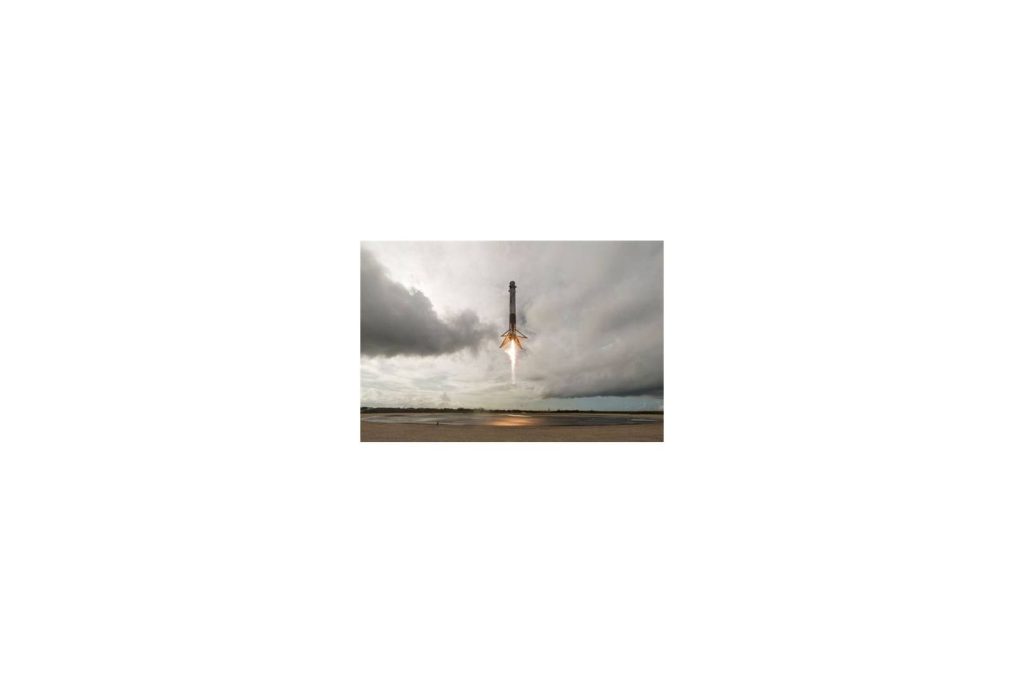
The footage Xinhua released is short. A rocket stage drops toward a ship off Hainan, hooks first, and then it stops, hanging in a web of taut cables. About six minutes had passed since the stage split from the rest of the Long March-10B.
That was July 10, the rocket’s debut flight, and it made China the second country to recover an orbital-class booster, after the United States. It lifted off from the Hainan Commercial Space Launch Site in Wenchang at 12:15 p.m. local time and carried a satellite to its target orbit. The China Aerospace Science and Technology Corporation (CASC) said the satellite reached “its predetermined orbit” but gave no details about it.
Hooks where SpaceX has legs
On the ground, the comparison people reached for was SpaceX, and the differences are easy to see. A Falcon 9 comes down on four fold-out legs, onto a pad or a droneship. SpaceX has landed orbital rockets more than 600 times, according to Space.com, and flies the Falcon 9 around 150 times a year. Blue Origin’s New Glenn, which first landed a booster in November 2025, also uses legs.
The Long March-10B has none. Four arresting hooks on the rocket’s body snag a net laid out in a grid across a recovery vessel called Linghangzhe, roughly “the Navigator.” A cable system with hydraulic damping bleeds off the downward momentum, auxiliary cables steady the stage against wind and waves, and an automated platform locks it in for the trip back to shore. One account likened it to a jet catching an arrestor wire on a carrier deck.
Weight is the reason. Legs ride all the way to orbit and work for a few seconds at the end. Chen Muye, a CALT expert, told state media that net recovery simplifies the booster’s structure, cuts its mass and raises its payload capacity. A wide net also forgives a landing that is slightly off target, which counts at sea, where wind and waves make a pinpoint touchdown harder.
One catch is not a fleet
The rocket stands about 63 meters tall and 5 meters wide, was built by the China Academy of Launch Vehicle Technology (CALT), and can lift about 16 tonnes to low Earth orbit in reusable mode. Two earlier Chinese attempts at landings on legs, by LandSpace and by a state team, failed within the past year.
Reaction online was loud. Space entrepreneur Martin Varsavsky said the US monopoly on affordable reusability was dead. Analyst Shanaka Anslem Perera was more careful: one flight did not dethrone SpaceX, he said, but it undercut the idea that there is a single way back from space.
The real test is a second flight. China says it plans to refly the recovered first stage before the end of the year. Until then, the sea-based net catch has worked exactly once.
The money chasing this market is large. This week Goldman Sachs raised its projection for satellites launched to low-Earth orbit in 2031 to 305,000, from an earlier estimate of 42,000, driven mainly by space-based data centres rather than satellite internet.
Sources
- China's Long March-10B rocket recovery shakes up space race
- Net vs. Legs: How China's Long March-10B Rocket Landing Is Different From SpaceX's Falcon 9
- Making history! China lands rocket during an orbital launch for 1st time ever (video)