
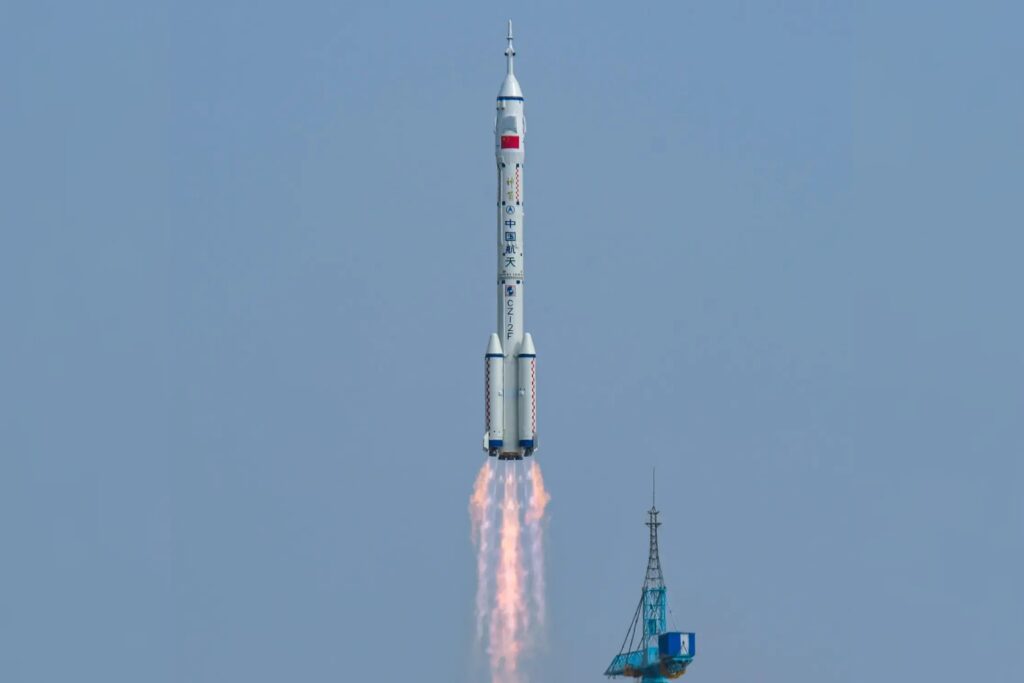
The Long March 10B left the pad at the Hainan commercial space launch site at 12:15 pm Beijing time on July 10, 2026. It put its satellite into the designated orbit. Then its first stage came back down and was recovered, which is why the economics of Chinese launches are now being discussed alongside the history.
The recovery happened roughly six minutes after the first and second stages separated. The booster made a controlled vertical descent and was caught by a net-based capture system on an offshore platform more than 300 kilometers from the launch site. The Global Times described it as China’s first successful controlled recovery of a launch vehicle’s first stage, and the world’s first net-based recovery of a launch vehicle. The 10B is now China’s first reusable launch vehicle to complete a recovery mission.
A name with a history
The rocket family carries the name of the Red Army’s trek of 1934 to 1936. Han Houjian, who worked on the overall design of the Long March-1, recalled the reasoning in remarks carried by Xinhua: “Naming the launch vehicle ‘Long March’ meant that, like the Red Army on the Long March, it would overcome every difficulty and ultimately achieve victory.”
Long Lehao, an academician of the Chinese Academy of Engineering and a launch vehicle expert at China Aerospace Science and Technology Corporation (CASC), told a media briefing on September 21 that the name came from a proposal by Qian Xuesen on May 31, 1966. Qian saw rocket development as a new Long March toward the stars.
The first launch came on April 24, 1970. A Long March-1 carried Dongfanghong-1, China’s first artificial satellite, into orbit. Xinhua reported that development began in the 1960s, when the country’s industrial base was weak and access to key technologies was tightly restricted from abroad.
From one satellite to 41
Long said the family has gone from carrying a single satellite at a time to deploying 41 in one mission. It has widened the range of spacecraft it can launch and has moved from expendable vehicles toward reusable designs.
On October 10, a Long March-12 placed the 27th batch of low-Earth orbit internet satellites into their planned orbit. Xinhua counted it as the family’s 671st launch.
Two flights this year show where the program is heading. On June 1, a Long March-12B flew for the first time from a commercial launch pad in the Dongfeng Commercial Aerospace Innovation Pilot Zone and delivered the 10th constellation of Qianfan satellites. Science and Technology Daily said the reusable rocket has a single core stage about four meters in diameter and is meant for commercial demand, including large internet constellations. Its development stresses performance, safety, efficiency and lower costs, the paper reported.
The 10B flight followed on July 10.
What comes next
Wang Yanan, editor-in-chief of Aerospace Knowledge magazine in Beijing, told the Global Times that today’s Long March rockets differ greatly from those of decades ago. Future versions will have to be larger and more capable, he said, to support more frequent launches, heavier payloads and a more sustainable launch program.
He compared the situation to the original march: reaching northern Shaanxi did not end the revolution, and each rocket milestone is likewise a stop on a continuing route. China’s wider space plans, he said, call for reusable, heavier and more advanced models.
Kang Guohua, a professor of aerospace engineering at Nanjing University of Aeronautics and Astronautics, argued that the program has repeatedly had to find a way through outside restrictions. He pointed to BeiDou and the country’s own space station as examples, and said the Long March rockets carried that effort forward.
Wang looked further out. “Reaching orbit is only stage one in humanity’s exploration of space, our journey will continue to other planets and deeper into the universe,” he said.




