
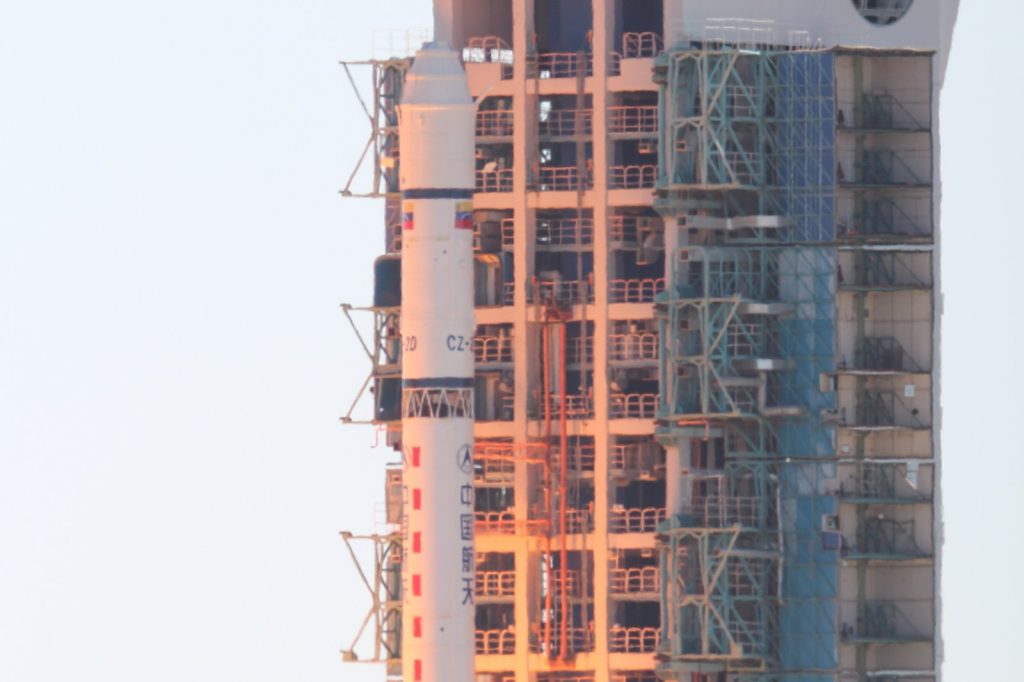
Engine Design and Technical Capabilities
The YF-100K delivers 120 tons of thrust at sea level and 130 tons in a vacuum, with specific impulse figures of 300 seconds at sea level and 335 seconds in vacuum. Its design employs an oxidizer-rich staged combustion cycle — the same basic architecture used in the Russian RD-180 engine. The engine has a dry mass of approximately 1.2 metric tons, a length of 3.5 meters, and incorporates a gimbal system for thrust vector control with a range of plus or minus 5 degrees. It is manufactured at CASC’s factory in Xi’an, Shaanxi province.
Development of the YF-100K began in 2016. Before its maiden flight, the engine underwent 50 test firings, and CASC has reported a 99 percent success rate in ground tests. The engine’s reliability is considered critical for China’s reusable rocket program. What distinguishes the YF-100K from its predecessor is the addition of features designed specifically for reusability. It includes throttle capability that allows thrust to be reduced to 60 percent for landing burns, and a restart capability that enables multiple ignitions in flight. These features allow the rocket to return to Earth after delivering its payload, a fundamental departure from the expendable launch model that has dominated the industry.
The YF-100K belongs to a family of engines designed for the first stages of China’s newest generation of launch vehicles. This technology evolved from the YF-100, which first flew in 2015 and was built to power the Long March 5, 6, and 7 rockets. Those vehicles replaced older systems to modernize how the Chinese government sends payloads into space. The transition to the YF-100K marks a shift toward reusable spaceflight, with the staged combustion cycle increasing efficiency over earlier designs.
Implications for the Asian Launch Market
The Asian launch market is already crowded. A reusable Long March 10B, powered by the YF-100K, could undercut prices across the board. The ability to reuse the first stage of a rocket dramatically reduces the per-launch cost, since the most expensive components — the engines and the stage structure — are recovered and flown again. For commercial satellite operators and government customers in Asia, lower launch costs could reshape procurement decisions and accelerate access to orbit.
What to watch next is the Long March 10B’s maiden flight. If successful, the YF-100K will be the first Chinese engine to demonstrate orbital reusability. That designation carries weight not just for CASC but for the broader competitive landscape. Every launch provider in the region will need to assess whether their own pricing and technology roadmaps can keep pace with a reusable vehicle that can be flown multiple times. The immediate implications for the broader Asian launch market are clear: a new benchmark for cost and capability is being set.
Role in China’s Broader Rocket Program
The YF-100K is not limited to the Long March 10B. It is also planned for use in the Long March 9 heavy-lift rocket, which is expected to have a lift capacity of 150 metric tons to low Earth orbit. Heavy-lift vehicles of that scale are designed for larger missions that require substantial payload capacity, including space station modules, deep-space probes, and crewed missions beyond low Earth orbit. By developing an engine that can serve both a reusable medium-lift rocket and a heavy-lift launcher, CASC is building a common propulsion system that can streamline production, reduce costs, and simplify logistics across multiple vehicle classes.
The engine uses kerosene and liquid oxygen to create thrust, a propellant combination that offers a favorable balance of performance, cost, and handling safety. The staged combustion cycle recirculates exhaust gases to drive the turbopumps before the propellants are burned in the main combustion chamber, extracting more energy from the fuel and oxidizer than simpler cycle designs. For China’s space program, the YF-100K represents more than a technical upgrade — it is a foundational element of a reusable, cost-competitive
{“@context”: “https://schema.org”, “@type”: “NewsArticle”, “headline”: “China Unveils YF-100K Engine with 130-Ton Vacuum Thrust”, “description”: “Engine Design and Technical Capabilities The YF-100K delivers 120 tons of thrust at sea level and 130 tons in a vacuum, with specific impulse figures…”, “datePublished”: “2026-07-10T09:30:00+00:00”, “author”: {“@type”: “Person”, “name”: “Muhammad Asim”}, “publisher”: {“@type”: “Organization”, “name”: “InfoPulse Today”, “url”: “https://newsfeed.infopulsetoday.com/”}}




