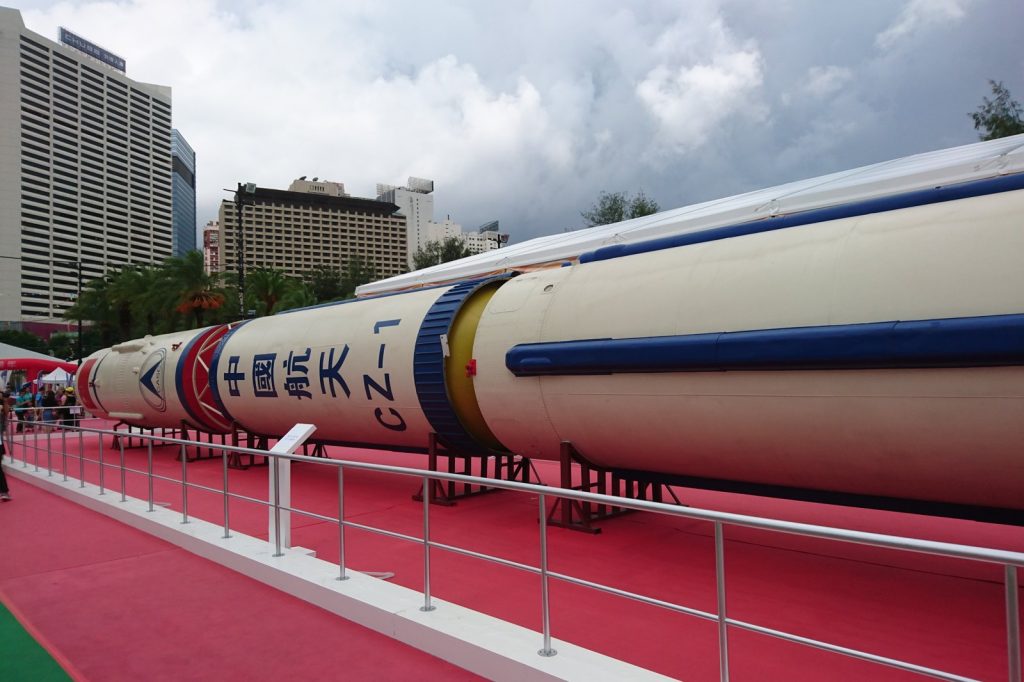
Officials said the Long March 10B lifted off from Hainan at 12:15 pm Beijing time on July 10, 2026, completing its maiden flight and marking China’s first successful controlled recovery of a launch vehicle first stage. The account indicates the first stage descended vertically and was caught by a net-based system on an offshore platform more than 300 kilometres downrange — a world first for net-based recovery.
According to state and international reports, the Long March family traces its name to a 1966 proposal by Qian Xuesen, invoking the Red Army’s 12,500-kilometre trek of 1934-1936. The first launch came on April 24, 1970, when Long March 1 placed Dongfanghong-1 into orbit. That flight followed years of work under difficult conditions, with a weak industrial base and restricted access to foreign technology.
The family has since conducted over 400 launches per Orbital Radar’s September 2026 tally, or 671 per Xinhua’s October count. The progression runs from single-satellite launches to deploying 41 at once. Variants span the Long March 2D (3,500 kg to LEO) through the Long March 5 (25,000 kg), with the 3B serving geostationary transfer orbits. Notable missions include the Chang’e lunar series — Chang’e 5 returned samples in December 2020 — and the Tianwen-1 Mars mission.
Officials said the rockets underpin the BeiDou navigation constellation, the Tiangong space station, and both civilian and military objectives. According to state and international reports, the programme has repeatedly navigated external restrictions, from US technology denials to Western hostility, with BeiDou and the indigenous space station cited as breakthroughs achieved amid barriers.
The account indicates a shift toward reusability. The Long March 12B flew from the Dongfeng commercial zone on June 1, 2026, delivering Qianfan internet satellites. The July 10 Long March 10B recovery demonstrates controlled vertical descent and net capture. Future variants — Long March 9 for deep space and crewed lunar missions, refined Long March 6 and 7 for efficient satellite deployment — aim for more frequent launches, heavier payloads, and a sustainable cadence.
As Wang Yanan of Aerospace Knowledge magazine put it, reaching northern Shaanxi did not end the Chinese revolution; likewise, orbital milestones mark waypoints on a continuing journey. The Long March into space, he added, is not only China’s journey but humanity’s. Kang Guohua of Nanjing University of Aeronautics and Astronautics noted that just as the Red Army fought to break encirclement, China’s space programme has repeatedly found ways through external restrictions.
Sources
- The Long March Rocket Family: A Comprehensive Guide | Orbital Radar
- China’s Long March rockets carry forward historic grit for new space exploration – Global Times