
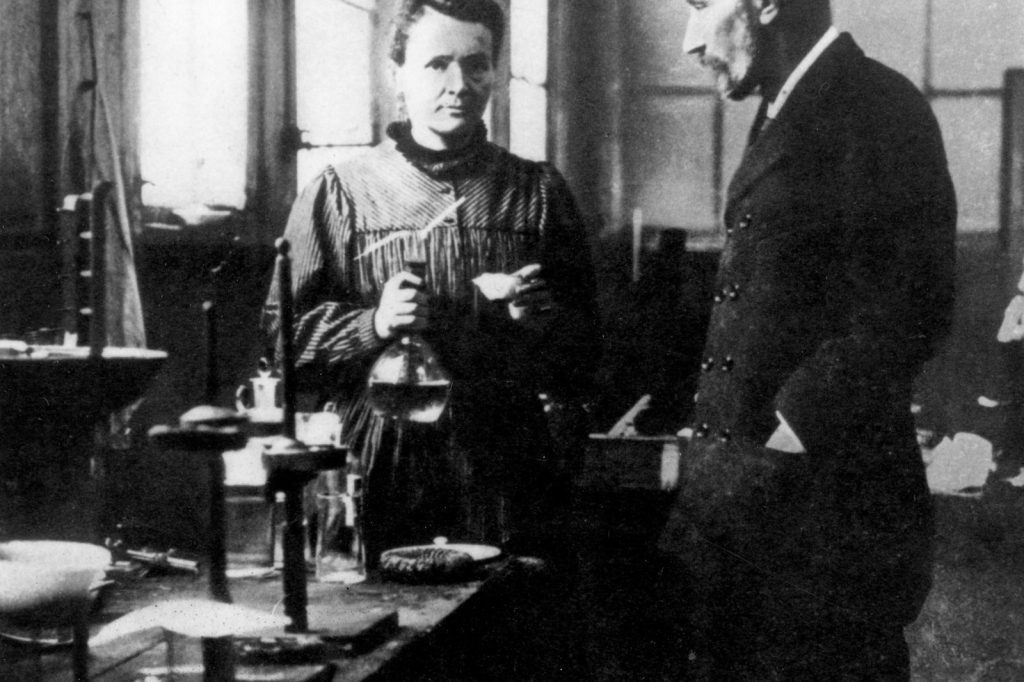
On 4 July 1934, at Sancellemoz in France, Marie Curie died of aplastic anemia, a condition tied to years of radiation exposure in her own laboratories. Nine decades later, the record still reads like an accounting error in her favour: two Nobel Prizes, two new elements, the first professorship at a major European university ever held by a woman.
The origin story explains the discipline. Born Maria Salomea Skłodowska in Warsaw on 7 November 1867, under Russian rule that suppressed Polish culture and barred women from universities, she studied at the Flying University, a secret network of educators working in private homes. To fund an education abroad she struck a bargain with her older sister Bronisława: governess work now, help with study later. She reached Paris in 1891, at 24, and enrolled at the University of Paris, taking first place in the physics degree and second in mathematics while living in poverty.
There she met Pierre Curie, her husband and colleague. The scientific opening had come in 1896, when Henri Becquerel observed the mysterious rays emitted by uranium. The Curies found the mineral pitchblende more radioactive than uranium itself and reasoned it must hold unknown substances; from it they extracted two new elements, polonium, named in 1898 for an occupied Poland that did not exist on the map, and radium. She coined the term radioactivity for the underlying property. The 1903 Nobel Prize in Physics was shared with Pierre and Becquerel, a share of one quarter, and only because Pierre insisted his wife be included after the committee leaned toward the two men.
Widowed in 1906 when Pierre was killed in a street accident, she took over his chair and became the first female professor at the University of Paris. In 1911 came the Chemistry Nobel, cited “in recognition of her services to the advancement of chemistry by the discovery of the elements radium and polonium, by the isolation of radium and the study of the nature and compounds of this remarkable element”. That made her the first person to collect two Nobels, and still the only one to take them in two different sciences.
The applied record is just as long. During World War I she developed the mobile radiography units known as “petites Curies”, trained medical staff to run them and drove one to the front herself; her own estimate ran to over a million soldiers examined. She led the first studies treating tumours with radioactive isotopes and founded Curie Institutes in Paris in 1920 and Warsaw in 1932, both still working research centres. Her notebooks sit in lead-lined boxes, radioactive enough that readers sign a waiver. In 1995 she became the first woman interred in the Panthéon on her own merits. The price was her health; the estate is permanent.
Sources
- Marie Curie – Facts – NobelPrize.org
- Marie Curie (1867–1934) — Biography & Historical Data – HistoryData




