
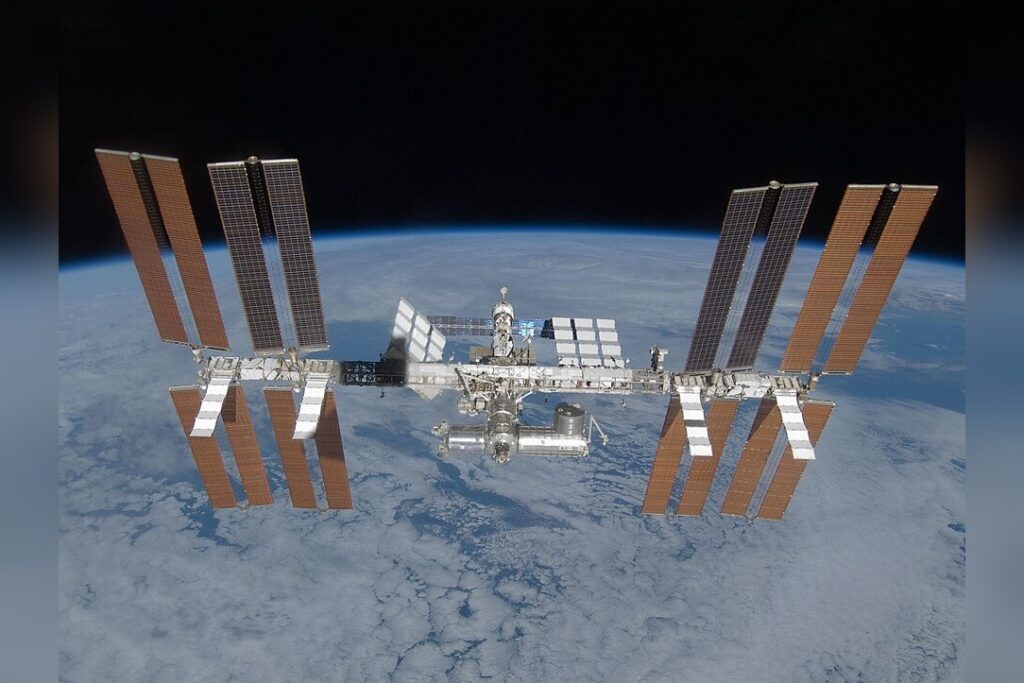
People have now lived in a pressurized can, continuously, for 25 years. The International Space Station, a joint project of NASA, Roscosmos, JAXA, ESA and the Canadian Space Agency, circles at roughly 420 kilometres up, at 28,000 kilometres per hour, tilted at 51.6 degrees so its ground track passes over 90% of the population. Somewhere under that track, a new institutional layer is forming. After a May 19 ASCEND 2026 panel in Washington, D.C., where the ISS National Lab detailed a handful of dedicated centers, on Earth, built to turn decades of station research into medical practice.
“There are things we can learn by exposing biology to the space environment that inform us about new cures, new therapies, and new ways to approach aging and disease here on Earth,” said Michael Roberts, chief scientific officer of the ISS National Lab, who led the session. “[These research centers] see space as a leverage point to increase their knowledge about human physiology…and to help treat disease.”
Three Centers, Three Angles
The Cleveland Clinic went first. Its Space Health Center, established by Kenneth Mayuga earlier in 2026, works on understanding and mitigating what spaceflight does to human health, drawing on a bench of physician scientists. “There are specific challenges in space and if they’re overcome, it can have a very real benefit to patients here on Earth. So my hope, my goal is just to continue that process.” Mayuga said.
Pittsburgh took the astronaut route. Its Trivedi Institute for Space and Global Biomedicine, set up at the University of Pittsburgh in early 2026, is led by founding director Kate Rubins, a retired NASA astronaut who ran experiments on the station herself. “When I left NASA last year, I wanted to build an institute that would fill what I saw was a gap in terms of being able to translate these amazing discoveries that we’re making…and all of this fantastic work the ISS National Lab is doing, and to really think about how that would affect human populations on Earth.” The institute’s job, as she frames it, is foundational science that others can commercialize.
Cedars-Sinai supplies the biology. Arun Sharma, who has run 10 years of ISS studies on microgravity and heart function, directs the Center for Space Medicine Research there, established in 2025, with stem cell work as the technical core. “We may be able to harness low gravity to make stem-cell-derived products…that may not be possible on the ground,” he said, and the hospital runs an on-campus biomanufacturing center to move discoveries along.
From Fringe to Field
The backstory is a decade of attitude change. Space-based stem cell research, once fringe material at conferences, now holds a much more prominent position, and Sharma dated the shift from his own graduate-school presentations. “It’s no longer just one crazy grad student doing a project, it’s multiple teams of stem cell researchers across different disciplines…and not just here in the United States but across the world,” he said.
Under the hood, the field is short of people. All three institutes run workforce programs; Mayuga built a one-week space medicine course with the International Space University, through an ISS National Lab grant, for Ph.D. students, medical students and postdocs. Rubins casts the centers as a cooperative effort rather than a race, and wants a government-led institution as an honest broker for the commercial stations that follow the ISS. “All of this sounds like something that should be government-supported and should be a neutral party because you’ve got government, academia, and commercial.”
Twenty-five years of continuous human presence, as of this year. The centers opened in 2025 and 2026.
Sources
- New Space Medicine Centers Turn ISS Discoveries Into Real-World Healthcare Solutions
- ISS: 25 Years of Continuous Human Presence | Orbital Radar




