
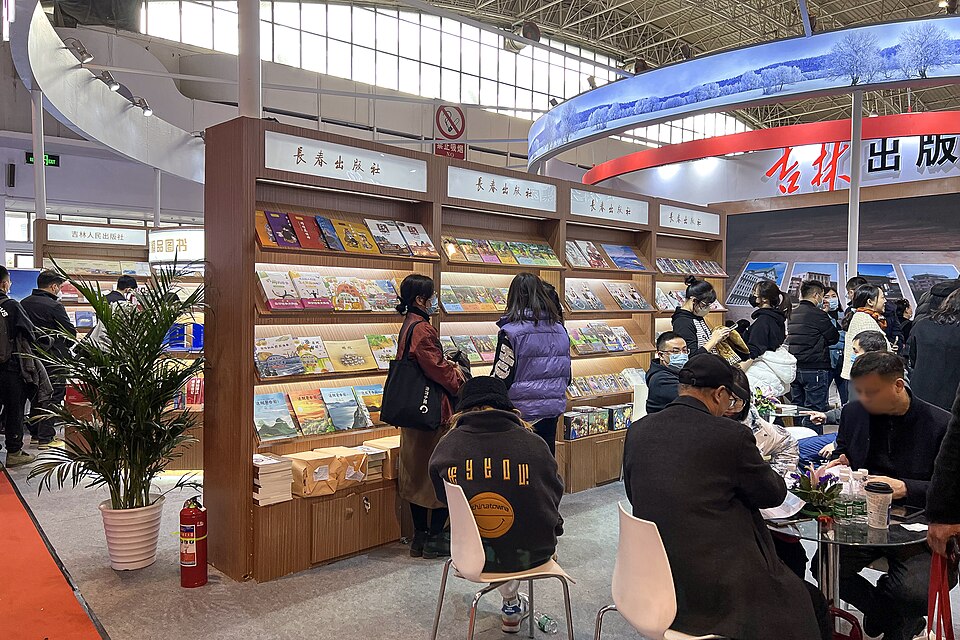
“Publishing is changing fast again and so must we.” The remark came from Lei Jianhua, vice president of CNPIEC, the organiser of the Beijing International Book Fair, ahead of the 32nd edition. It is not the usual mood music for a trade fair, and the programme backed it up. The fair ran from 17 to 21 June at the China National Convention Center, and its stated focus was AI and cross-media licensing of intellectual property.
The scale, notably, was not in doubt. The count was 82 countries and regions and more than 1,700 exhibitors, with around 220,000 titles on show. Chinese media reported ten more participating countries than at the previous edition, 27 joint pavilions for countries and regions, and 26 international publishers making a debut. The first two and a half days were reserved for the trade, with the public admitted from Friday afternoon.
The new corners of the floor
Publishers Weekly pointed to three additions. The first was an IP Licensing Zone, built with the China Toy and Juvenile Products Association and featuring more than 20 companies. The second was a larger BIBF ComicHub, the animation, comic and game sector, which took on newcomers such as Insight Editions of the United States and Comic Republic of Nigeria.
The third was an Internet Publishing Joint Pavilion of 20 exhibitors, set up to show AI-generated content tools and publishing workflow applications. Among the Chinese digital companies represented were NetEase, Tencent, Yuewen and Fanqie Novel, the reading app owned by ByteDance. For all the noise about AI, it would seem the fair’s organisers regard the platforms as part of the book trade now.
The reason is on the retail side. Publishers Weekly cited OpenBook’s 2025 China Retail Book Market Trend Report: content-driven e-commerce, meaning sales pushed by influencers on apps, grew 30.43% year on year and now makes up 40.53% of the retail book market, ahead of online bookstores. On Douyin, book-related uploads more than doubled, and book orders there rose 99%.
Guests and buyers
The United Arab Emirates was guest of honour. According to the state news agency WAM, its “UAE House” pavilion united 29 government, cultural, academic and creative institutions, and the programme included more than 20 panel discussions and forums, plus matchmaking meetings between Emirati and Chinese institutions on translation rights and co-publishing.
The foreign visitors were after rights. Gabor Barta, a Hungarian historian and publisher, said he wanted a partnership on translating Chinese books into Hungarian. Alexei Brov, a Russian publisher, said he came “to buy foreign rights and maybe to sell Russian rights to the Chinese publishers.”
A literature week ran alongside, with sinologists and translators from 17 countries and regions and nearly 100 Chinese writers. Patrizia Liberati, an Italian sinologist, said she has translated almost 20 Chinese works since starting in 2003.
Sources
- Beijing International Book Fair to Focus on AI, IP Licensing – Publishers Weekly
- Global publishers, sinologists seek partnerships at Beijing Int'l Book Fair – Bastille Post (CMG)
- Beijing Book Fair welcomes UAE as Guest of Honour – Sharjah24 (WAM)




