
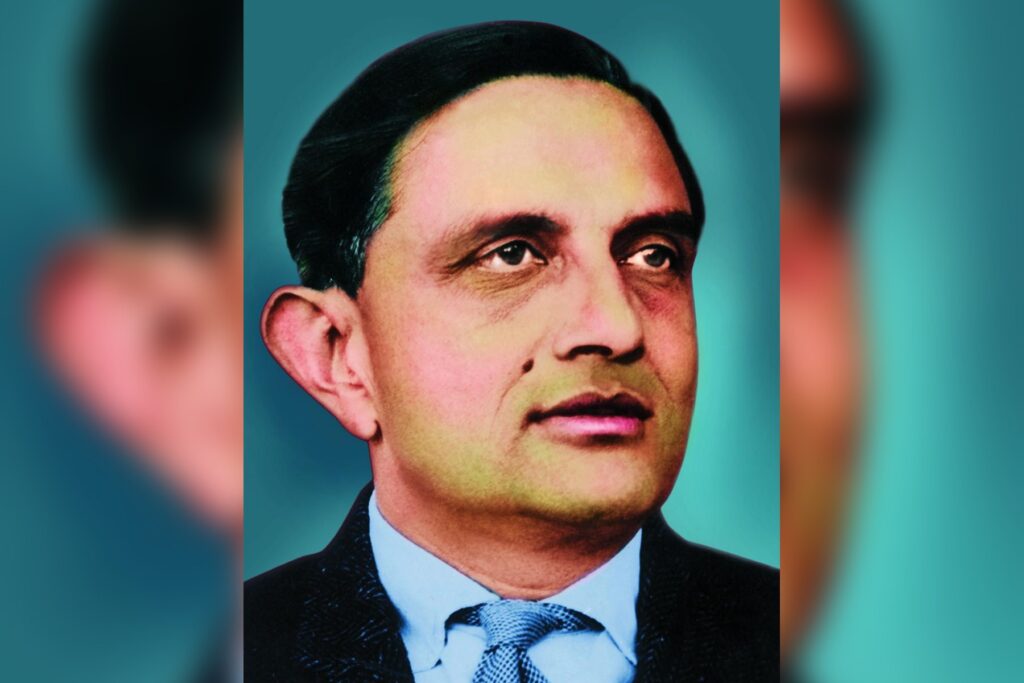
Vikram Sarabhai is remembered in India the way founders of nations are: as the father of India’s space program. Born in Ahmedabad on 12 August 1919 into a wealthy Jain mill-owning family, one of eight children of the industrialist Ambalal Sarabhai, he turned a textile fortune into laboratories, rocket pads and management schools before his death on 30 December 1971 at Kovalam, on the Kerala coast.
The case he made for space, in a poor and newly independent country, remains his signature. After the Russian Sputnik launch he persuaded the government that satellites and rockets served a developing nation directly, and ISRO’s own biography preserves his reasoning in his words: “There are some who question the relevance of space
activities in a developing
nation.” To them he answered, “We do not have the
fantasy of competing with
the economically advanced nations in the exploration of the moon or the
planets or manned
space-flight.” The ambition was pointed elsewhere: India, he insisted, had to excel at putting “advanced technologies
to the real problems of man and society” if it wanted to play “a meaningful
role nationally, and in
the community of nations” at home or abroad.
Thumba and the first rocket
With support from Homi Jehangir Bhabha, the father of India’s nuclear science program, Sarabhai built the country’s first rocket launching station at Thumba, near Thiruvananthapuram on the Arabian Sea. The coastal site was picked chiefly for its proximity to the equator. After a marathon effort to assemble the infrastructure, personnel, communication links and pads, the first flight lifted off on November 21, 1963 carrying a sodium vapour payload.
An empire of institutions
Institutions were the family trade, and Sarabhai practiced it relentlessly. Home again in a newly free India from 1947, he talked charitable trusts linked to his family and friends into endowing a research institute nearby: the Physical Research Laboratory in Ahmedabad, founded on November 11, 1947, when he was 28. He and other Ahmedabad industrialists created the Indian Institute of Management in the same city; he built a Community Science Centre there in 1966, now renamed for him; and a later merger of six of his centres produced the Space Applications Centre. The list runs on through the electronics and uranium corporations, a breeder test reactor at Kalpakkam and a variable energy cyclotron project in Calcutta.
Cosmic rays to chairman
The credentials underneath were scientific. After Gujarat College he went to St. John’s, Cambridge, took his Tripos in natural sciences, and, with the Second World War closing England off, returned to research cosmic rays at the Indian Institute of Science in Bangalore under the Nobel laureate C. V. Raman. A doctorate from Cambridge followed in 1947, and in 1966 he was appointed Chairman of the Atomic Energy Commission. The Indian Space Research Organisation itself took shape under him, formally coming into existence on August 15, 1969.
He did not live to see the harvest. Aryabhata, the first Indian satellite, reached orbit only in 1975, flying from a Russian cosmodrome; the Satellite Instructional Television Experiment he negotiated with NASA in 1966 beamed educational television to villages across July 1975 to July 1976. The honours arrived anyway: the Bhatnagar Award in 1962, the Padma Bhushan in 1966 and, after his death, the Padma Vibhushan in 1972. In 1974 the International Astronomical Union renamed a lunar crater in the Sea of Serenity the Sarabhai Crater, and the Vikram Sarabhai Space Centre at Thiruvananthapuram, where India still builds its rockets, carries his name into every launch.




