A Vertical Bridge Between Eras
The retired Space Shuttle Endeavour now stands vertically at the California Science Center, creating a direct visual link between NASA’s historic government missions and the emerging commercial spaceflight industry.
This installation transforms the orbiter into a bridge connecting two distinct chapters of aerospace history, situated within a new facility that expands the existing museum footprint significantly.
The Engineering of a Legacy Orbiter
Space Shuttle Endeavour is the fifth and final operational orbiter built by NASA, designated as Orbiter Vehicle OV-105.
Following the loss of Space Shuttle Challenger in 1986, the United States Congress approved the construction of a replacement vehicle to continue critical missions.
NASA chose to build much of Endeavour from spare parts rather than refitting the Enterprise prototype due to cost grounds, utilizing structural spares built during the construction of Discovery and Atlantis.
The orbiter was assembled in July 1990 and rolled out in April 1991 after a national competition for schools selected its name based on HMS Endeavour, the Royal Navy ship that took Captain James Cook on his first voyage of discovery.
Endeavour cost $1.7 billion to build and was delivered by Rockwell International Space Transportation Systems Division in May 1991 before launching its first mission, STS-49, a year later.
The shuttle completed its 25th and final mission, STS-134, in May 2011, after which it was retired from active service.
A New Facility for Public Engagement
Construction of the new Samuel Oschin Air and Space Center building was completed through a public-private partnership with investments from the Newsom administration and the Legislature.
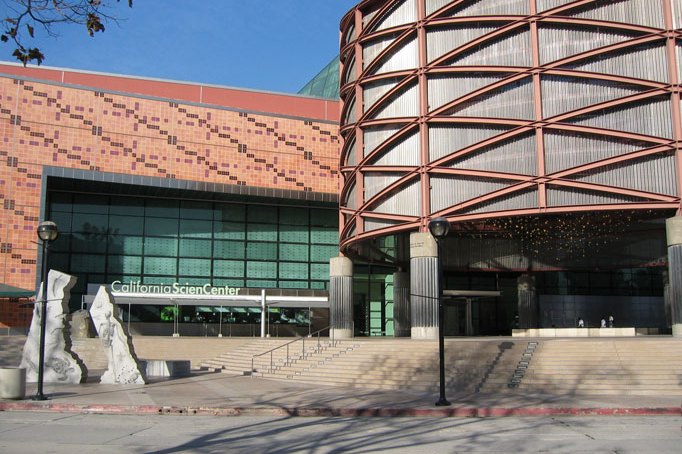
The expansion adds roughly 200,000 square feet to the existing facility at state-owned Exposition Park in Los Angeles.
This development is part of a larger $450 million project that turns Southern California’s aerospace legacy into a sprawling, immersive museum experience opening to the public on November 13.
The California Infrastructure and Economic Development Bank began a partnership with the California Science Center Foundation in 2006, issuing an $82 million tax-exempt bond for the Howard F. Ahmanson Building.
Additional bonds issued in 2021 and 2025 provided approximately $145 million and $62 million respectively to help fund construction of the new center.
The installation is described as the world’s first and only authentic display of a space shuttle in launch position, featuring the external tank and twin solid rocket boosters.
This configuration offers an unprecedented opportunity for Californians and visitors globally to experience one of the nation’s most iconic aerospace achievements.
The Science Behind Commercial Spaceflight History
By displaying a retired government orbiter in its launch-ready stance, the center creates a tangible narrative about how spaceflight has evolved from government-led exploration to commercial enterprise.
The region’s history is pivotal here: by the end of World War II, Southern California boasted about two-thirds of the nation’s aircraft companies.
This industrial base later birthed moon-bound Apollo spacecraft and all five Space Shuttle orbiters, including Columbia, Challenger, Discovery, Atlantis, and Endeavour.
NASA’s Jet Propulsion Laboratory in La Cañada Flintridge continues to build and operate many robotic space missions, while SpaceX has forged most of its rockets and spacecraft in Hawthorne.
The juxtaposition of the historic shuttle with exhibits on modern aviation and space exploration allows visitors to trace the trajectory from the Apollo era through the Shuttle program to today’s commercial rockets.
Aviation and space exhibits within the new center offer dozens of fun and educational opportunities, turning the miracle of flight into theater while highlighting the continuity of human ingenuity.
Endeavour’s Vertical Launch Configuration
Endeavour’s new installation at the California Science Center features the retired orbiter in a vertical launch configuration, positioned between its external tank and twin solid rocket boosters. This display marks the world’s first and only authentic presentation of a space shuttle in launch-ready stance. The configuration was made possible through a complex engineering effort to reposition the orbiter vertically within the new Samuel Oschin Air and Space Center. Visitors can now view Endeavour as it appeared on the launch pad, creating a direct visual connection to the final missions of NASA’s Space Shuttle program.
The vertical display includes the external tank and twin solid rocket boosters, components that accompanied Endeavour on its 25 missions. This arrangement provides an unprecedented opportunity for visitors to experience the scale and engineering of the Space Shuttle program. The installation represents a significant transformation of the museum’s existing footprint, adding roughly 200,000 square feet to Exposition Park.
Private Ventures Meet Public Heritage
While the Samuel Oschin Air and Space Center showcases Endeavour’s vertical legacy, the surrounding aerospace landscape reflects a shift toward commercial enterprise. By the end of World War II, Southern California boasted about two-thirds of the nation’s aircraft companies, a foundation that later birthed the Apollo spacecraft and all five Space Shuttle orbiters. Today, that industrial heritage underpins a new era: SpaceX has forged most of its rockets and spacecraft in Hawthorne, continuing the region’s tradition of orbital development. This transition from government-led missions to private orbital flight represents a fundamental change in how humanity reaches space, with the retired shuttle serving as a tangible bridge between the Apollo era and the current commercial launch market.
Governor Newsom’s remarks at the opening underscored this evolution, highlighting California’s unmatched leadership in aerospace and innovation. The state, now the world’s fourth-largest economy, leverages its deep roots in aviation to drive private sector growth. NASA’s Jet Propulsion Laboratory in La Cañada Flintridge continues to build and operate many robotic space missions, creating a dual track of exploration—government-led science from JPL and commercial crew and cargo delivery from companies like SpaceX. The new center’s design explicitly positions Endeavour as a catalyst for this narrative, allowing visitors to trace the trajectory from the Shuttle program’s government origins to the rise of private enterprise shaping the final frontier.
Sources
- Space Shuttle Endeavour
- Governor Newsom highlights California’s out-of-this-world economy at the new Space Shuttle Endeavour installation | Governor of California
- Review: One of the greatest museum artifacts ever is at L.A.'s $450 million Air and Space center
Photo: Richard Kim (CC BY 3.0)