
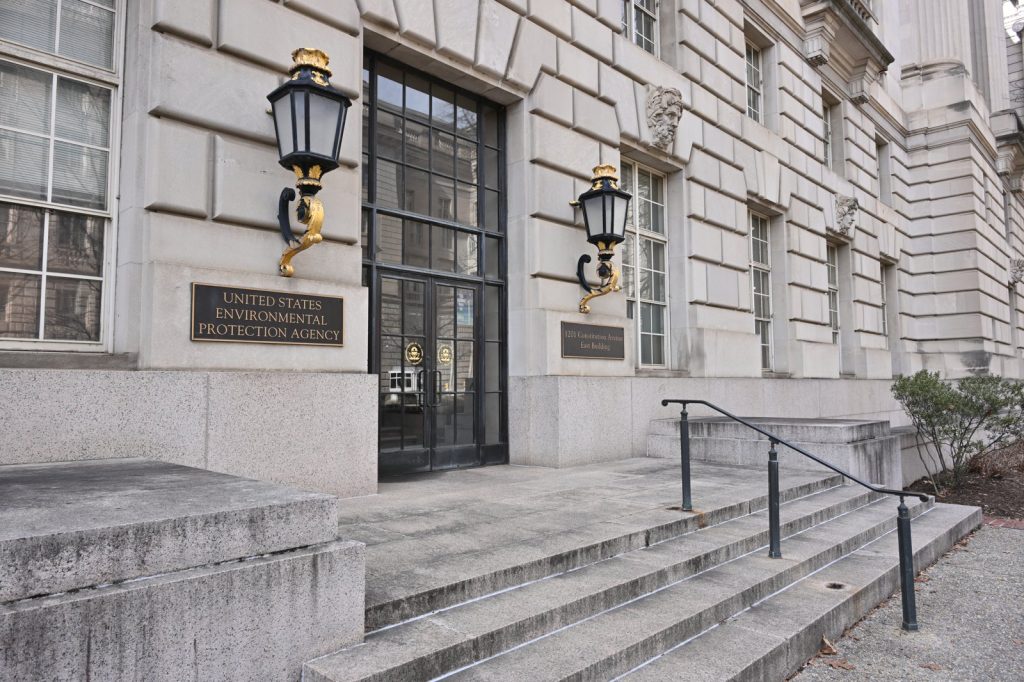
Up to 84,000 premature deaths by 2047, and billions of dollars in healthcare costs. That is the price tag environmental and public health groups put on the Trump administration’s decision to scrap most of the Biden-era limits on greenhouse gas emissions from coal and gas power plants. On Thursday they took the fight to court.
The Natural Resources Defense Council, the American Lung Association, the Environmental Defense Fund, the American Public Health Association, the Clean Air Council and Clean Wisconsin asked the U.S. Court of Appeals for the D.C. Circuit to review the Environmental Protection Agency’s final rule. The agency had announced the repeal days earlier, and it appeared in the Federal Register the same week. It also proposed dropping the remaining greenhouse gas requirements for the plants.
“Repealing these standards without a replacement is an abdication of EPA’s legal responsibility to protect public health and the environment,” said Meredith Hankins, federal climate legal director at the NRDC. She added that the Clean Air Act and Supreme Court precedent require the EPA to address climate pollution from the largest industrial source in the country, and called the agency’s legal reasoning “fatally flawed.”
What the repeal removes
In 2024 the EPA estimated that its tougher standards for coal and gas plants would avoid up to 1,200 premature deaths and 360,000 asthma symptom cases in 2035 alone. It projected a cut of 1.38 billion metric tons of carbon pollution through 2047.
A new Environmental Defense Fund analysis turns that around. Repeal, it estimates, would add 7.5 billion metric tons of climate pollution and cause up to 84,000 premature deaths by 2047.
EPA officials have taken the opposite view of the rule’s costs. They said the change lets utilities make the best decisions for their ratepayers instead of being forced to close aging or inefficient plants. Administrator Lee Zeldin, when he proposed the repeal last year, described it as an end to the Biden and Obama administrations’ “war on so much of our U.S. domestic energy supply.” The agency told Inside Climate News it does not comment on pending litigation and did not answer questions about criticism of the rule.
Where the lawyers see the fight
Lawrence Hafetz, legal director of the Clean Air Council, said the rollback means “millions of Americans will get sicker, face more extreme weather, and pay more for energy and electricity.”
Sean Donahue, who represents the Environmental Defense Fund, pointed to what the EPA chose not to do. It eliminated the standards rather than replace them with weaker ones, he said, which undercuts any claim that this is a technical debate. Frank Sturges of the Clean Air Task Force argued the 2024 rule rested on sound science and law that the repeal never engaged with.
Pat Parenteau of Vermont Law & Graduate School expects the case to turn on whether it has been “adequately demonstrated” that the 2024 requirements, including carbon capture and sequestration, are feasible. Judges, he said, will have to look closely at how far the technology has matured. That is “new territory” for judicial review.
Michael Gerrard, founder of Columbia University’s Sabin Center for Climate Change Law, called the suit “inevitable.” He cited a New York University School of Law study of the first Trump administration, which found it won only 23 percent of challenges to its agency actions, against about 70 percent for earlier administrations. Many of those losses were procedural, Gerrard said, and “they’re not being any more careful this time.”
Sources
- Environmental and Public Health Groups Sue Over the Trump EPA’s Latest Attempt to Bolster Fossil Fuels – Inside Climate News
- Groups Sue EPA Over Power Plant Emissions Rollback




