
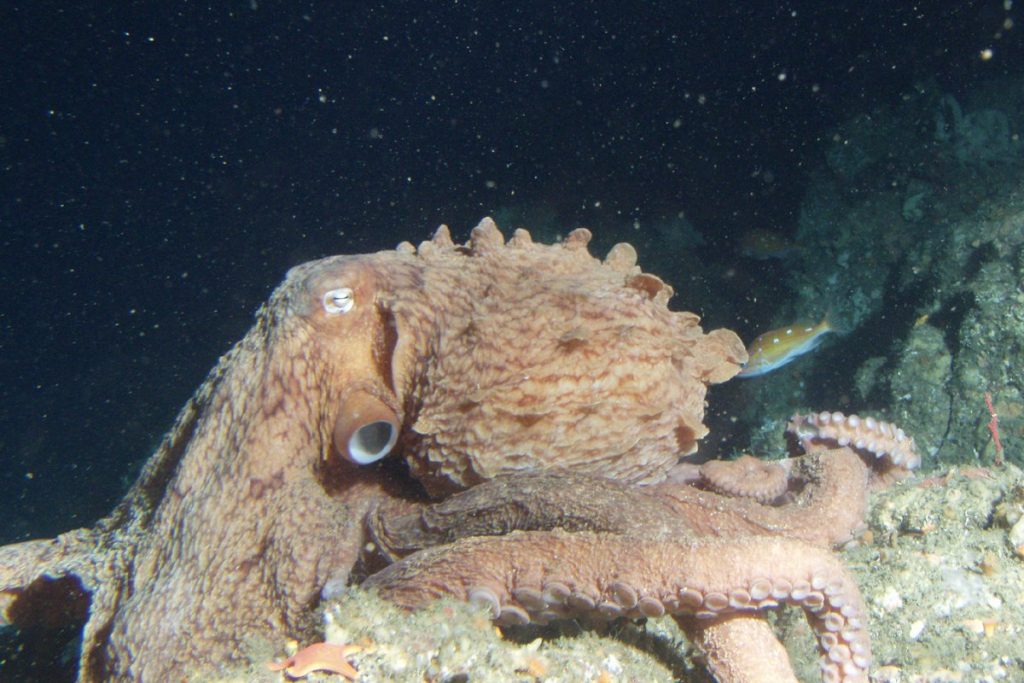
Octopuses leave almost nothing behind when they die. No bones, no shell, just soft tissue that rots away. That is the catch in studying their origins, and it is why a team led by researchers at Hokkaido University went looking for jaws instead.
The strategy worked. Writing in Science on April 23, 2026, the group described fossil jaws from Late Cretaceous rock, dated between 100 and 72 million years ago. Some came from Japan, some from Vancouver Island, both places where calm seafloor conditions preserved fine detail. Finding them took high-resolution grinding tomography and an artificial intelligence model, which picked the jaws out of rock samples that would otherwise have hidden them.
What the jaws show
The specimens belong to Cirrata, an extinct group of finned octopuses. Their size, shape and surface wear point to active hunters that could crush hard prey.
The wear is the mechanism that matters here. According to Professor Yasuhiro Iba, the damage was the most surprising part: chipping, scratching, cracking and polishing across the jaws. In well-grown specimens, he said, up to 10% of the jaw tip, measured against the whole jaw length, had been worn away. That is “larger than that seen in modern cephalopods that feed on hard-shelled prey.”
His reading: “repeated, forceful interactions with their prey.” The animals were not scavenging.
On size, Iba said the jaws indicate total lengths of up to nearly 20 meters, “which may have surpassed the size of large marine reptiles of the same age.” The word to watch is “may”. The estimate is built from jaws alone.
Older than thought
The finds extend the earliest known record of finned octopuses by about 15 million years. The overall octopus timeline moves back by around 5 million years, putting their origins at roughly 100 million years ago.
There is also a hint about behavior. In both species studied, one side of the biting surface was more worn than the other. That suggests a preference for one side of the jaw, called lateralization, which in modern animals goes with advanced brain function. The authors raise the possibility of complex, intelligence-related behavior, though they stop short of proving it.
Rewriting the hierarchy
The usual account of ancient seas gives the top spots to vertebrate predators and treats invertebrates as minor players. This study argues giant octopuses were an exception that competed directly with large vertebrates.
Iba called it “the first direct evidence that invertebrates could evolve into giant, intelligent apex predators in ecosystems that have been dominated by vertebrates for about 400 million years.” Powerful jaws and the loss of superficial skeletons, he said, were essential to reaching that scale.
The paper’s authors also see a payoff in the technique. Pairing digital fossil-mining with artificial intelligence could turn up many more hidden fossils and allow far more detailed reconstructions of ancient ecosystems.




