
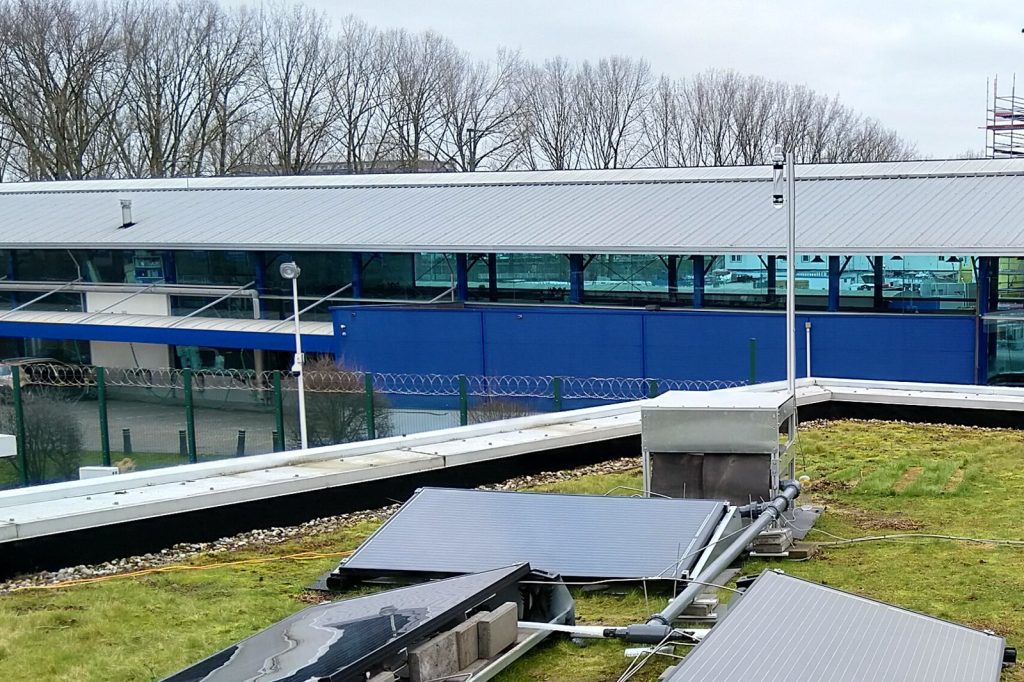
The test rig is small: a lens covering just 64 square centimeters. Set up outdoors, it turned up to 31.3 percent of the sunlight hitting it into chemical energy stored in hydrogen. Researchers at the Fraunhofer Institute for Solar Energy Systems ISE in Freiburg announced the result on June 29, 2026, and called it a new record.
“Our new record shows that hydrogen can be produced very efficiently directly from sunlight,” said Frank Dimroth, head of the institute’s III-V Photovoltaics and Concentrator Technology Department.
How the module works
Most solar hydrogen setups pass the electricity through converters between the panel and the electrolyzer. The Fraunhofer team skipped that step. A Fresnel lens array focuses direct sunlight onto III-V solar cells, which the institute describes as the most efficient solar cells in the world. Until now they have mostly flown in space. In this module their open-circuit voltage is over 4 volts.
Project manager Juan Francisco Martinez Sanchez explained the choice of concentrating photovoltaics, which use lenses rather than ordinary flat panels. Tom Smolinka, who heads the institute’s membrane electrolysis department, described the wiring. The solar cells connect straight to the cathode and anode of two PEM electrolysis cells in series, which gives what he called a perfect match between the electrical characteristics of the two parts.
The result, in Smolinka’s account, is that the power goes into making hydrogen without detours and without losses. The 31.3 percent figure is measured against the higher heating value of hydrogen.
Early days
This is a proof of concept, and the team says so. “Development is still in its early stages, and it’s hard to say how quickly we’ll be able to achieve competitive systems,” Dimroth said. The researchers think concentrating systems could make the approach economical for use on the ground, and they say the results show what integrated photovoltaic-electrolysis systems can do for green hydrogen.
The institute has also published a research paper on the work, titled “Photovoltaic water electrolysis reaching 31.3% solar-to-H2 conversion efficiency under outdoor operating conditions.” To push the concept further, Fraunhofer ISE is looking for investors in a planned spin-off called Clearsun Energy.
Sources
- New solar hydrogen module achieves 31.3% sunlight-to-hydrogen efficiency
- Efficient Production of Solar Hydrogen Through Direct Coupling of Concentrating Solar Cells and Electrolyzer – Fraunhofer ISE




