
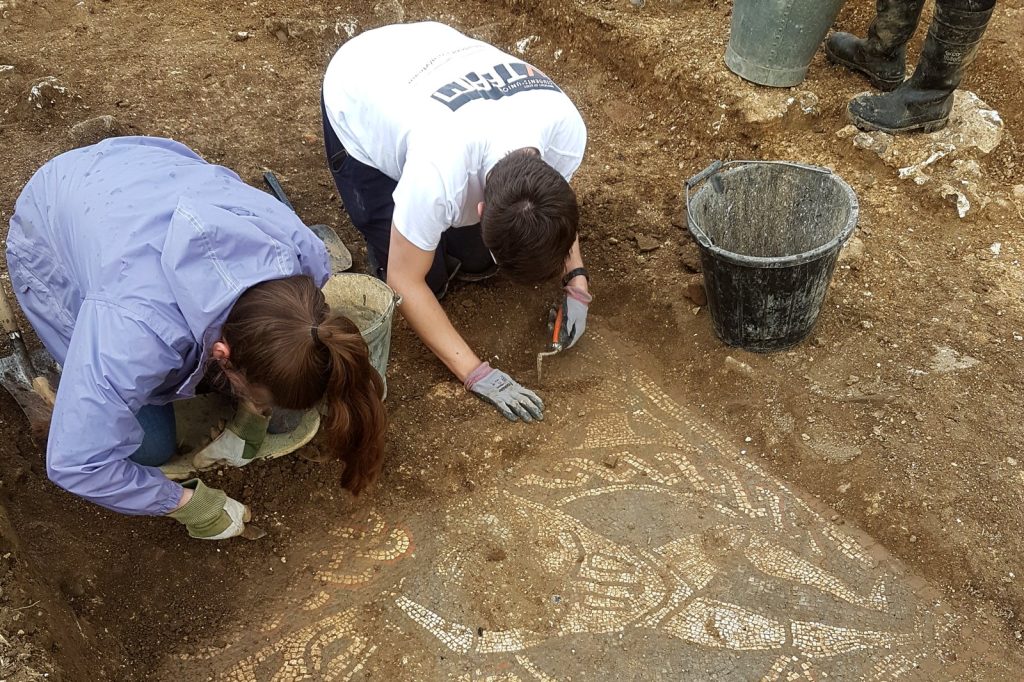
SPOLETO, Italy — The basketball games will stop. That much is certain. What happens next at Liceo Classico Pontano Sansi high school is anyone’s guess, because the gym floor now opens onto a fourth-century Roman villa of a quality that has stunned even the archaeologists who knew Roman ruins lay somewhere beneath this town.
Workers broke through the concrete last week. What they found was not the usual scatter of broken pottery and foundation stones.
It was a sprawling complex of rooms, mosaic floors, and wall frescoes, all intact. The mosaics show scenes from classical mythology, their tesserae still holding color. The frescoes in what appears to be a reception hall depict garden scenes so detailed that botanists have been called in to identify the plants.
That level of preservation is rare. That it happened under a mid-century gymnasium floor is something else.
The statues are the real prize. Several marble figures have been recovered so far, all deliberately buried face down. That positioning is what saved them.
For centuries, looters and builders recycled Roman stone into new construction. Everything above ground got taken, broken, burned for lime. But these statues were hidden.
By whom is not yet clear. The villa’s last owners may have done it.
Someone else entirely may have done it. That mystery is part of what makes the site so compelling to the archaeologists now working the site under the direction of Dr. Elena Marchetti. “We knew this area had Roman ruins,” Marchetti said.
“But nothing prepared us for what was under the gym. The statues alone are a major find.” By Tuesday night, the excavation had pushed beyond the gymnasium floor into the school courtyard.
Students watched from classroom windows as archaeologists carefully brushed dirt from a marble foot, then a hand, then the face of a goddess. That image — teenagers in school uniforms staring down at a buried goddess emerging from the earth — captures the stakes of this discovery. The site sits directly under a functioning school.
The gym floor rattles every afternoon under the feet of students playing basketball. Nobody paid much attention for decades. Now the ground has given up a secret it held for nearly two thousand years.
The villa dates to the fourth century A.D. That is a late date for a Roman villa of this quality.
The empire was already fracturing. The craftsmanship here is extraordinary. That combination — late date, high quality, perfect preservation — makes the site archaeologically significant in a way that a more typical ruin would not be.
It suggests that the old story of decline and fall is too simple. Someone in Spoleto, in the fourth century, was still commissioning elaborate mosaic floors and detailed frescoes.
Someone was still wealthy enough to own multiple marble statues. And someone, perhaps in a panic as the empire collapsed around them, buried those statues face down in the hope that they would survive. They did.
Nearly two thousand years later, high school students are watching them come back into the light. The question now is what the school does about it. The gym is gone.
The courtyard is gone. The excavation is expanding.
The site will have to be preserved, studied, possibly opened to the public. That means the school will have to change. The basketball games will not come back.
What replaces them is still being uncovered, brushstroke by brushstroke, in the dirt beneath the classroom windows.
{“@context”: “https://schema.org”, “@type”: “NewsArticle”, “headline”: “Gym floor in Italian high school reveals intact Roman villa beneath”, “description”: “SPOLETO, Italy — The basketball games will stop. That much is certain. What happens next at Liceo Classico Pontano Sansi high school is anyone’s guess,…”, “datePublished”: “2026-06-26T16:35:00+00:00T09:30:00+00:00”, “author”: {“@type”: “Person”, “name”: “Dmitry Volkov”}, “publisher”: {“@type”: “Organization”, “name”: “InfoPulse Today”, “url”: “https://newsfeed.infopulsetoday.com/”}}




