
Closer to home, even the faraway has a rhythm families can mark on a calendar. At 5:16:07 a.m. Eastern on November 18, NASA’s Voyager 1 becomes the first craft to reach a distance of one light-day from Earth: 25.9 billion kilometers out, over four times the sun-to-Pluto distance. From that moment, a command sent from Earth needs a full day to arrive, and the answer needs another day to come back. The aging probe, launched in 1977 weeks ahead of its twin, has been the farthest human-built object since it passed Pioneer 10 in 1998, and the milestone it is about to pass is the frontier this piece is about: the heliopause, the invisible boundary where the sun’s influence ends.
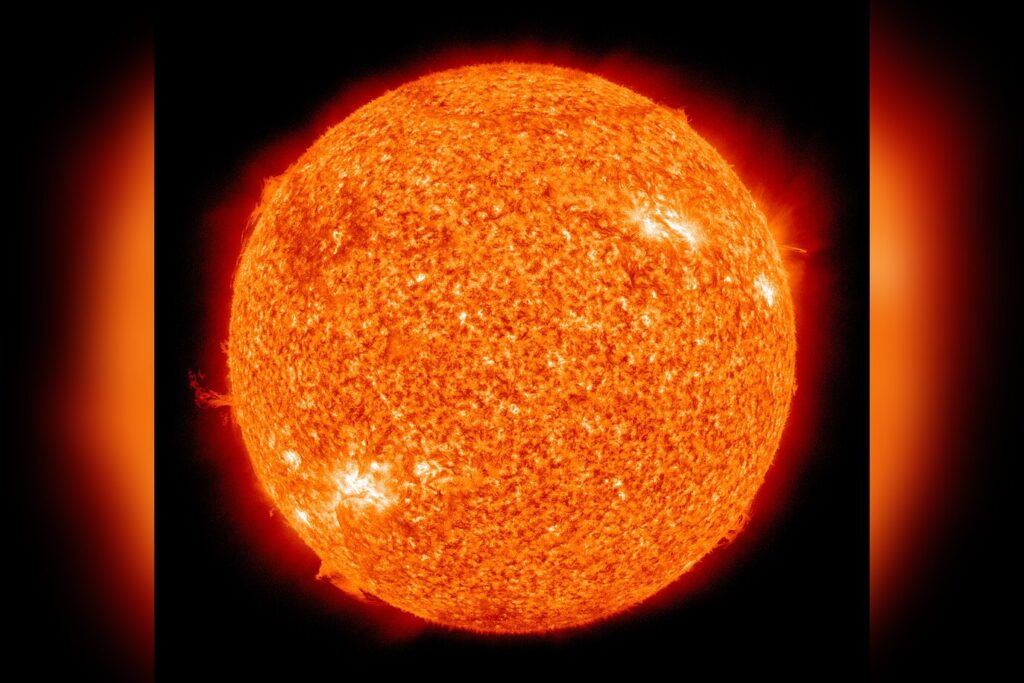
The mechanism is simple enough to explain at a kitchen table. The sun constantly blows a stream of charged particles, moving at 300 to 700 kilometers per second, and that wind carves a bubble around the solar system, the heliosphere, which shields the planets from cosmic radiation. Far out, the wind meets the thin gas between the stars and slows abruptly at the termination shock, then compresses through a hot, dense heliosheath until, at the heliopause, the pressure of the two sides balances and the solar wind turns back. By the guide figures, that boundary sits about 123 AU from the sun, roughly 18 billion kilometers, and it moves: as one European Space Agency scientist put it, “the distance of the heliopause from the Sun changes as the heliosphere breathes in and out on the timescale of the solar cycle.”
Voyager 1 crossed it on August 25, 2012, and knowing even that took a year of detective work. The instruments showed the signposts, a jump in galactic cosmic rays and a collapse in solar particles, but the magnetic field readings looked unchanged, and the plasma instrument that could have settled the matter had died. The lucky break came in April 2013, when a solar eruption sent a pressure wave outward that set electrons around the probe vibrating, letting scientists measure the density and confirm the crossing, at about 120 times Earth’s distance from the sun. Voyager 2 followed through the boundary in 2018. “This is the beginning of a new era of exploration for us”, the mission’s founding scientist Ed Stone said at the time.
What lies beyond is quieter, and stranger. Particle speeds and gas temperatures drop, the magnetic field weakens, and dust is about half as abundant as inside the bubble. Since four unexplained spikes in field strength and particle density that ended in mid-2020, the readings have stayed high, and no one knows why. The border itself is fuzzy: “this boundary is not very sharp or very thin”, says physicist Jeewoo Park of NASA’s Goddard Space Flight Center, and scientists still argue whether the whole heliosphere is shaped like a comet, a sphere or a croissant, a question the IBEX and IMAP space telescopes may yet answer.
The people carry the story as much as the physics. Linda Spilker, now Voyager head scientist at the Jet Propulsion Laboratory, was at the first launch in 1977 and planned her children’s births around mission milestones; “I just never imagined [the mission] would last that long”, she says, and “Voyager, to this day, is a multi-generational mission”. Physicist Jamie Rankin started her doctorate the very month Voyager 1 crossed over, and her view of the daily data is plain: “Every piece of data, every day that goes by that we get data from the Voyagers, tells us something new”, because “Every day, it’s in places nobody’s ever explored before.”
The mission’s earlier chapters gave the world the volcanoes of Jupiter’s moon Io, first images of Uranus’s and Neptune’s rings, erupting geysers on Triton, and, in 1990, the family portrait of the planets in which Earth hung, faintly, as a pale blue dot. The power sources will fade in 10 to 15 years, and the conversation will end, but the journey goes on, toward the stars. What it means for people, generations onward, was best said by Carl Sagan about that last image: “Everyone you love, everyone you know, everyone you ever heard of, every human being who ever was, lived out their lives … on a mote of dust suspended in a sunbeam”. A boundary marked by a lonely probe is also, in his telling, the far mirror in which the whole species, every family included, can see itself whole.
Sources
- The Heliopause: Everything You Need To Know Guide – The Planets
- Voyager 1 is now one light-day from Earth. What’s out there?
Sources
- Studying the Edge of the Sun’s Magnetic Bubble – NASA
- Heliopause — Edge of the Sun’s Heliosphere | Universe Map




