
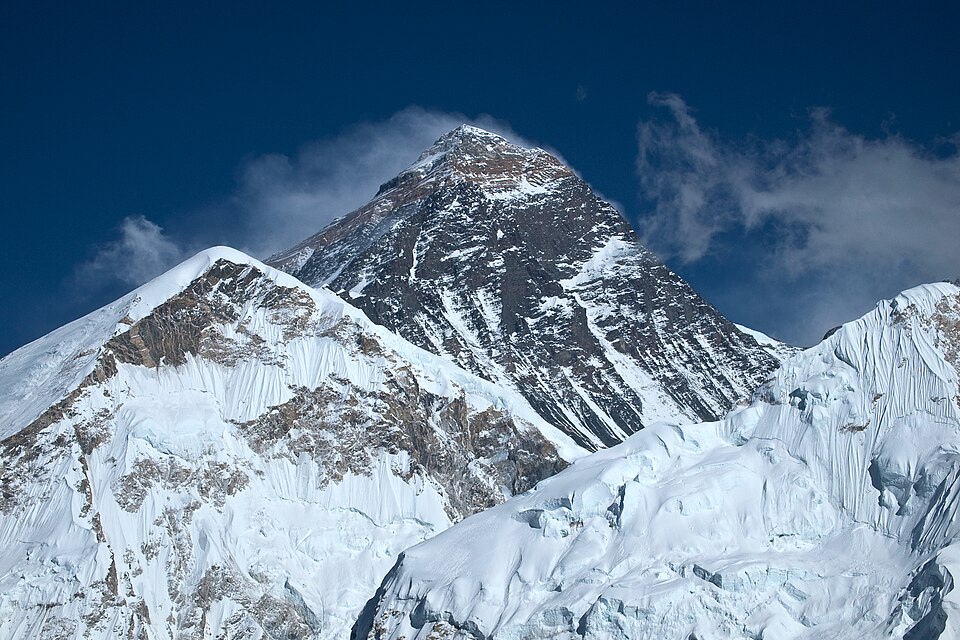
The mud tsunami that tore through Nepal in late August 2026 has pulled the region’s slow-moving crisis into plain view. Thousands of people remain missing and the death toll keeps climbing. Dozens of bridges are gone, vast stretches of road erased, and rescue crews are fighting terrain that gets harder the deeper they push into the Himalayas.
Beneath the immediate disaster sits a structural one. The Himalaya, Karakoram and Hindu Kush ranges together hold more than 55,000 glaciers, more ice and snow than anywhere outside the poles, which is why the region gets called the “third pole”. It is warming faster than the global average. Glaciers retreat, and the meltwater pools behind walls of loose sediment and rock. Umesh Haritashya, a glacier expert at the University of Dayton working with the international investigation into the disaster, has catalogued 1,466 glacial lakes across the region, most of them formed as temperatures rose through the second half of the 20th century. Their barriers can fail on their own, or an avalanche or rockfall can crash in, sending a displacement wave over the top: a glacial lake outburst flood.
When the glue melts
The second problem is underfoot. Large parts of the Himalayas are permafrost, ground whose moisture stays frozen year-round, and that ice binds mountain slopes together. “The ice plays the role of the glue between the rocks or between the fragments of the rocks”, Haritashya said. Thaw it and the binding is gone, raising the odds of landslides, debris flows and avalanches of rock and ice. Researchers at the Indian Institute of Technology Bhubaneswar concluded this year that a warming climate is pushing the 0 degree Celsius boundary, the line where ground stays solid, higher up the mountains.
What worries scientists most is the cascade. Warming melts glaciers and leaves dents that become lakes; the same warming thaws the permafrost on the slopes above those lakes; then one failure triggers another. The glacier involved in the late-August disaster sat above 5,000 metres, where ice normally stays frozen all year, and it is too early to say what broke it.
Shifting ground, shifting rain
Thawing ground is already an infrastructure bill. A Chinese study of the Qinghai-Tibet Engineering Corridor found cracked and buckled roads, bridges and foundations losing bearing strength, and damaged pipelines and power infrastructure. Adrian McCallum, a glaciologist and polar engineer at the University of the Sunshine Coast, puts it plainly: frozen ground that builders relied on “becomes part liquid, part solid, part soup”. In his view, “the word permafrost is an inappropriate term because it’s not permanent anymore”. In northern India’s Kinnaur region, researchers have found some permafrost under about a third of villages, and a newly built road toward the India-Tibet border crosses several rock glaciers.
Climate historian Ruth Gamble, speaking from Kathmandu near where the landslip occurred, points to the water cycle. The region is fed by the monsoon from the Bay of Bengal and Arabian Sea, and by a winter cold cycle off Eurasia that lays down the snow. A warmer, more erratic monsoon now drops more rain than snow, in violent bursts rather than soaking drizzle. History gives the change its scale: records she has studied trace outburst floods back to 603 CE. “But they were rare. The people saw them as being rare events. And then what’s happening now is every year there’s more and more.” Scientists estimate roughly 8,340 square kilometres of permafrost were lost between 2002-04 and 2018-20.
For Kathmandu climate activist Shreya KC, the accounting matters as much as the physics: “Climate justice for Nepal means confronting who created this crisis and who is being forced to pay for it”. Haritashya frames the task beyond any one country. “It’s an issue that transcends the boundaries”, he says. The fix, in his words, has to be trans-boundary, not merely Nepali.




