
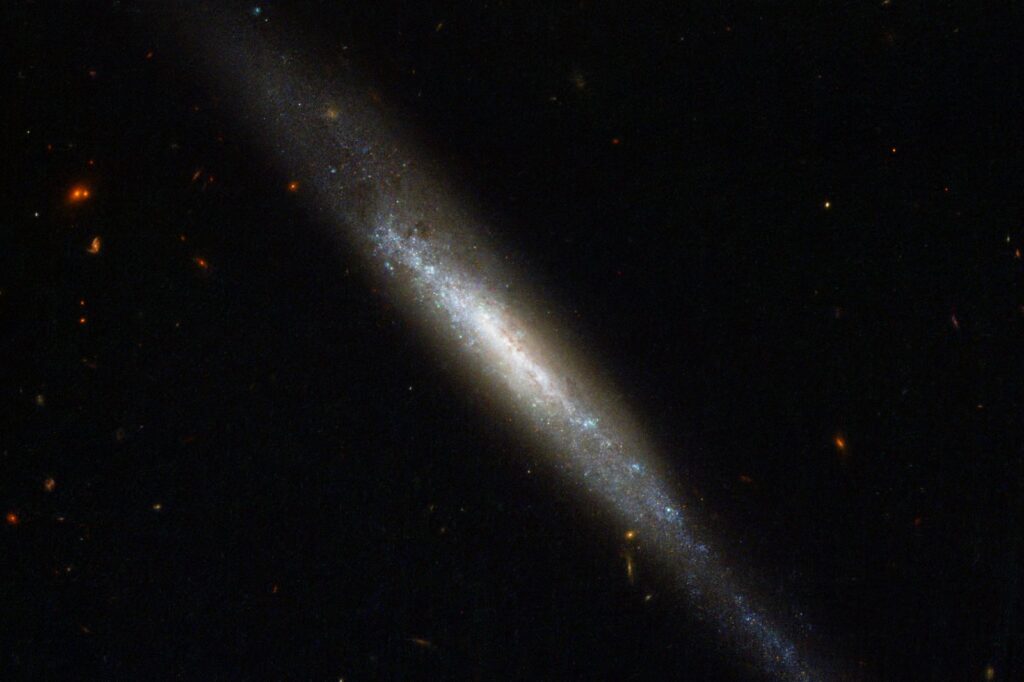
Light from a star that blew apart more than 12.5 billion years ago has just reached the James Webb Space Telescope, and it caught the blast in its first days. Astronomers think this may be one of the most distant supernovas ever seen.
What the team found
The explosion, named AT 2026abck, dates to roughly 1.15 billion years after the Big Bang, when the universe was less than a tenth of its present age. The distance between us and the star has since stretched about sixfold as space expanded. The work went onto the arXiv preprint server on Sept. 29 and has not yet been peer reviewed.
It was a monster. “At its peak, the supernova is about 8 billion times the brightness of the sun,” said co-author Xiaohui Fan of the University of Arizona, adding that this is almost as bright as the whole Milky Way. Over the course of the blast it gives off the energy our sun would emit in about 2 billion years. The glowing shell is hotter than 30,000 degrees Fahrenheit (16,000 Celsius) and had swelled to a radius of around 46 astronomical units, roughly the reach of Pluto’s orbit at its farthest.
The host galaxy, ID101411, holds about 6.3 billion solar masses and, in lead author Mingyang Zhuang’s words, forms stars more than ten times faster than the Milky Way. It is short of metals, meaning elements heavier than hydrogen and helium. Not enough time had passed for earlier generations of massive stars to forge them.
Luck, and slow motion
The find came from the NEXUS Treasury program, which has Webb return to the same patches of sky to hunt for ancient explosions. Webb had studied this galaxy for a few years. On May 28, 2026, the star had not yet gone off. On Aug. 7 the supernova was there. The team puts the sighting at four to 10 days after the explosion.
Here is the odd part. Between those two looks, 71 days passed on Earth, but only about 12 passed for the star. Expansion stretches time as well as space. “Changes that took one week at the supernova take about six weeks to unfold from our point of view,” Zhuang said.
Supernovas this far back are usually found only when a massive galaxy cluster bends and magnifies their light, an effect Einstein predicted and called gravitational lensing. This one needed no such help. Zhuang called it the most distant supernova actually seen to appear, and said the team was lucky: the same sliver of sky must be watched repeatedly, and the star has to blow at the right moment.
What kind of explosion
The authors suspect it was not an ordinary core-collapse supernova, where a star roughly eight to 50 times the sun’s mass runs out of fuel and falls in on itself. It may instead be a superluminous supernova, a rarer type that releases tens or hundreds of times more energy. Whether it keeps heating or starts to cool should help settle the cause. “Our interpretation is still preliminary,” Zhuang said.
Why Webb can see it
Expansion drags the light of such distant events from visible wavelengths into the infrared, which is where Webb looks. Its 6.5-metre gold-coated beryllium mirror, built from 18 hexagonal segments, gathers about six times the light of Hubble’s. Hubble works in the near ultraviolet, visible and near infrared; Webb covers long visible wavelengths through the mid-infrared. To keep its own warmth from drowning the faint signal, the telescope stays below 50 K behind a five-layer sunshield, parked near the Sun-Earth L2 point about 1.5 million kilometres from Earth.
Sources
- James Webb telescope discovers a 12.5 billion-year-old supernova erupting near the dawn of time
- James Webb Space Telescope
- James Webb telescope discovers a surprise around our galaxy's black hole
Photo: ESA/Hubble & NASA (CC BY 4.0)




