
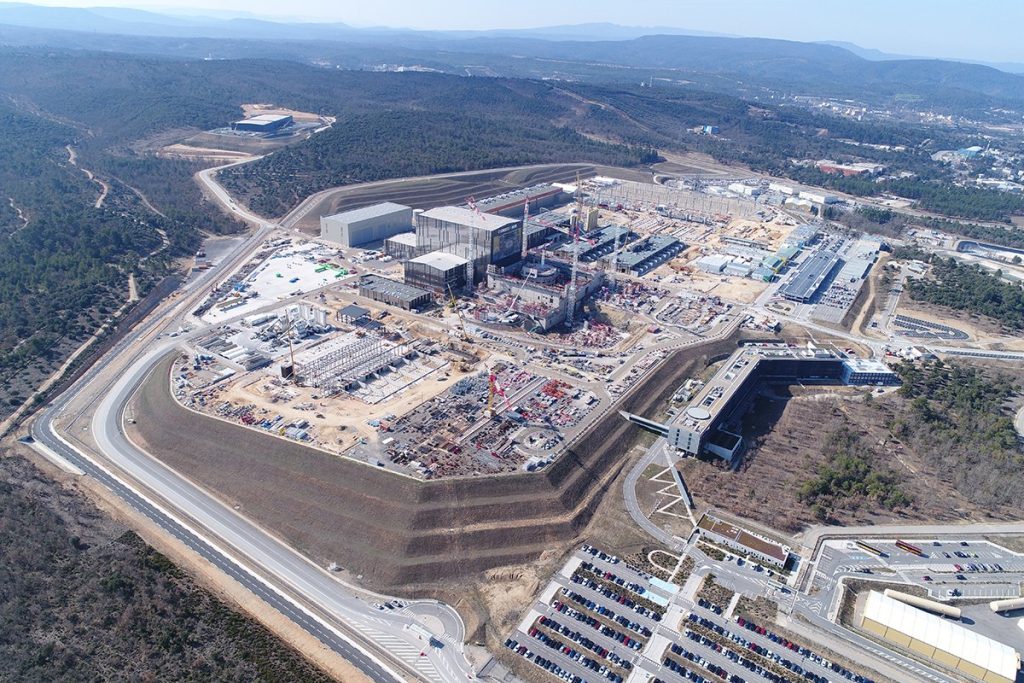
Strategically speaking, the star in question is a modest one: a hydrogen plasma held beyond 150 million degrees, ten times the Sun’s core temperature, until fusing nuclei release more energy than the machine spent heating them. Recreate that on Earth and the fuel is effectively inexhaustible. After 75 years of research the physics is increasingly called solved; the engineering is not, and that distinction is now written into American policy.
There are two ways to bottle a star. Magnetic confinement does it with fields: tokamaks and stellarators hold the charged gas inside a ring, and high-temperature superconducting magnets make compact machines possible. Commonwealth Fusion’s SPARC tokamak, about 75 percent complete in Devens, Massachusetts, is expected to start operations in late 2027, and Max Planck simulations published this June found that alpha particles, the helium nuclei fusion emits, actively calm plasma turbulence in SPARC and ITER models, with heating gains up to 25 percent. Inertial confinement uses lasers: the National Ignition Facility proved the principle in December 2022, 3.15 megajoules from 2.05, and by April 2025 had standardized ignition at a gain factor near 4.13, with 8.6 megajoules out of a 2.08 megajoule input. A commercial plant would need several shots per second, not single shots.
The fuel is its own strategic problem. Deuterium is abundant in seawater; tritium, a radioactive hydrogen isotope with a 12-year half-life, is scarce, drawn from aging Canadian fission reactors. So every plant must breed its own: reaction neutrons strike lithium blanket modules lining the vessel wall, and a hit on a lithium-6 nucleus splits out a tritium atom and a helium atom. A Tritium Breeding Ratio above 1.0 lets the reactor feed itself; below it, the business case dies. No full-scale blanket has ever been tested under fusion-relevant conditions.
The materials wall is the other blocker. Fusion’s 14.1 MeV neutrons carry roughly ten times the energy of their fission cousins and wreck structural steel in ways fission experience cannot predict: transmutation byproducts, void swelling and embrittlement profiles all their own. No American facility can irradiate samples at fusion energies; the roadmap’s answer is a Fusion Prototypical Neutron Source, on the community’s list for four decades. General Atomics moved on June 11, 2026 to design a blanket test facility, plus a $20 million California credit on June 22. “No one has tested a fusion blanket at this scale,” said Anantha Krishnan of its Energy Group.
The wider calculus: DOE’s June 9 roadmap runs three parallel tracks, classifies fusion devices as “byproduct material” for lighter licensing, and leans on over $11.4 billion in disclosed private investment. Not everyone buys the 2030s. John Holdren, a former White House science adviser, wrote in April that such predictions “really are hype at this point”. The physics is a star. The next decade is a forge.
Sources
- DOE Fusion Roadmap Finalized: America's National Strategy for Commercial Fusion Energy | POC.HK — Powering Orbit & Civilization
- Fusion Energy Hits a Materials Wall: DOE Roadmap Targets Engineering Gaps With 2030s Deadline




