
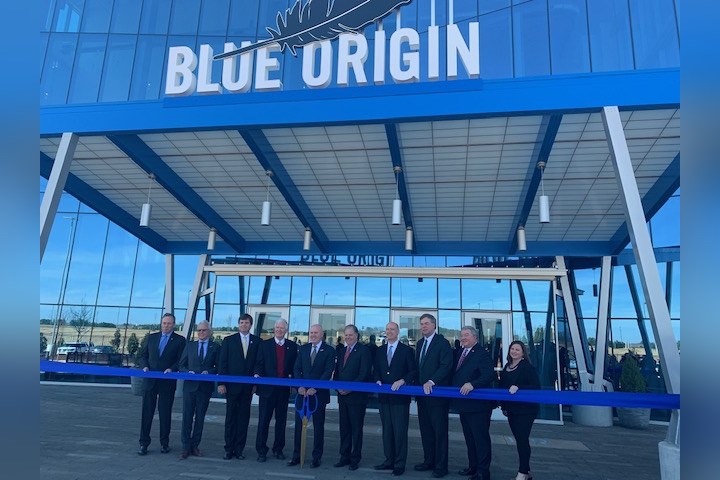
The figure that matters is $10 billion. On October 7, 2026, Jeff Bezos confirmed that Blue Origin, the space company he has bankrolled since 2000, had taken its first outside money: a primary equity round from institutional investors that The Wall Street Journal reported in late September values the venture at roughly $140 billion. The bottom line for investors: after more than a quarter-century of one man’s Amazon shares funding the rockets, Blue Origin’s growth now has other shareholders behind it. A day later came the physical proof, a $550 million satellite manufacturing complex dubbed Constellation Park, announced October 8 for central Texas.
The Texas Complex, by the Numbers
The plant is to rise in Hutto, in the Greater Austin corridor: 120,000 square meters, about 1.3 million square feet given over to cleanrooms, environmental test chambers and automated assembly lines. Local development filings project up to 2,000 manufacturing and engineering jobs across a 10-year ramp. The hardware agenda is specific: spacecraft for TeraWave, a planned 5,408-satellite broadband constellation spanning low and medium Earth orbit that is designed to offer 6 terabits per second of symmetrical backbone capacity for enterprise and defense clients, plus tracking antennas and ground terminals for Project Quartz, the company’s proprietary ground station network. Everything is meant to feed the heavy-lift New Glenn rocket and shorten assembly cycles.
Why the Money Model Changed
Bezos’s stated recipe never varied: “sell about $1 billion a year of Amazon stock”, as he put it in 2017, a drip-feed he has kept up since founding the company in 2000. The costs, though, have compounded. New Glenn first flew in January 2025 and has flown twice more, but the latest mission, in April, failed to place its payloads in the right orbit, leaving the rocket grounded pending an investigation under Federal Aviation Administration oversight. Past reporting had Blue Origin aiming for up to 12 New Glenn flights this year and, in the long run, 100 annually. Add expanded Florida manufacturing and launch sites, a $3.4 billion NASA contract for a crew-capable lunar lander, national security launch awards and the Blue Ring orbital platform, and the capital demands explain themselves. So does the competition: SpaceX, the rival for both talent and contracts, is preparing an IPO that could value it above $2 trillion.
The Road to Public Markets
Bezos cast the round as a sign of maturity rather than need, pointing to an expanding commercial order book and recurring revenue. “I see the financial future of Blue with some clarity now,” he said in explaining the decision to invite institutional partners. He confirmed that he expects Blue Origin to become a publicly traded company eventually, while noting an offering remains “possibly several years from now”. Investors will note the sequencing: construction at Hutto starts in early 2027, satellite assembly lines are meant to be running in time for the first TeraWave launches in late 2027, and the equity cushion of $10 billion buys the balance sheet room to get there. The man who sold Amazon stock by the billion for a quarter-century has, at last, let others buy a piece of the machine it funded.
Sources
- Blue Origin Commits $550M to Texas Satellite Complex as Jeff Bezos Confirms $10B Equity Round and IPO Roadmap – SatNews
- Jeff Bezos' Blue Origin space venture reportedly mulls fundraising – GeekWire




