
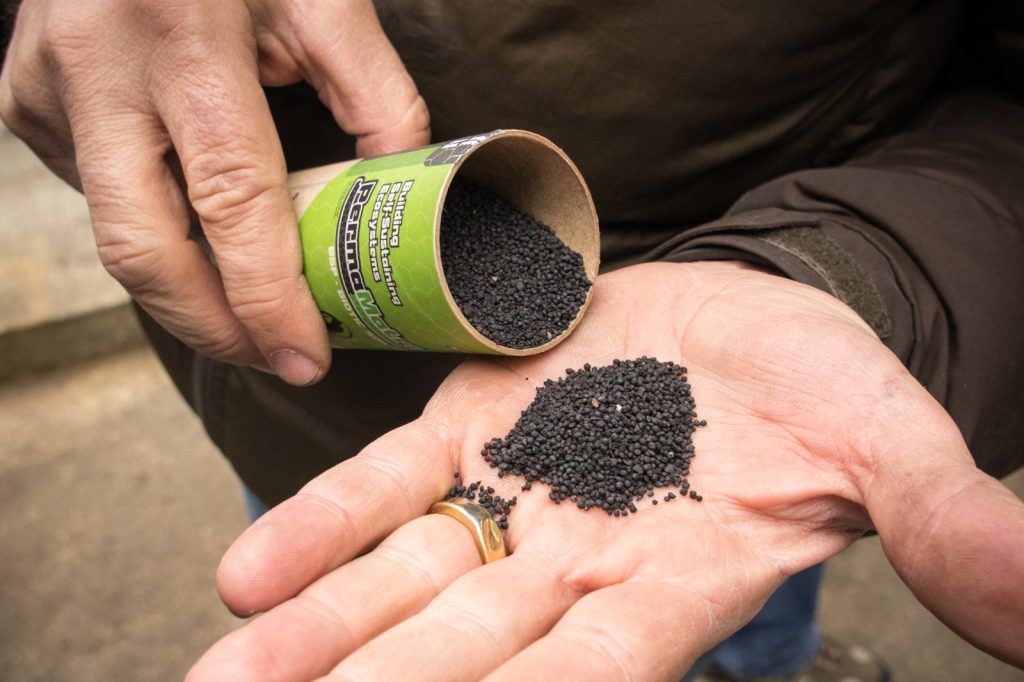
Thirty grams of soggy coffee grounds go in. Ninety seconds later, 5 g of biochar come out. That is the result researchers at the Korea Institute of Geoscience and Mineral Resources (KIGAM) reported for a plasma-flame method they call Flame Plasma Pyrolysis, or FPP, and the study appeared in the Chemical Engineering Journal.
The trick is that nobody has to dry the grounds first. Nor does anyone have to strip out oil.
Why wet grounds were a problem
People worldwide produce over 10 million tons of spent coffee grounds a year, by one estimate; another puts the figure at 8 to 10 million tons. Most of it goes to landfill or gets incinerated, which produces greenhouse gases. The waste can also leach into soil.
The grounds carry plenty of energy because of their high carbon content. Getting at it has been the hard part. Used grounds hold 55-60% moisture, and existing routes demand costly, energy-hungry drying. Torrefaction and conventional pyrolysis need long residence times. Fast pyrolysis needs dry feedstock. Hydrothermal carbonization can take up to 6 hours under extreme pressure.
How the KIGAM process works
The team burned liquefied petroleum gas in compressed air to produce plasma flame jets of around 800-900°C (1,472-1,652°F), then fed in coffee biomass with 55% moisture at atmospheric pressure. The heat flash-boils the water trapped inside each particle. The pressure builds until the particle bursts in a microscopic explosion, and the result is a porous carbon material. Moisture, normally the obstacle, ends up acting as a steam-activation agent that speeds the reaction.
Mass dropped by 83.3% over the 90 seconds, moisture included. The biochar measured 29.0 MJ/kg in heating value, against 21.8 MJ/kg for the raw grounds, a gain of around 33%, and in line with anthracite coal. Fixed carbon rose from 15.6% to 46.2%. All sulfur compounds disappeared, so burning the char would not release sulfur oxides. Specific surface area jumped from 1.5 m2/g to 115.4 m2/g, which makes the material a candidate precursor for activated carbon or for filtration. Smoke and tar stayed minimal.
Timing matters here. Pushing past 90 seconds lowered fuel quality, because excess heat damages the carbon structure. And against hydrothermal carbonization, which typically takes 1 to 6 hours, FPP is up to 240 times faster, according to the Tech Insights write-up.
What comes next
“This technology presents a new paradigm in which waste is no longer viewed as a disposal problem but as a valuable energy resource,” said lead author Taejun Park in a press release from South Korea’s National Research Council of Science and Technology. “We plan to expand the technology to various types of high-moisture organic waste and further optimize the process for industrial-scale commercialization.”
The study dealt only with coffee. The researchers think the same approach could handle food waste, sewage sludge and agricultural residues. The compact design and short processing time also suit small on-site waste-to-energy units, where transport and drying costs limit how much material can be recovered.
Sources
- An Energy Drink? Turning Coffee Waste into Sustainable Fuel – Tech Insights
- Scientists Say New Method Turns Coffee Grounds Into High-Potency Renewable Fuel
- Turning Coffee Grounds Into Bio-Fuel in Just 90 Seconds – GOODNET




