
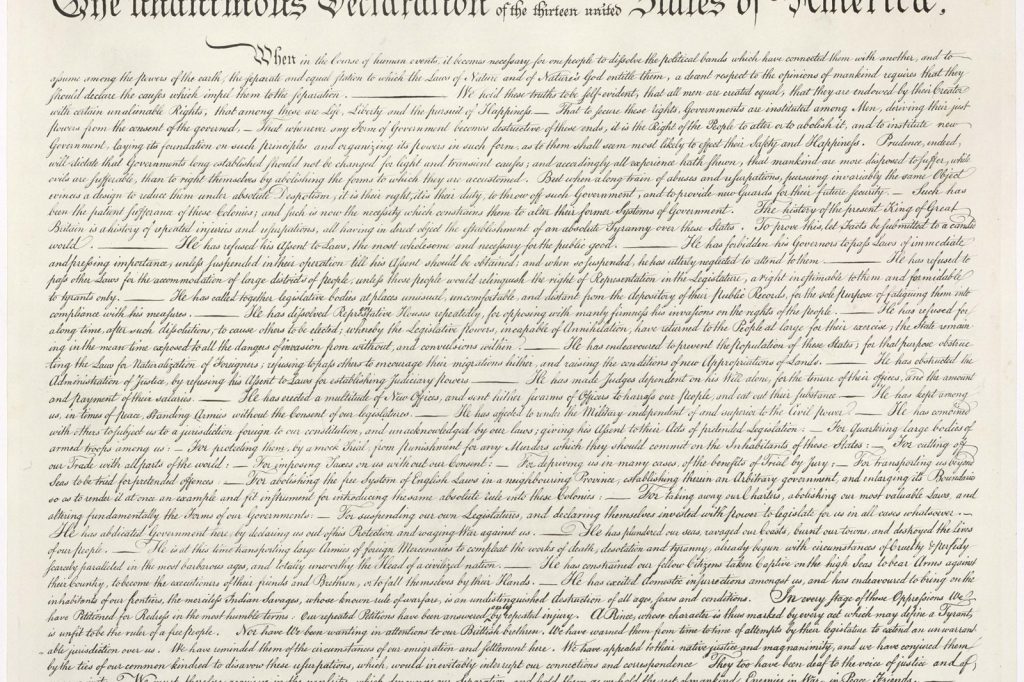
“We hold these truths to be self-evident, that all men are created equal, that they are endowed by their Creator with certain unalienable Rights, that among these are Life, Liberty and the pursuit of Happiness.” Walter Isaacson counts 35 words there and has written a short book about them, The Greatest Sentence Ever Written. As the Declaration of Independence turned 250, writing coach Roy Peter Clark recommended it in Poynter on July 1, 2026.
Isaacson, Clark noted, is not praising the sentence from a distance. He picks it apart phrase by phrase: “We,” self-evident truths, “all men,” created equal, unalienable rights. He reads Jefferson’s original text alongside the revisions Benjamin Franklin suggested and the debate that followed. The result is a reminder of the limits of the wording. “All men” left out women, enslaved people and many men without property.
Where the words came from
That raises an older question: whose ideas was Jefferson putting into those words? One line of legal scholarship points to William Blackstone, whose Commentaries on the Laws of England appeared in 1765. Carli Conklin’s 2019 book The Pursuit of Happiness in the Founding Era of the “pursuit of happiness” reads Jefferson’s reworking of John Locke’s triad of life, liberty and estates through Blackstone’s text.
Hans Eicholz, reviewing the book for Law & Liberty, called the approach worthwhile but limited. In his view Blackstone “reflects rather than originates” the ideas that fed the Declaration. For Jefferson and John Adams, Eicholz wrote, Edward Coke remained the go-to authority. Jefferson said as much in 1810, advising a correspondent, William Duane, that aspiring lawyers should start with “Coke’s institutes and reports” and read Blackstone last. Blackstone, he wrote, was “nothing more than an elegant digest” of the real fountains of the law.
Eicholz also pointed to Jefferson’s own legal Common Place Book. Before 1776 it cites Lord Kames far more often than Blackstone. His conclusion: the Commentaries are neither the main source of the phrase’s meaning nor the best guide to it.
What Blackstone actually wrote
Still, Blackstone’s own wording is worth reading, and it is specific. He called the sum of man’s absolute rights “the natural liberty of mankind” and reduced the rights of Englishmen to three: personal security, personal liberty and private property. Personal security, he wrote, meant a person’s legal and uninterrupted enjoyment of his life, limbs, body, health and reputation.
On life he was precise: “Life is the immediate gift of God, a right inherent by nature in every individual; and it begins in contemplation of law as soon as an infant is able to stir in the mother’s womb.” His law treated an unborn child as born for many purposes. It could receive a legacy and have a guardian assigned.
Sources
- Is this sentence in the Declaration of Independence really the greatest ever written? (Poynter, Roy Peter Clark)
- The Perennial "Pursuit of Happiness"—Its Meaning and Origins (Law & Liberty, Hans Eicholz)
- William Blackstone, Commentaries on the Laws of England, 1:120-41 (The Founders' Constitution, University of Chicago Press)




