
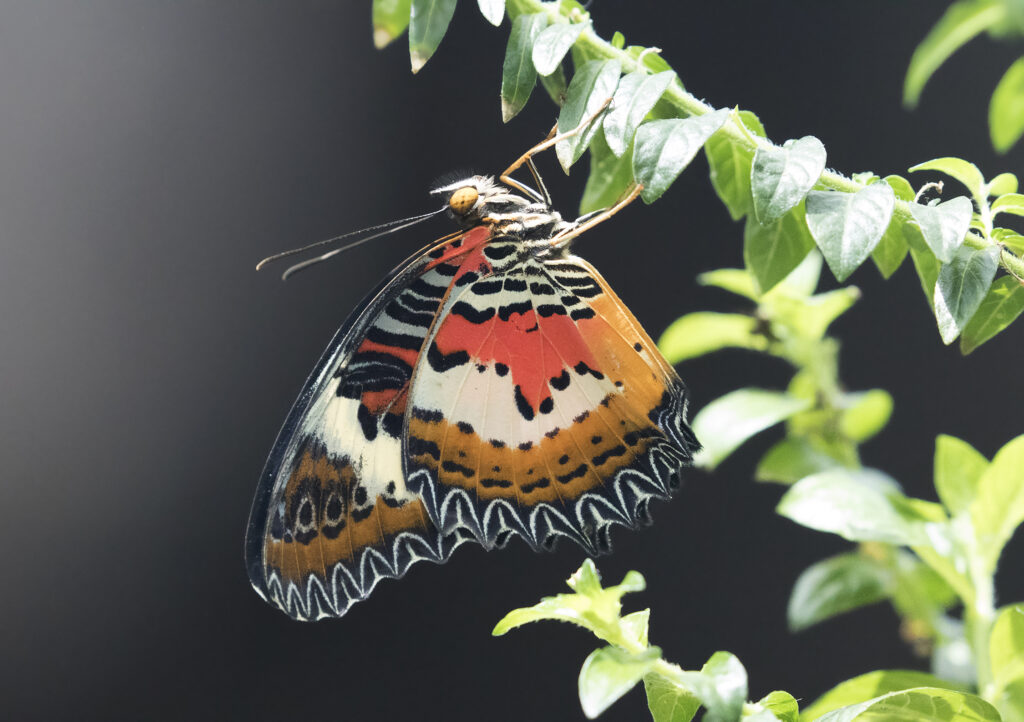
Heliconius hewitsoni, a tropical butterfly, has lived as long as 348 days as an adult. Its relative Dione juno managed 14. That 25-fold gap in maximum lifespan sits at the center of a study published in Nature Communications on June 16.
Most butterflies spend two to four weeks on the wing. The Heliconius genus, also called longwings or heliconians and native to Central and South America, can last close to a year. Jessica Foley of the University of Bristol’s School of Biological Sciences and her colleagues found that, on average, these butterflies live about three times longer than closely related species.
No sign of slowing down
To measure physical decline, the team built a grip-strength test known as “the pullinator”. Foley described it to CNN: “We placed this on a lab balance, zeroed the balance, and then gently held a butterfly by the wings and lowered it until it grasped the perch. We then tugged until it let go.” The balance dropped negative as the insect pulled, and the largest negative reading showed how much weight it could carry before letting go.
Older Heliconius hecale did as well as younger ones, with no obvious deterioration. The short-lived Dryas iulia told a different story: older individuals showed a clear drop in physical performance.
“What makes them particularly remarkable is that they appear to have evolved not only longer lifespans, but also slower aging,” Foley said in a statement. That, she added, lets them outlive close relatives from which they split fairly recently in evolutionary terms.
The pollen question
Adult Heliconius collect and eat pollen, which is unique among butterflies. Most species live on nectar. Heliconius species that eat pollen outlive those that do not, and scientists have suspected diet explains the long lives.
The researchers noted that pollen from Psiguria, the plant the study butterflies mainly fed on, is rich in the amino acid proline. Proline plays a key role in energy storage in insect muscle and in haemolymph, the fluid that carries nutrients and oxygen around an arthropod’s body. Pollen-fed H. hecale held on to body mass and muscle function with age. Those denied pollen lost body mass steeply.
Yet diet is not the whole answer. Taking pollen away did not erase the advantage. “H. hecale has evolved a slower rate of aging, resulting in the observed lifespan extension,” the authors wrote, adding that the slowed rate holds even under pollen deprivation. They also reported that Heliconius evolved the physiology to make full use of the pollen, and that D. iulia apparently did not.
The wider Heliconius package includes more investment in neural structures for learning and memory, and more stable long-term visual memories.
Why researchers care
“By comparing long-lived Heliconius butterflies with their short-lived relatives, we have a natural evolutionary experiment that can help reveal how lifespan is extended,” the researchers said, calling the group a promising new model for research on the biology of aging.
Jaret Daniels, an entomologist at the University of Florida who took no part in the work, said the mechanisms of aging are often similar across the animal kingdom, so the butterflies could help advance longevity studies with possible implications for humans.
NPR’s Short Wave struck a more cautious note. Katie Wu, a science journalist at The Atlantic, said how exactly the butterflies use pollen is still a mystery, and that it is no magic elixir. Giving pollen to other butterflies does not make them live longer.
Sources
- The Pollen Secret Behind Butterflies That Live Almost a Year
- EXCLUSIVE: Butterfly That Defies Aging Lives 25x Longer Than Peers, May Hold Clues To Human Longevity
- What's this super-aging butterfly’s longevity secret? : Short Wave




