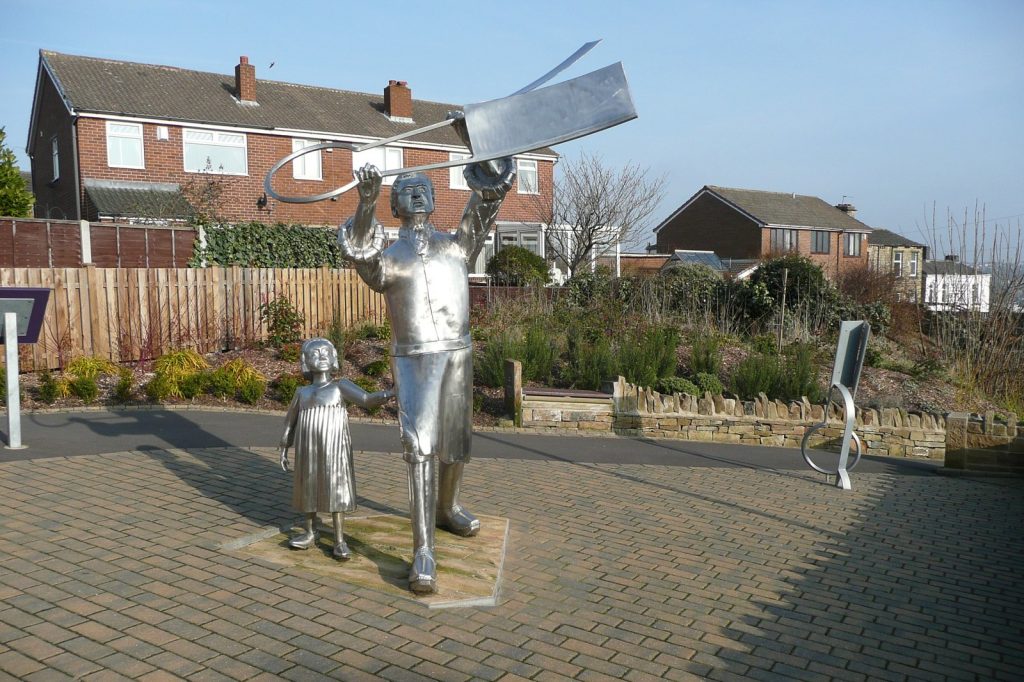
Between March 1811 and February 1812, men with sledgehammers and blackened faces smashed about a thousand machines in the English Midlands. They were not enemies of progress, whatever the modern insult “Luddite” suggests. They were stocking knitters and weavers who could see their trade being undercut, and they had run out of other ways to say so.
Their name came from Ned Ludd, a figure who may never have existed. Legend made him an apprentice who wrecked textile equipment in 1779, and later followers issued manifestos in the name of “General Ludd”. Historic UK notes there is no evidence of the man himself, and the Victorian Web puts him in Sherwood Forest and calls him “perhaps” mythical. The invented leader was useful. He gave a scattered movement a banner and gave magistrates someone to hunt.
A trade in decline
Stocking knitting was mostly a domestic industry. The knitter rented his frame from a master, worked in his own small shop and handed the finished goods back for sale. By 1810, according to the Victorian Web, a change in fashion and the effect of the Orders in Council had cheapened the trade and lowered the standard of craftsmanship it required. Masters who brought in the new machines did so to employ less skilled hands for less money.
That was the squeeze. Historic UK describes the workers as skilled, well-trained artisans who had spent years honing their craft, now facing low-paid labourers in larger factories. The Napoleonic Wars made it worse, and the country in 1812 was in the worst trade depression since the 1760s.
The Luddites tried talking first. Their early demands, as Historic UK tells it, included a minimum wage, minimum labour standards and a tax to build a fund for workers’ pensions. The factory owners were not interested. With no unions to fall back on, the machines became the target.
How the raids worked
The scattered frames made it easy. A Luddite could break one and vanish into the village. There was no national organisation and, the Victorian Web stresses, no evidence of any political motive. The first major riot came on 11 March 1811 at Arnold, near Nottingham. Activity stayed centred on Nottinghamshire through late 1811, reached Yorkshire the next year and Lancashire in March 1813.
Some attacks turned deadly. In April 1812 about 150 attackers went for William Cartwright’s mill at Rawfolds near Huddersfield. Cartwright and a handful of soldiers held it, and two of the attackers died. A week later William Horsfall, another manufacturer, was killed. The same month the Luddites burned the West Houghton mill in Lancashire.
Not everyone in the crowd was a rebel. Samuel Whitbread, an MP, told Parliament that ten of the disguised men at a meeting near Manchester were spies sent by magistrates, and that these spies were “the very ringleaders of the mischief”.
The state answers
Machine-breaking had been a capital offence since 1721, and a special Act in 1811 tightened the screws around Nottingham. At the Nottingham Assizes in March 1812, seven Luddites were sentenced to transportation for life. Historic UK says the government sent around 14,000 soldiers into the affected areas, and that spies infiltrated the groups.
The courts were harsher in York. In January 1813 three men were hanged for Horsfall’s murder, and fourteen more followed a week later for the attack on Cartwright’s mill and related acts. Lord Sidmouth and Lord Ellenborough expected the executions to have the “happiest effects in various parts of the kingdom”.
Parliament offered no relief. A committee looking at the cotton workers’ distress agreed it was lamentable, then said that interfering with the freedom of trade would be a mistake. Lord Liverpool, the prime minister, agreed that government meddling usually did harm. A bill to regulate the stocking trade and ban the cheap “cut-ups” died in the House of Lords. When the workers tried to form a trade society, it was ruled illegal under the Combination Acts and collapsed.
A last flare in 1816
A bad harvest and a downturn in trade brought violence back in 1816. On 28 June the Luddites attacked Heathcote and Boden’s mill in Loughborough and smashed 53 frames. Troops ended the riots. Six men were executed and three more transported.
Historic UK links the last recorded Luddite-style action to Jeremiah Brandreth, an unemployed stockinger from Nottingham who led the Pentrich Rising.