
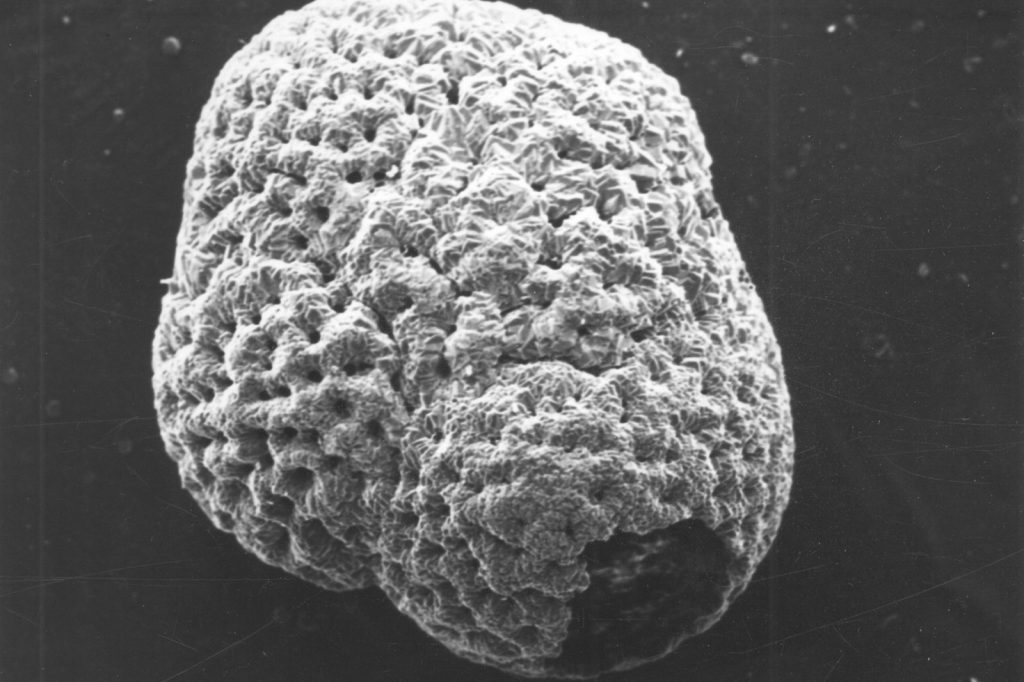
425 microns. That is the size where sodium-calcium ratios in certain foraminifera shells stop climbing and start falling. The threshold showed up in a 2026 Frontiers study that measured trace elements in planktonic foraminifera from a single surface sediment sample.
The shells of these single-celled organisms have long served as the backbone of paleoceanography. Researchers collect sediment cores, isolate the fossilized tests, measure magnesium-to-calcium ratios, and translate those numbers into temperature estimates. The method has built decades of ocean history. But the new work suggests the translation step is messier than textbooks imply.
Shells are not uniform
“The shells consist of multiple layers formed at different stages of the organism’s life,” said researchers at UiT The Arctic University of Norway. Those layers can carry significantly different chemical signatures. A study published in Nature World News this May highlighted the finding: the chemistry recorded in a juvenile chamber may not match the chemistry of the final chamber added just before reproduction.
Think of it like a tree ring that rewrites itself every few days. Foraminifera add chambers every two to four days when well fed. Spinose species — the ones with spines — host photosymbionts that moderate the uptake of pH-sensitive elements such as boron and uranium, and possibly magnesium. Larger individuals apparently host more symbionts while calcifying. Non-spinose species, living deeper, show barium-calcium ratios higher by a factor of 10 compared to their spinose cousins.
Size matters, species matters more
Lithium-calcium drops as Globigerinoides ruber grows. Manganese-calcium rises in Globorotalia tumida. Sodium-calcium peaks in the smallest Trilobatus sacculifer, Globigerinoides ruber pink, and Neogloboquadrina dutertrei, then declines once shells exceed 425 microns. The patterns are not interchangeable. “Clear differences in patterns of trace element incorporation are observed between spinose and non-spinose species that cannot simply result from differences in depth habitats,” the Frontiers authors wrote.
Neogloboquadrina pachyderma dominates cold-water assemblages. Its abundance and sensitivity make it a go-to proxy in polar regions. But even this workhorse carries the same layered complexity.
Strontium-calcium ratios stay similar across spinose and non-spinose groups, suggesting calcification rates are comparable despite size differences. The bulk of shell building unfolds over roughly a month. Larger or thicker shells do not calcify faster; they just calcify more often, probably during windows of optimal food or conditions.
The practical upshot
Strongly significant correlations (p < 0.01) link lithium-magnesium and manganese-calcium ratios to apparent calcification depth and seawater neutral density. Those relationships may help untangle the depth signal from the temperature signal. Here's what it means: every Mg/Ca temperature estimate carries a hidden variable -- the size and life stage of the shell that produced it. Narrowing that uncertainty is the next step. The better we understand how the ocean recorded its own past, the clearer the forecast becomes.
The Frontiers study analyzed mono-specific, size-separated samples from a single sediment sample.
Sources
- Frontiers | The effects of shell size and mass on trace element incorporation in different species of planktonic foraminifera
- New Study Improves Past Ocean Change Records and Foraminifera Climate Proxy Accuracy




