
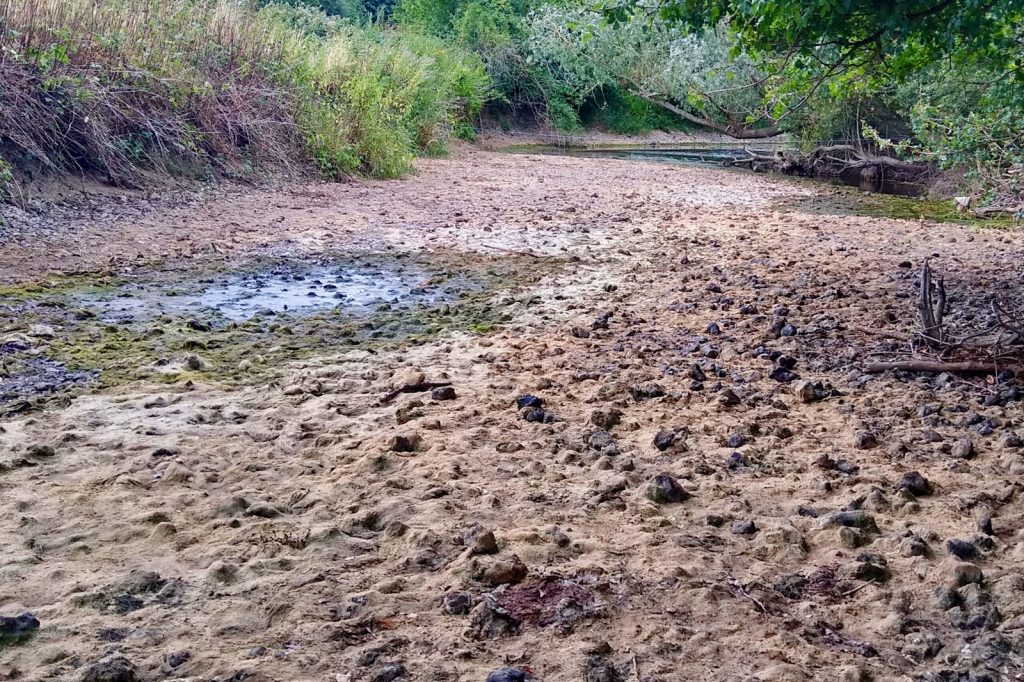
Spring 2026 left England with 65% of its average rainfall across March, April and May. That shortfall is why the National Drought Group met on Thursday 18 June, just three months after the last drought was officially declared over.
The picture was uneven. Northern England had 90% of its usual rainfall. Southern England had only 50%. A very wet start to the year had left water resources in a relatively healthy state, and reservoir storage stood at 88.6%, but parts of the country were already showing strain.
Heat and rivers
The late May heatwave made it worse. Some areas went six straight days above 30C, and West London hit 35.1C, a new May record. Water demand surged, and some public supplies were interrupted.
East Anglia is the weak spot. Parts of the region, namely the Cam and Ely Ouse, North-West Norfolk and North Norfolk catchments, were due to enter prolonged dry weather the following week. East Anglia had been the last area to return to normal status after the 2025 dry spell, in March 2026. Devon and Cornwall sit on a watchlist for later in the summer. No area was in drought at the time of the meeting.
Roughly two-thirds of rivers were still running near normal. The Burn, Yare, Ely Ouse and Cam were notably low, and the River Till in Northumbria was exceptionally low.
The warning from the group
Helen Wakeham, chair of the group and the Environment Agency’s Director of Water, said England was entering summer in a “generally favourable position.” She was careful, though. “We can never be complacent ahead of those crucial drier months,” she said.
The Met Office expects the rest of June and July to stay mostly dry and settled, with above-average temperatures in many places. Its Head of Environment and Energy, Sarah Davies, pointed out that droughts struck in 2018/19, 2022 and 2025. Nine of the ten warmest springs since 1884 have come in the last 20 years.
Farmers were among the first to feel it. Crops grew slowly, and irrigation started earlier than normal in the east and south east. Paul Tompkins of the National Farmers’ Union asked that growers keep flexibility under their water licences, because summer water availability looks moderate to poor in parts of the country.
This summer is also 50 years on from the severe drought of 1976, which brought standpipes, rota cuts and failed crops. An amber heat health alert covered the East of England, London, the South East and the South West.
The group, which draws in the Met Office, regulators, water companies, farmers and conservation experts, was set to meet monthly through the summer. Within days, the weather would test it. Thames Water asked customers on 26 June to use water only for essential needs, and a hosepipe ban for around 850,000 South East Water customers in Kent became enforceable at 00:01 on 3 July.




