
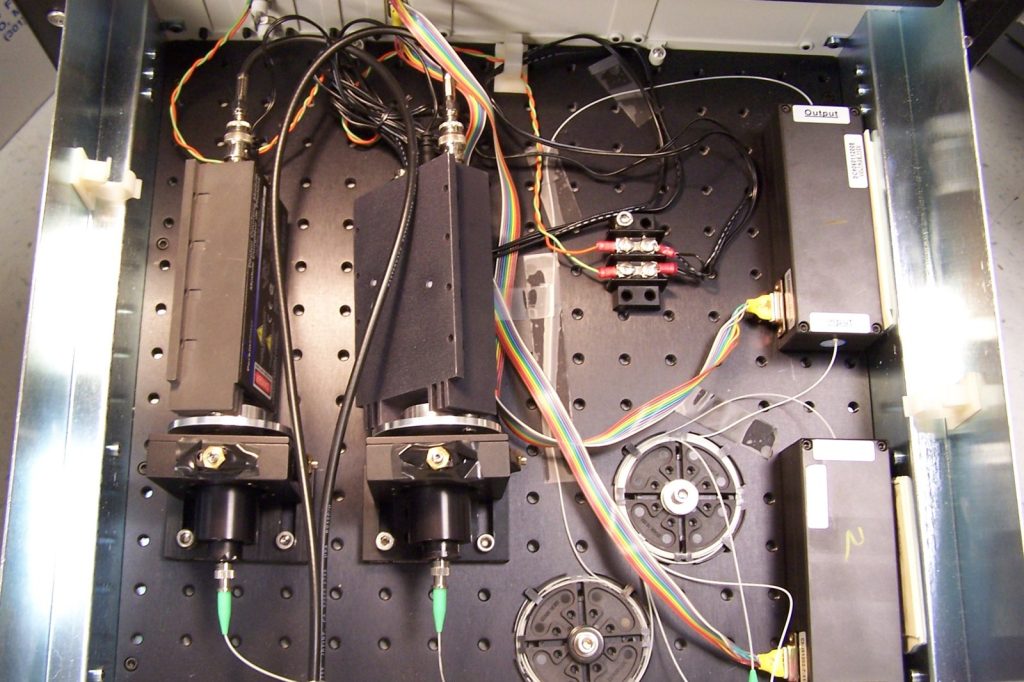
Two clouds of laser-cooled rubidium atoms sat 420 kilometers (261 miles) apart, joined only by a length of optical fiber, and physicists got them entangled. A team at the University of Science and Technology of China, led by Xi-Yu Luo, Chao-Yang Wang and Ming-Yang Zheng, reports the longest fiber-based matter-to-matter entanglement yet. That is more than four times farther than earlier demonstrations.
The group writes in Physical Review Letters that the experiment “provides a test bed of studying quantum network applications beyond metropolitan scale.”
Why memories, and why distance hurts
Many entanglement experiments use photons. A future quantum internet will need something sturdier, devices that can store quantum information, and the longer the fiber, the harder it is to keep two such memories linked. In this work the memories were the rubidium clouds, housed in two units the researchers nicknamed Alice and Bob. A third node, Charlie, sat between them and received photons from both. If Charlie sees the right interference pattern, Alice and Bob are entangled, though the two never meet.
It worked over the full 420 kilometers.
Three techniques, none brand new
The team combined and improved three existing techniques.
First, the memories emit photons at wavelengths that fiber absorbs quickly. The researchers converted them to the wavelengths the telecom industry uses, which lose far less in transit. “A more efficient quantum frequency conversion protocol helps us to reduce the fiber loss and extend the transmission distance,” they write.
Second, tiny temperature shifts and vibrations can scramble the interference that entanglement depends on. The team built a stabilization system that corrected those fluctuations continuously and kept the quantum states synchronized along the whole link. They describe it as “a novel phase stabilization scheme” that “can be conveniently applied to other platforms.”
Third, they used a single-photon entanglement scheme, which needs only one photon to survive the trip instead of two.
Past the PLOB bound
A 2017 paper sets a benchmark known as the PLOB bound, a limit on how much quantum information can pass through a lossy channel without repeaters or memories. Beyond 320 kilometers, Luo and colleagues found, their system produced entanglement at a higher rate than direct transmission through the same fiber could possibly manage under that bound.
That does not break the bound. It shows that memory-based quantum networks can beat the best direct fiber link.
A practical quantum internet is still a long way off, and long-distance entanglement between quantum memories is widely regarded as one of its essential building blocks. The experiment also produced entanglement at a high rate over shorter distances, around 100 kilometers, which the researchers say is of significant interest for building quantum repeaters. Paired with storage lasting under a second in an optical lattice, they write, entanglement swapping could connect many remote segments.
Sources
- Physicists Shatter Quantum Entanglement Distance Record With 420 Kilometers of Optical Fiber
- Physicists Achieve Record 420km Quantum Entanglement Distance | Fastorial posted on the topic | LinkedIn




